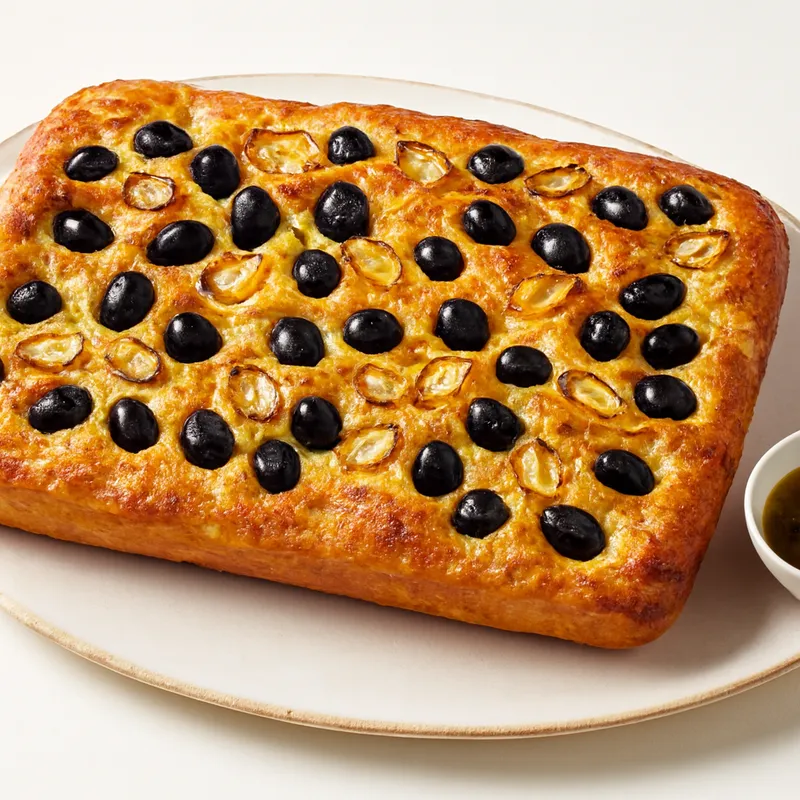



Ligurian, with documentation going back to medieval Genoa — focaccia genovese is the standard oil-and-brine version, while the distinct cheese focaccia of Recco (focaccia col formaggio) is, by legend, traced to the 12th-century Saracen raids — though it is documented in the restaurant record only from the late 1800s. Older still: the name traces to Latin «panis focacius», hearth-bread baked in the ashes, predating commercial ovens. The dimples are functional — they were originally fingerprints proving the dough had been worked enough.
From Latin focus, hearth — pre-Roman flatbread baked in ash. Genoese alta is 2cm thick with deep finger dimples to hold olive oil and coarse salt; Bari version is thinner, with cherry tomato and oregano.
Flat slab of bread, two fingers thick, dimpled all over with finger-pressed pits that pool olive oil during baking. Top is golden-blistered, salty with flaky sea salt, often spiked with fresh rosemary. Crumb is open and stretchy; tear, don't slice. Best within four hours of the oven; cold focaccia revives in a 200°C oven for two minutes.
High hydration — 80–85% water-to-flour — is what makes focaccia open and pillowy rather than tight like pizza dough. Long cold ferment (12–24 hours in fridge) develops gluten and flavor without overproof. The dimples, pressed in just before baking, hold pools of olive oil that fry the top crust from above; without them, the oil runs off. Top with coarse salt only after the oil — salt directly on dough draws water and deflates.
Variations
Focaccia genovese (alta, oil-and-salt); focaccia barese (thin, tomato-olive); focaccia di Recco (paper-thin, stracchino-stuffed, no leaven); Tuscan schiacciata (lower hydration, drier); pizza bianca romana is the Roman cousin.
On the Palate
Where Focaccia sits in the Italian flavor cloud
Ingredients
Serves 8How it's made
5 steps · 40 min active + 1 hour waiting
- 15 min
In a large bowl, combine the flour, yeast, sugar, and salt. Gradually add warm water and olive oil, mixing with your hands until a sticky dough forms.
- 210 min
Turn the dough onto a floured surface and knead it until smooth and elastic, about 10 minutes. The dough should be slightly tacky but not sticky.
Watch outThe dough should feel slightly tacky and springy, not dry — when it pulls back slowly after a poke, the gluten is ready.
- 30 min
Place the dough in an oiled bowl, cover it with a damp cloth, and let it rise in a warm area until doubled in size, about 1 hour.
Watch outWait until it has genuinely doubled and jiggles like a cushion; underproofed dough bakes dense.
- 45 min
Preheat your oven to 220°C (430°F). Punch down the risen dough and transfer it to a well-oiled baking sheet, stretching it gently to fit the pan.
- 520 min
Dimple the surface of the dough with your fingertips, drizzle with olive oil, and sprinkle with rosemary and sea salt. Bake until golden brown and crisp on the edges, about 20 minutes.
Watch outPull it when the edges are deep gold and crisp and the oil in the dimples is sizzling — pale focaccia is gummy inside.
Archive tool suggestions — not reviewed
These legacy suggestions have not been evidence-reviewed and are not presented as required tools.