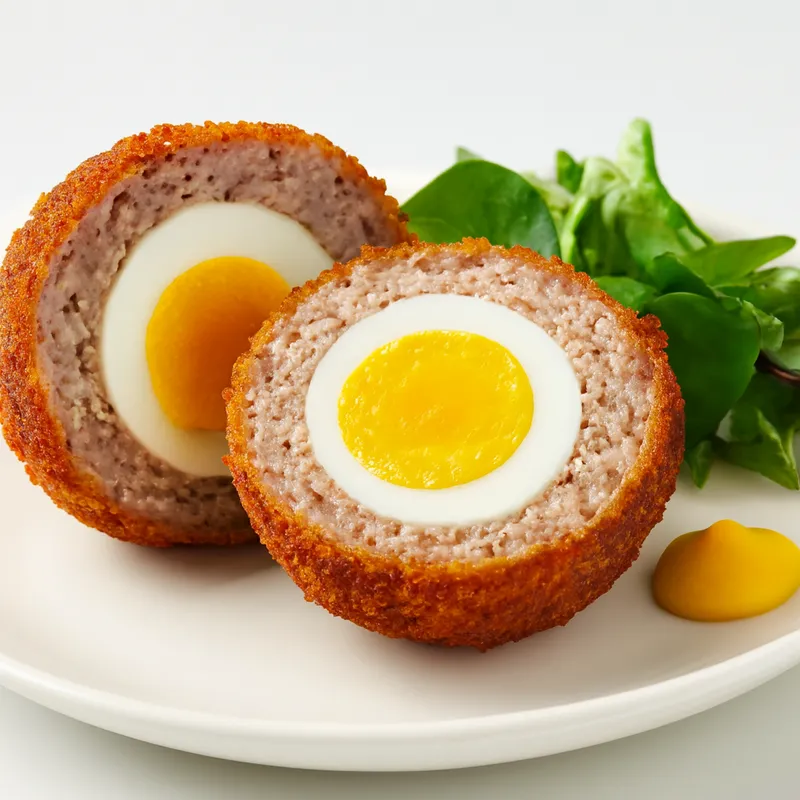
A hard-boiled egg wrapped in sausage meat, coated in breadcrumbs, and fried.



Claimed by Fortnum & Mason of London as their 1738 invention for travelling gentry — a portable cold protein for stagecoach journeys. Food historian Annette Hope speculated in 1987 (cited in the Oxford Companion to Food) that the likely ancestor is the Mughal nargisi kofta — a boiled egg in seasoned meat, named for the narcissus its halved cross-section resembles — possibly brought back via British India in the 18th century. The name's origin is genuinely disputed: the Oxford Companion to Food records the first use of "Scotch egg" in 1809 (Maria Rundell's cookbook), well before the rival William J. Scott & Sons (Whitby, Yorkshire) eatery theory would allow; "to scotch" the meat (mince/score) is only one of several competing explanations, not the settled one. By the 1900s it had become a pub and picnic staple.
Fortnum & Mason claims the 1738 invention as a wealthy traveler's snack. The yolk must run when cut — overcook by 30 seconds and the whole thing becomes a meatball with a chalk center.
A whole hard- or soft-boiled egg wrapped in a layer of seasoned sausage meat, breaded and deep-fried until the crust is dark gold. Cut in half: the yolk should be just past liquid in a proper one — bright orange and slightly jammy at the centre. Eaten cold with English mustard or piccalilli. Pub versions are warm, served with chutney. Grey overcooked yolk means the egg sat in the fryer two minutes too long.
Two competing versions, two techniques. Cold-eaten classic: hard-boil to fully set yolk, wrap, fry, refrigerate. Modern pub style: 6-minute soft-boil, ice-bath, peel carefully, wrap in chilled meat, fry only long enough to brown the crust without overcooking the yolk — about 4 minutes at 175 °C. The trick is keeping everything cold until the fryer hits, so the meat layer doesn't shrink off the egg.
Variations
Manchester egg uses a black-pudding-and-pork shell with a pickled egg inside; Worcester egg uses a quail egg; vegetarian versions sub haggis-style oats or a bean-mushroom mix.
On the Palate
Where Scotch Egg sits in the British flavor cloud
Ingredients
How it's made
3 steps · 45 min
- 15 min
Preheat your oven to 200°C (400°F). Divide the sausage meat into six portions and flatten each into a disc. Season with salt and pepper.
- 210 min
Wrap each hard-boiled egg with a sausage disc, ensuring it is evenly covered. Roll each in the beaten egg, then coat thoroughly with breadcrumbs.
Watch outThe meat should fully seal the egg with no gaps, then take an even, complete coat of crumbs.
- 330 min
Place the coated eggs on a rack in a baking pan. Bake in the preheated oven for 30 minutes, turning every 10 minutes to ensure even browning.
Watch outTurn every 10 minutes and pull at golden-brown all around — don't chase deeper color and dry the yolk.
Archive tool suggestions — not reviewed
These legacy suggestions have not been evidence-reviewed and are not presented as required tools.