Che dau do is the red-bean counterpart to the everyday mung-bean chè: adzuki (or red kidney) beans simmered until tender in lightly sweetened water, often with a little tapioca for body, and finished with salted coconut cream. The cooked bean stays whole and slightly starchy rather than dissolving, giving the soup a coarser, more rustic texture than its yellow sibling. It is eaten warm or iced and turns up at home and on hawker carts alike. In recent years it has also acquired a curious second life among young Vietnamese as a That Tich treat, though that custom is far more modern than the dessert itself.
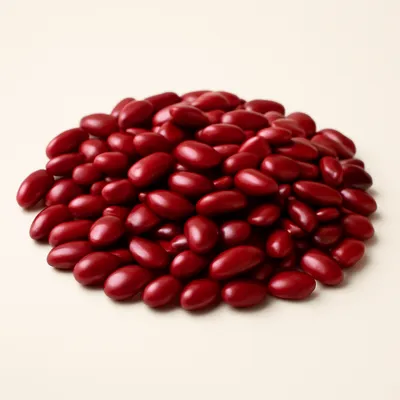


Red-bean sweet soups belong to the broad chè family eaten the length of Vietnam, and like the mung-bean version they descend from the shared sweet-pulse cookery of southern China and mainland Southeast Asia rather than from any single inventor. The dessert is old and ordinary. Its modern association with That Tich (the seventh night of the seventh lunar month, the Qixi lovers' festival) is recent and largely social-media driven: a fashion grew in the 2010s for single women to eat red-bean chè that day to 「find love」, but this rests on a linguistic mix-up. In Vietnamese the auspicious 「love bean」 (hat hong dau, the red jequirity seed of Chinese romantic lore) sounds close to 「red bean」 (hat dau do), and the two were conflated — so the trend is a charming misunderstanding, not an inherited tradition.
Coarser and earthier than mung-bean chè: the whole beans give a soft, mealy bite that breaks cleanly, with a faint mineral edge that the salted coconut rounds off. The broth is gently sweet, the tapioca adds a slithery contrast, and the coconut cream lays a savoury-rich blanket over the top. Warm, it is hearty and a little nutty; iced, the bean firms up and the coconut tastes brighter. Over-sweetening flattens it — the adzuki's own roasted-earthy note should stay legible.
Unlike the skinned mung bean, the adzuki keeps its skin, so it needs a long soak and a slow simmer to soften without bursting — the goal is a bean that is creamy inside but still holds its shape. As with all chè, sugar is added late: put in before the beans are tender, it firms the skins and they never fully cook. A small amount of tapioca starch or pearls gives the thin broth enough body to carry the beans rather than letting them sink. The salt in the coconut cream is structural to the flavour, sharpening a sweetness that would otherwise read flat.
Variations
The plainest is adzuki, sugar, and coconut; cooks may add tapioca pearls, lotus seed, or a strip of dried tangerine peel. Some southern versions use larger red kidney beans for a firmer bite. Red bean is also a core layer in chè ba màu and chè thap cam (mixed chè), and the sweetened paste fills banh and mooncakes. Around That Tich, stalls dress it up with extra toppings to ride the seasonal trend.
On the Palate
Where Che Dau Do sits in the Vietnamese flavor cloud
Ingredients
Serves 4How it's made
6 steps · 25 min active + 1 hour 35 min waiting
- 1240 min
Rinse adzuki (or red) beans and soak in plenty of cool water 4 hours or overnight.
- 290 min
Drain, cover with fresh water by two fingers, bring to a boil, skim, then simmer gently until the beans are tender but whole, about 60-90 minutes, topping up water as needed.
Watch outSimmer gently until the beans are tender but still whole — the adzuki keeps its skin, so a rolling boil bursts them before the inside goes creamy.
- 35 min
Stir in cane sugar and a pinch of salt; simmer a few minutes until dissolved.
Watch outAdd the sugar only after the beans are tender — put in early it firms the skins and they never fully soften.
- 45 min
Slacken a little tapioca starch with cold water and stir in (or add cooked tapioca pearls) to lightly thicken the broth.
- 55 min
Warm coconut milk with a pinch of salt until just steaming.
- 62 min
Ladle into bowls or over crushed ice and finish with the salted coconut cream.
Archive tool suggestions — not reviewed
These legacy suggestions have not been evidence-reviewed and are not presented as required tools.