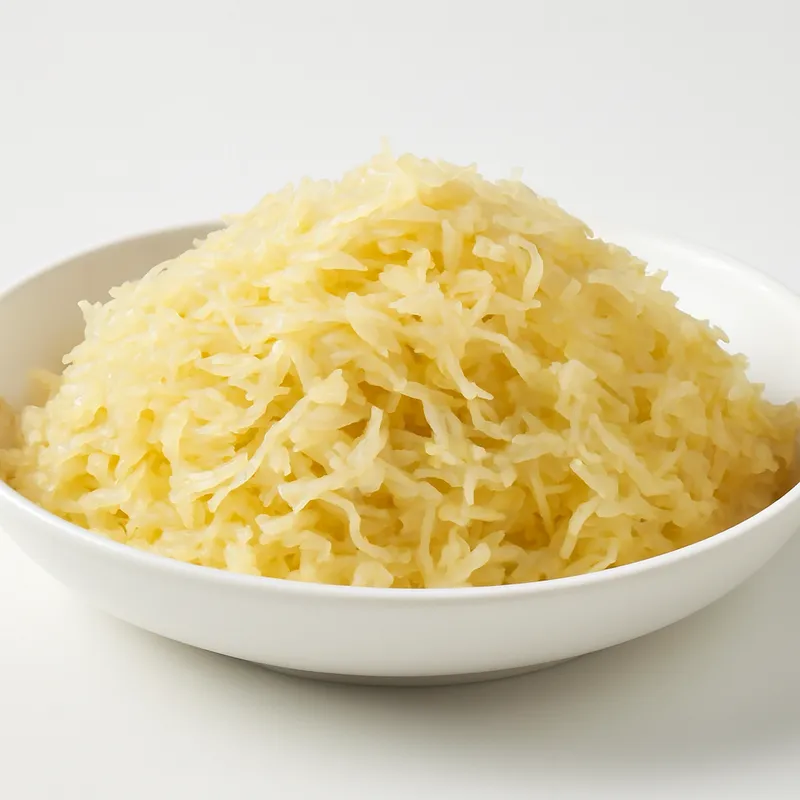
Döppekooche is a Rhenish potato cake of coarsely grated raw potato bound with egg, onion and diced bacon or Mettwurst, packed into a heavy lidded pot and baked slowly in the oven until it sets into a creamy interior under a dark, crisp crust. It is a Topfkuchen — a pot cake — and is deliberately distinct from the pan-fried Reibekuchen: rather than thin pancakes fried on the stove, the whole mass is oven-baked for roughly two hours, so the surface against the hot iron caramelises while the centre stays soft. Cut into thick slices, it is served with applesauce or the Rhenish sugar-beet syrup Rübenkraut. It belongs to autumn and to St. Martin's Day, the kind of warming, frugal dish made when a goose was beyond reach.






Döppekooche is a rural dish of the Rhineland, the Eifel and the Bergisches Land, and its precise origin is unrecorded — it is peasant cooking built on the potato, the cheapest filling staple of the region. The name is dialect: Döppe (also Döbbe or Düppe) is the Rhenish word for a pot, cognate with High German Topf, and Kooche is cake, so the dish is literally 'pot cake', named for the cast-iron Döppe it bakes in rather than for any ingredient. It is firmly tied to St. Martin's Day and the autumn potato harvest; in poorer households the baked potato cake stood in for the St. Martin's goose that richer families ate. The same dish carries different dialect names across its range — Kesselskuchen in the Eifel, Dibbekooche or Datschert in the Westerwald, and others — and it is a close cousin of the Westphalian Potthucke, which is made differently.
The crust is the prize — a dark, almost lacquered shell where the potato met the hot iron, crackling under the knife, while the inside is dense, moist and creamy, flecked with smoky bacon or coarse sausage. Each thick slice carries the sweetness of slow-cooked onion and the savour of rendered Speck against the clean starch of the potato. A spoonful of cold, sharp applesauce cuts straight through the richness; some prefer the darker, treacly note of Rübenkraut. Eaten hot from the pot, the contrast of brittle crust and soft centre is the whole pleasure.
Baking the cake whole in a lidded pot, rather than frying thin cakes, lets the dish work in two zones at once. Where the grated potato presses against the hot cast iron, surface water boils off and the starch and any rendered bacon fat brown through the Maillard reaction, building the hard, dark crust; the heavy pot holds and radiates that heat evenly. Under the lid the interior cooks gently in trapped steam, so the potato starch gelatinises and the egg coagulates into a set, custardy crumb without drying out. The long two-hour bake is what separates it from a Reibekuchen: time, not a hot pan, develops the crust, and salting the grated potato and squeezing out some liquid keeps the centre from turning watery.
Variations
Names and details shift by valley: Kesselskuchen in the Eifel, Dibbekooche or Datschert in the Westerwald, Kulles or Puttes in pockets of the Mittelrhein. Eifel cooks often grate apple into the batter for a sweeter, moister cake; some swap Mettwurst for streaky bacon, or add leek or marjoram. The Westphalian Potthucke is the best-known relative — it blends cooked, riced potato with the raw grated potato for a finer, denser crumb and is eaten with Schwarzbrot and Rübenkraut rather than applesauce. A Saarland version exists too, while the Rheinland cake most often comes to the table plain but for its applesauce.
On the Palate
Where Döppekooche sits in the German flavor cloud
Ingredients
Serves 4

How it's made
6 steps · 30 min active + 2 hours waiting
- 115 min
Peel and coarsely grate the raw potatoes, salt them and let them sit a few minutes, then squeeze out the excess liquid by hand or in a cloth.
- 210 min
Finely dice the onion and the Mettwurst or bacon; mix into the potato with the eggs, salt, pepper and a little marjoram.
- 310 min
Generously grease a heavy lidded cast-iron pot or Dutch oven with lard, line the base with a few bacon slices if you like, and pack in the potato mixture, levelling the top.
- 4110 min
Cover and bake at 200°C for about 1.5 to 2 hours, until a deep crust has formed; lift the lid for the last 20 minutes to let the surface darken and crisp.
Watch outBake covered at 200°C for 1.5–2 hours, then lift the lid for the last 20 minutes — the long time, not a hot pan, builds the hard dark crust where the potato meets the iron; uncover early and it dries out.
- 55 min
Run a knife around the edge, turn out or slice the cake straight from the pot into thick wedges.
- 62 min
Serve hot with cold applesauce or Rübenkraut on the side.
Archive tool suggestions — not reviewed
These legacy suggestions have not been evidence-reviewed and are not presented as required tools.