The small, dark-green, marbled lentils grown on the volcanic plateau of the Velay around Le Puy-en-Velay — the only French lentil with a protected appellation, and a benchmark for the variety worldwide. They need no soaking, cook quickly, and hold their shape with a firm, almost peppery bite. Two preparations are classic: dressed warm or cool as a salad with shallot vinaigrette, and simmered into a warm dish with onion, carrot and a piece of sausage or salt pork.
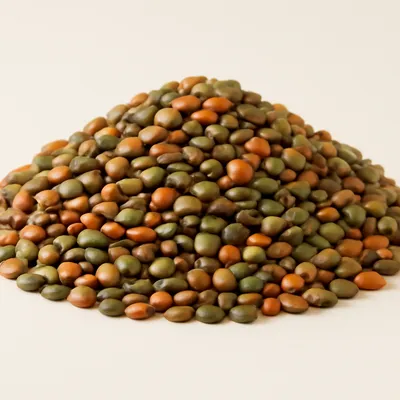




Lentils have been grown in the Velay since at least the seventeenth century — the chronicler Antoine Jacmon recorded the crop in 1643 — and the dry, sunny volcanic soils of the plateau around Le Puy give the variety its small size, marbled colour and reputation. A 1935 court ruling recognised the lentil as an appellation of origin under the 1919 law, and in 1996 it became the first vegetable in France to receive an AOC; PDO status followed in 2008. Its protected zone is confined to a group of municipalities in the Haute-Loire. Long a staple protein of this poor upland country, it is now an exported specialty.
Cooked right, the lentils stay whole and distinct, tender to the tooth but with a slight resistance at the centre and never mushy. The flavour is clean, earthy and lightly peppery, more delicate and less starchy than larger lentils, with a thin skin that almost disappears. In a salad, shallot, mustard and a good vinaigrette sharpen them; warm with sausage they drink up the savoury fat and turn richer and rounder.
The Puy lentil's quality is largely agronomic: grown without irrigation on a dry, mineral-rich volcanic plateau at altitude, it develops a thin seed coat and a low-starch, firm flesh, which is why it holds its shape where softer lentils collapse. In the pot this means it needs no pre-soaking and cooks in around twenty to twenty-five minutes. Salt and acid are added late, not early — both slow the softening of the seed coat, so seasoning a salad's vinaigrette or salting the cooking water at the start can leave the lentils stubbornly firm; cooking them first in plain water, then dressing, gives the tender-but-intact texture the variety is prized for. Their thin skin also lets a vinaigrette penetrate well, which is why they make such a good cold salad.
Variations
The two anchors are the cold or warm salade de lentilles with shallot vinaigrette and the warm lentils stewed with onion, carrot, a clove-studded onion and a sausage or piece of salt pork — close to the regional petit salé aux lentilles. Lardons, a poached egg, smoked sausage such as Morteau, or confit are common additions; some serve the warm lentils as a bed under fish or game. Substituting an ordinary brown lentil changes the dish — it cooks softer and muddier — which is the point of insisting on the Puy variety. The lentils also go into hearty soups.
On the Palate
Where Lentilles Vertes du Puy sits in the French flavor cloud
Ingredients
Serves 4


How it's made
8 steps · 20 min active + 30 min waiting
- 13 min
Rinse the lentils and pick over for any grit; do not soak.
- 22 min
Put them in a pot with cold unsalted water, a clove-studded onion, a carrot and a bay leaf.
- 323 min
Bring to a boil, then simmer gently for 20-25 minutes until tender but still holding their shape.
Watch outSimmer twenty to twenty-five minutes and check — they should be tender but still hold their shape; the Puy lentil is meant to keep its bead, not collapse.
- 43 min
Drain, and discard the aromatics; season with salt only now.
Watch outSalt only now, after draining — add salt or acid early and it toughens the skins and the lentils cook up stubbornly firm.
- 56 min
For a salad: dress the warm or cooled lentils with a shallot, mustard and vinegar vinaigrette and chopped parsley.
- 68 min
For a warm dish: gently fry onion, carrot and lardons, add the drained lentils, and warm together with a little broth.
- 74 min
Optionally add a sliced cooked sausage and let it heat through.
- 81 min
Serve as a side, or warm under fish, sausage or confit.
Archive tool suggestions — not reviewed
These legacy suggestions have not been evidence-reviewed and are not presented as required tools.