
Sand-coated taro is a classic Chaoshan sweet of taro batons deep-fried until powdery-soft, then tossed in a hot sugar syrup that cools and re-crystallizes into a dry white frost clinging to every piece. The name 'fan-sha' — 'returning to sand' — names the technique itself: white sugar is boiled with water to a syrup, the fried taro is folded in off the heat, and as the supersaturated syrup loses water the sucrose sets back into a dry sandy crust rather than a sticky candy thread. It is the dry-frost opposite of pulled-sugar 'ba-si.' Each baton comes out cloaked in matte white, crisp outside and floury within. Taro and sweet potato are often plated together as 'gold and silver pillars' for their two colors.
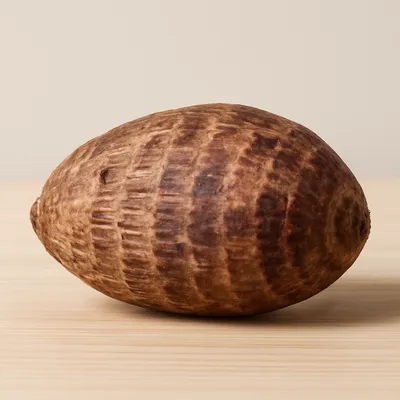


Sand-coated taro belongs to the Chaoshan repertoire of sweets built on 'fan-sha' — a regional sugar-work technique in which white sugar is boiled into syrup, then fried food is folded in and cooled so the syrup re-crystallizes into a white sandy frost. Taro suits it because its powdery, high-starch flesh fries dry and soaks up the coating without going soggy; the prized variety is the dense, fragrant Lipu-type taro. In Chaoshan the dish is most often served with its sweet-potato twin, the two plated together as 'gold and silver pillars' — golden sweet-potato bars beside silvery taro. The method is a measure of skill: under-boil the sugar and the syrup is too thin to frost, over-boil it and the sugar scorches and turns bitter, and the same fan-sha is applied to ginger, lotus seed and other fillings across the local sweet table.
A baton sheathed in matte, dry white frost that powders faintly against the lips, with none of the stickiness of glazed sweets. The crust is thin and crisp; bite through and the taro inside is hot, soft and floury, dense and gently nutty, the sugar reading as a clean snowy sweetness rather than a syrupy one. There is a pleasant grit to the frosted shell, like fine crystallized sand, that gives way to the powdery flesh. It is best warm, when the contrast of crisp dry coat and soft interior is sharpest; the frost is delicate and will slowly weep if it sits in a humid room.
Fan-sha is controlled re-crystallization. White sugar is boiled with a little water to drive off moisture and concentrate the syrup; the cook judges it not by a candy thread but by the bubbles, which shrink from large and loose to small and dense as the syrup thickens — well short of the caramel stage. The pan is taken off the heat and the fried taro folded in, often with a fan blown across the pan to cool it fast. As the now-supersaturated syrup loses heat and the last water evaporates, the dissolved sucrose can no longer stay in solution and seeds back out as fine crystals, sheathing each baton in a dry white 'sand.' This is the deliberate opposite of pulled-sugar ba-si, where the sugar is taken hotter, cooked in oil to a clear caramel and kept liquid so it draws into glassy threads; fan-sha stops cooler, in water, and is cooled to force the crystals back. The taro is fried first so its surface is dry and starchy — a wet or oily surface would let the syrup slide off instead of frosting.
Variations
The most common pairing is with sweet potato — 'fan-sha sweet potato' — the two served together as the golden-and-silver 'gold and silver pillars.' The same technique frosts ginger slices, lotus seeds, water chestnut, and even fried mantou or pumpkin across the Chaoshan sweet table. The frost can be left plain white or finished with a scatter of sesame, and some cooks add a touch of crushed peanut. The variable that matters most is the taro itself: a powdery, fragrant, high-starch taro frosts cleanly and stays floury, while a watery or waxy taro goes soft and the sugar will not set into a dry sand.
On the Palate
Where Sand-Coated Taro sits in the Chinese flavor cloud
Ingredients
Serves 4How it's made
6 steps · 30 min active + 10 min waiting
- 18 min
Peel the taro and cut into batons about 1.5 cm thick and 5 cm long; pat the surface dry.
- 210 min
Heat oil and deep-fry the taro for 8-10 minutes until cooked through, lightly crusted and floury inside; lift out and drain.
Watch outDeep-fry the taro until cooked through, lightly crusted outside and floury within — it has to be fully done here, because the sugar-coating step adds no more cooking; underfried taro stays hard under the frost.
- 33 min
Pour off the oil, add white sugar and a little water to the pan, and boil into a syrup.
- 44 min
Cook the syrup down over low heat, stirring, until the bubbles turn from large to small and dense — short of any color — then take the pan off the heat.
Watch outWatch the syrup's bubbles, not the color — take it off the heat the instant they shrink from large and loose to small and dense, well short of any browning; overcook and it turns to hard caramel that won't frost.
- 53 min
Tip in the fried taro and toss to coat every piece, fanning air across the pan to cool it quickly.
- 64 min
Keep turning as the syrup cools and re-crystallizes, until the batons are sheathed in a dry white frost; plate and serve warm.
Watch outKeep turning off the heat as the syrup cools — the supersaturated sugar reseeds into fine white crystals that sheathe each baton; stop stirring too soon and it stays sticky instead of frosting dry.


