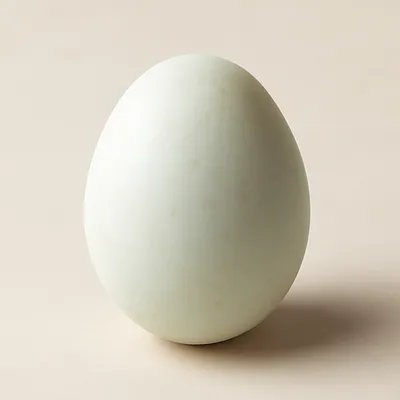
Fresh duck eggs cured in a clay-salt mixture for 30 days until the egg white is pleasantly salty and the yolk transforms into a vivid orange, sandy, oil-gushing sphere. The definitive Chinese cured egg, eaten daily with congee and ritually at Dragon Boat Festival.


The earliest confirmed documentation is in Qi Min Yao Shu (《齐民要术》), the Northern Wei agricultural encyclopedia compiled by Jia Sixie in the 6th century CE, which records egg preservation methods including brined preparations in the Suyang region (now northern Jiangsu). By the Northern Song, the poet Qin Guan (1049–1100) gifted duck eggs from his home region to his teacher Su Dongpo. The Qing dynasty gourmet Yuan Mei (1716–1797) declared in his Suiyuan Shidan (《随园食单》): 'Salted eggs from Gaoyou are finest — the color red and the oil abundant.' Writer Wang Zengqi (1920–1997), also a Gaoyou native, immortalized them in his celebrated essay Duanwu de Yadan (《端午的鸭蛋》), read by generations of Chinese students. In 1910, Gaoyou salted duck eggs won recognition at the South Seas Encouragement Society exposition and became an export to Japan, America, and Singapore.
Split the cold cooked egg: the white is firm and pleasantly salty without being aggressive; the yolk is the revelation — grainy, crumbling, intensely orange, and beading with tiny droplets of bright orange fat. One pierced yolk and a bowl of plain congee is among the most satisfying combinations in Chinese food.
Salt penetrates the duck eggshell through thousands of tiny pores via osmotic pressure over approximately 30 days at around 25°C. In the egg white, rising salt concentration denatures and firms albumin proteins while drawing out water, producing the characteristic dense, salty texture. The yolk transformation is more complex: the salt destabilizes the phospholipid-fat emulsion of the raw yolk. Fat droplets coalesce and separate from the protein matrix, redistributing as visible oil globules — this is why a properly cured yolk gushes orange fat when pierced. The orange-red color intensifies because beta-carotene (from the duck's diet of aquatic organisms) concentrates as water leaves. Eggs selected around Qingming Festival are traditionally prized: the received view holds that ducks consume fewer fishy-tasting earthworms at this season, yielding a cleaner yolk, though this remains a folk observation.
Variations
Two primary curing methods: mud-pack (泥腌法, yellow clay and salt paste wrapped around each egg, 30 days) and wet brine (盐水腌制, submerged in salt water, 40 days). Gaoyou (Jiangsu) is the prestige origin; Guangxi Beihai also produces widely sold versions. Salted duck egg yolks are a key ingredient in Cantonese mooncakes, Cantonese liu sha bao (流沙包), and Suzhou-style pastries. Smoked versions (熏鸭蛋) exist in Hunan.
On the Palate
Where Salted Duck Egg sits in the Chinese flavor cloud
Ingredients
Serves 6How it's made
7 steps · 20 min
- 15 min
Select large, fresh duck eggs (over 70 g each); clean gently with a damp cloth; allow to air-dry completely.
- 210 min
Mix yellow clay, fine salt (approximately 1 part salt to 3 parts clay by weight), and a small splash of baijiu into a firm paste.
- 35 min
Roll each dried egg in the clay-salt paste until fully coated in an even 1 cm layer; roll in dry ash or additional coarse salt to seal the surface.
- 45 min
Wrap each coated egg in paper or plastic wrap; pack snugly into a sealed ceramic jar or food-safe container.
- 543200 min
Store at room temperature around 25°C for 30 days; mark the start date clearly.
- 615 min
After 30 days, remove and rinse the eggs clean; boil in fresh water for 12 minutes over medium heat until fully cooked.
Watch outBoil the cured eggs 12 minutes to fully set both white and yolk — undercooked and the salted white stays slimy.
- 75 min
Cool under cold running water; crack and serve halved alongside congee — a properly cured yolk will leak bright orange oil when the tip of a chopstick is pressed into it.
Watch outA properly cured yolk gushes bright orange oil when a chopstick tip presses in — pale and dry means it needed more curing time.


