A Jinjiang cold-cut speciality from Anhai Town: deboned pig-trotter skin packed with pork strips marinated in gaoliang spirits and five-spice, sewn shut, wound in cheesecloth and simmered until skin collagen sets into natural gelatin — sliced crosswise into oval medallions revealing a mosaic of red meat and white skin, eaten with garlic-soy-vinegar dip.
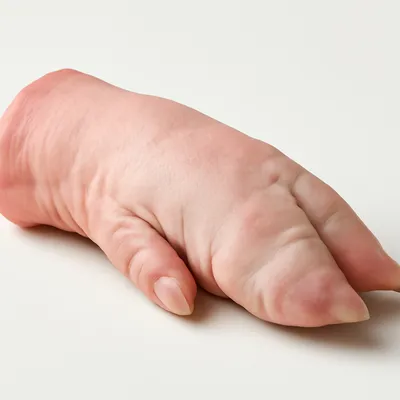


Anhai bundled trotter traces its roots to family craft in Anhai Town, Jinjiang, with the Li Kai Bundled Trotter lineage recording over a century of continuous production. The technique of packing seasoned lean meat into the intact deboned skin of a pig trotter, binding and simmering it until the collagen sets, belongs to a broad family of East Asian pressed-meat traditions — analogous in structure, if not flavour, to Vietnamese giò lụa or European head cheese — adapted here to Minnan taste preferences: mildly sweet, aromatic with gaoliang spirits, and served cold as a celebratory banquet course across southern Fujian.
Cool, dense and faintly gelatinous at the outer skin layer; the interior pork is tender and lightly sweet, with a subtle floral warmth from the gaoliang spirits. The garlic-soy-vinegar dip cuts through the richness with a sharp, pungent counterpoint.
Pig-trotter skin is rich in collagen, approximately 25–30% of dry weight. During simmering at 80–95°C, collagen's triple-helix structure denatures into disordered gelatin chains; on cooling below 35°C, these chains re-associate into a cross-linked gel network that bonds the pressed meat layers together without additives. Gaoliang spirits (around 50% ABV) penetrate muscle fibres during marination, solubilising some myoglobin — which explains the faint red hue on cut surfaces — and carrying volatile aromatics deep into the tissue. Sugar in the marinade draws water into the muscle cells by osmosis, keeping the interior moist even after prolonged simmering.
Variations
Some makers add pork tendon alongside the lean strips for a chewier texture; others include cinnamon or liquorice in the marinade to deepen the aromatics. A larger banquet version uses the whole hind trotter. Some households substitute pork belly strips for a richer, fattier cross-section.
On the Palate
Where Anhai Braised Trotter Roll sits in the Chinese flavor cloud
Ingredients
Serves 4


How it's made
7 steps · 1 hour
- 120 min
Score around the pig front trotter with a sharp knife; carefully peel the skin off in one intact piece; remove all bones; separate the lean meat from the skin
- 230 min
Scrape the skin clean of excess fat and any hairs; cut lean meat into strips about 1 cm thick; marinate with salt, sugar, five-spice powder and gaoliang spirits; leave for 30 minutes
Watch outScrape the skin dead clean of fat and stubble — this is the gel layer that binds the roll; leftover grease makes the slices split apart cold.
- 310 min
Lay the trotter skin flat, exterior side down; pack the seasoned pork strips tightly along the centre in a cylinder; fold the skin up and around to enclose, re-forming the trotter shape
- 410 min
Sew the seam shut using a steel trussing needle and kitchen twine, making stitches every 1 cm to prevent the seam from splitting during cooking
Watch outStitch the seam every centimeter, tight — leave a gap and it splits open in the pot and the whole roll unravels.
- 510 min
Wrap the sewn roll firmly in a double layer of food-grade cheesecloth; tie both ends securely; wind kitchen twine tightly around the body from end to end to maintain a round cross-section
- 670 min
Lower into a pot of boiling water; reduce heat and maintain a gentle simmer for 60–70 minutes, turning once halfway through; remove and cool to room temperature
Watch outKeep it at a gentle simmer, never a hard boil — rolling water bursts the cheesecloth wrap and pushes the meat out of shape.
- 7120 min
Refrigerate for at least 2 hours until fully set; unwrap; slice crosswise into 5 mm medallions; arrange on a platter; serve with minced garlic, soy sauce and rice vinegar
Archive tool suggestions — not reviewed
These legacy suggestions have not been evidence-reviewed and are not presented as required tools.