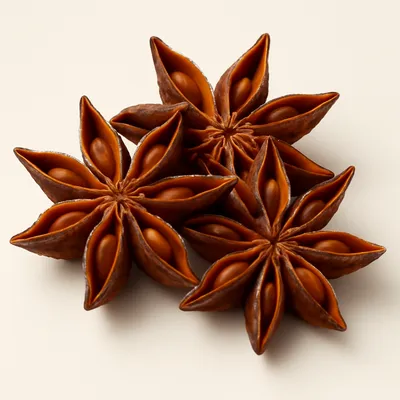
A centuries-old Huizhou pressed tofu from Xiuning County's Five-City Town: soy curds pressed under heavy stones until dense and firm, then slow-simmered for five hours in spiced brine of star anise, cinnamon and rock sugar. The result is chewy, intensely savory, and meant to be savored slowly alongside tea.





Wucheng Dried Tofu traces its origins to the Southern Song dynasty (reportedly the late Song, circa 13th century), with the craft maturing through the Yuan and flourishing in the Qing. The soft mountain spring water from the Xin'an River headwaters at Five-City Town was long credited as the key to its superior texture. The product now carries geographical indication protection covering eight townships of Xiuning County.
Firm and densely chewy — closer to aged cheese in resistance than to ordinary tofu. The spice brine saturates every layer; star anise and cinnamon linger warmly at the back of the palate.
Heavy-stone pressing expels most free water from the curd, forcing soy proteins into a dense cross-linked matrix — the physical explanation for the signature chew. Subsequent low-temperature brining at 70–75°C (well below normal simmering at 90°C+) keeps the protein from toughening further while allowing flavor molecules — anethole from star anise, cinnamaldehyde from cinnamon — to slowly diffuse deep into the protein lattice. A final 15-minute raise to 95–98°C firms the surface.
Variations
Some Xiuning workshops now infuse green or black tea extract directly into the brine, adding tannin depth that echoes the 'tea accompaniment' origin. Vacuum-packed commercial versions use a lighter spice mix for shelf-life extension.
On the Palate
Where Wucheng Spiced Dried Tofu sits in the Chinese flavor cloud
Ingredients
Serves 6How it's made
8 steps · 30 min
- 1600 min
Pick and rinse dried soybeans; soak in cold water for 8–10 hours until fully plumped and the skin is taut.
- 220 min
Drain soaked beans; grind with fresh cold water into a smooth slurry. Strain through doubled cheesecloth, squeezing firmly to extract all soy milk.
- 315 min
Bring soy milk to a rolling boil, skimming foam. Cool to about 80°C; slowly stir in gypsum water and let stand undisturbed until soft curds form.
Watch outLet the just-boiled soy milk cool to about eighty degrees before adding the gypsum — too hot and the curd sets coarse and grainy instead of tender.
- 4150 min
Ladle curds into square molds lined with damp cheesecloth; fold cloth over the top and press under 3–5 kg weight for 2–3 hours to expel moisture and form firm cakes.
Watch outPress under weight until the cakes feel firm and springy with no water weeping out — leftover moisture gives a loose curd that won't take on the signature chew.
- 55 min
Blanch pressed cakes in boiling water for 2 minutes to seal and firm the surface; drain and cool.
- 635 min
Prepare spice brine: combine water, star anise, cinnamon, rock sugar, soy sauce and salt; bring to a boil and simmer 30 minutes. Reduce heat to 70–75°C.
- 7300 min
Submerge tofu cakes in brine; steep covered at 70–75°C for 5 hours, gently turning every hour so flavor penetrates evenly.
Watch outHold the brine at a bare seventy-odd degrees, never a boil — a rolling simmer toughens the protein and the flavor stays on the surface instead of soaking in.
- 815 min
Raise temperature to 95–98°C for the final 15 minutes to firm the surface; remove cakes, drain and cool on a rack before slicing.
Archive tool suggestions — not reviewed
These legacy suggestions have not been evidence-reviewed and are not presented as required tools.



