Velveted chicken breast slices poached in warm lard and finished with an infusion of Junshan Silver Needle yellow tea — one of China's most prized tribute teas from Junshan Island on Dongting Lake — producing a dish at once snowy-white and jade-green, delicate in texture and clean in fragrance.


A signature creation of the Dongting school of Hunan cuisine, Junshan Silver Needle Tea Chicken pairs the famous Junshan Silver Needle — a yellow tea plucked as single buds from Junshan Island and a tribute tea since at least the Five Dynasties period — with thinly sliced chicken breast. Yueyang cooks deliberately echo the comparison with Hangzhou's iconic Longjing Shrimp, asserting a rival pairing of great tea and delicate protein. The dish celebrates the extraordinary terroir of Junshan Island: surrounded by Dongting Lake water, its tea trees produce exceptionally mellow, low-astringency buds whose refined sweetness survives the sealed-pile yellowing process.
A single piece delivers butter-soft chicken sheathed in a silken egg-white glaze, then a clean vegetal fragrance — the Silver Needle's grassy sweetness blooming on the back palate like mist rising over Dongting Lake in the early morning.
Junshan Silver Needle is a yellow tea whose sealed-pile yellowing (闷黄) process mildly oxidises tea polyphenols in a warm, humid enclosure, degrading chlorophyll to pheophytin and reducing astringent catechins while preserving high theanine levels — producing a sweet, mellow liquor. When the cooled tea infusion is tossed into the chicken at the end of cooking, heat-sensitive aromatic compounds (linalool, geraniol) volatilise gently, coating the dish in fragrance without bitterness. The chicken is velveted in beaten egg-white and lily-root starch: a classic technique that wraps the myosin chains in a protein-starch shell that gelatinises at around 65 °C, locking in moisture and creating the characteristic silken texture. Oil-poaching at 40% heat (approximately 120 °C) cooks the chicken from outside in, keeping the interior barely over 70 °C so the muscle proteins coagulate just enough to set without toughening.
Variations
Some cooks substitute river shrimp for chicken to create Junshan Silver Needle Shrimp, further sharpening the Longjing Shrimp comparison. A vegetarian version uses silken tofu cut into strips and velveted by the same method. High-end banquets sometimes wrap the finished dish in lotus leaves before serving, layering the lotus fragrance over the tea's delicacy for a richer aromatic profile.
On the Palate
Where Junshan Silver Needle Tea Chicken sits in the Chinese flavor cloud
Ingredients
Serves 2How it's made
7 steps · 20 min active + 5 min waiting
- 15 min
Steep Junshan Silver Needle tea in 100 ml boiling water for 2 minutes, discard the water; re-steep the same leaves with 75 ml fresh boiling water for 2 minutes, then set aside and allow to cool completely.
- 25 min
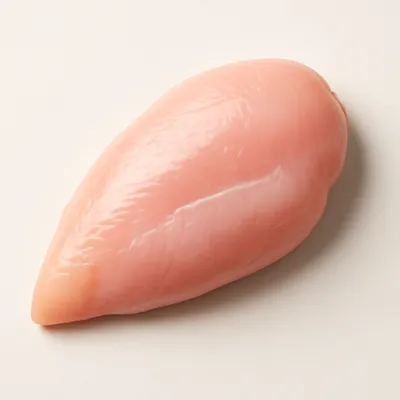
Remove sinew from the chicken breast; slice diagonally against the grain into thin pieces approximately 3.5 cm × 2.5 cm.
- 35 min
Beat 3 egg whites to a light foam; fold in lily-root starch (40 g), a pinch of salt and white pepper; coat chicken slices evenly in the batter.
- 43 min
Heat lard in a wok over medium heat to around 120 °C (40% heat); slide chicken pieces in one by one with chopsticks and let them poach gently in the lard for about 15 seconds until 80% cooked; drain into a strainer.
Watch outKeep the lard gentle at about a hundred twenty degrees and poach the chicken maybe fifteen seconds — too hot and the egg-white coat seizes and peels off; it should just turn opaque.
- 51 min
Retain 5 g of lard in the wok over medium heat; return chicken slices to the wok.
- 62 min
Pour the cooled tea infusion and leaves into the wok; season with salt and a pinch of MSG; stir-fry briefly to combine.
Watch outThe tea must be fully cooled before it hits the wok, and only a quick toss — its fragrance is delicate, and boiling it hard just cooks out the aroma and turns it bitter.
- 72 min
Add a thin cornstarch slurry to lightly thicken; toss the wok twice to coat evenly; finish with a drizzle of sesame oil and plate immediately.


