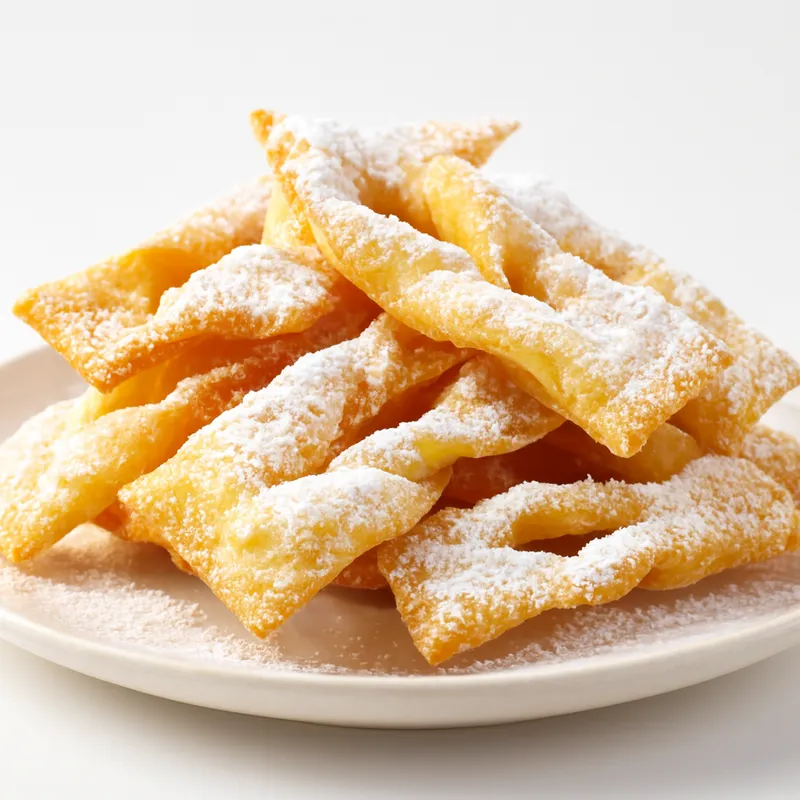
Delicately crisp pastries, twisted into thin strips, lightly fried and generously dusted with powdered sugar.




Faworki entered Polish cooking in the 17th century via French court influence (the name comes from French faveur, the ribbons given as a token of favor), brought by Queen Marie Louise Gonzaga and the wave of French cuisine that followed her marriage to King Władysław IV. The carnival-week timing matched the same pre-Lent splurge logic as pączki — eggs, butter, and lard cleared from the pantry.
Entered Polish kitchens via Queen Marie Louise Gonzaga and the 17th-century French wave at the court of King Władysław IV — name comes from French faveur, the ribbons given as a token. Dough rolled paper-thin, under 1 mm; thicker and they go biscuit-y instead of glass-shard crisp. A spoon of vodka or sour cream cuts gluten so they stay tender.
Ribbon-thin strips of pastry twisted through a slit in the middle to make a knot, deep-fried for under a minute, dusted heavily with powdered sugar. Light enough to shatter at a touch — a single faworek can disappear in two bites and leave only sugar dust on the chin. Eaten alongside pączki on Fat Thursday and through carnival week.
The dough is rolled paper-thin and stretched further by hand before twisting; thickness more than 1 mm and the result feels biscuit-like instead of glass-shard crisp. A spoonful of vodka or sour cream in the dough cuts gluten so it stays tender, not chewy. Fried briefly at 180 °C — any longer and the sugar-friendly pale color goes brown and bitter.
Variations
Polish faworki / chrust (paper-thin twisted ribbons); Italian chiacchiere are the Carnival cousins, slightly thicker; Ukrainian-Russian khvorost; Spanish-Mexican buñuelos use the same fry-thin-and-sugar logic but a different shape; baked-in-oven faworki are a 2010s health-fad version most Poles will tell you don't count.
On the Palate
Where Faworki sits in the Polish flavor cloud
Ingredients



How it's made
6 steps · 1 hour 30 min
- 13 min
Combine flour, egg yolks, sour cream, vinegar, and vodka into a dough.
- 230 min
Knead until smooth and let rest.
- 34 min
Roll out thinly and cut into strips.
Watch outRoll the dough until you can almost see through it, thinner than a millimeter, then stretch by hand — any thicker and it fries up biscuit-hard instead of glass-crisp.
- 45 min
Twist and shape strips into loops or knots.
- 58 min
Fry in hot oil until golden and crisp.
Watch outFry only until pale gold, a few seconds a side at around 180 度 — let it brown and the sugar-friendly color tips into bitter.
- 62 min
Drain on paper towels and dust with powdered sugar.
Archive tool suggestions — not reviewed
These legacy suggestions have not been evidence-reviewed and are not presented as required tools.