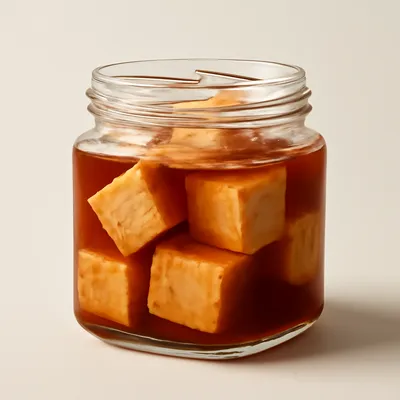
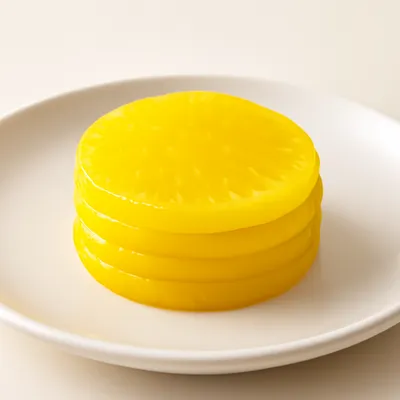
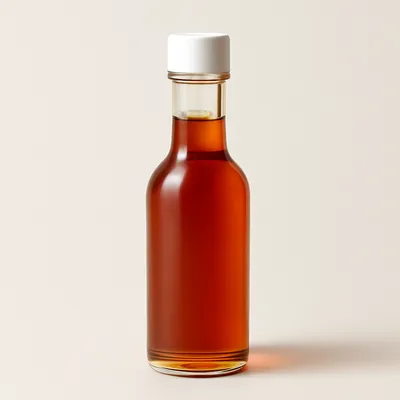
A cool, knife-scraped gel made from buckwheat starch grown in the high-altitude farms around Zhijin County, Bijie, Guizhou. After six hours of soaking and three hours of constant stirring, the paste sets overnight into a translucent jelly; it is scraped into thin strips and served with a pungent dipping sauce built on local fermented tofu, chili oil, pickled radish, and fried soybeans — a snack that Zhijin people describe as the defining taste of home.



Buckwheat jelly has been sold on the streets of Zhijin County, Bijie, for generations, rooted in the high-altitude buckwheat-growing tradition of northwestern Guizhou. The craft was officially listed as a Guizhou Provincial Intangible Cultural Heritage in 2024 (sixth batch); the 'Chenjia' (陈记) family variety is also cited in local sources as holding county- and city-level intangible heritage designations, though independent documentary confirmation of those specific designations rests with local authorities. Whether the recipe was invented locally or arrived with migrants from elsewhere in Guizhou remains debated; what is not disputed is that cold buckwheat gels have long served as a defining summer staple in these mountain communities.
Cool, smooth strips with a faint earthy sweetness give way to a bolt of sour heat from the dipping sauce; the fermented tofu underpins everything with a deep savory funk, while fried soybeans snap against the jelly's silky chew.
Buckwheat starch contains roughly 25–30% amylose, the long-chain fraction that forms tight hydrogen-bonded networks upon cooling (retrogradation). After three hours of constant stirring above 90°C, the starch granules fully gelatinize; when the hot paste cools over ten hours, amylose chains crystallise into a firm but yielding gel. The remaining 70–75% amylopectin synergistically stabilizes the water content, keeping the set jelly translucent and preventing syneresis (liquid weeping). The result is a springy bite — firmer and more elastic than cornstarch or mung bean gels of the same starch concentration.
Variations
In nearby Qianxi and Nayong counties, similar buckwheat gels are eaten hot in sour soup broth during winter. Some Zhijin vendors enrich the dipping sauce with salted duck-egg yolk for extra richness and a golden color.
On the Palate
Where Zhijin Buckwheat Jelly sits in the Chinese flavor cloud
Ingredients
Serves 4

How it's made
7 steps · 8 hours
- 1360 min
Remove husks from sweet buckwheat; rinse clean; soak in cold water for 5–6 hours until fully hydrated.
- 2120 min
Place soaked buckwheat in a cloth bag; knead vigorously in clean water, squeezing out the starchy white liquid; repeat 2–3 times with fresh water; combine all starchy liquid and let settle for 2 hours; pour off the clear surface water.
- 35 min
Mix the settled buckwheat paste with 4 times its volume of fresh water; stir to form a uniform slurry.
- 410 min
Bring the slurry to a boil over high heat, stirring constantly to prevent scorching.
Watch outStir without stopping the moment it comes up to the boil — buckwheat starch scorches on the bottom in seconds and the burnt taste spreads.
- 5180 min
Reduce to low heat; continue stirring every 30 minutes for 3 hours until the paste turns thick and translucent.
Watch outCook it down until the paste turns glossy and translucent and a spoonful falls in a thick ribbon — thin paste never sets into a springy jelly.
- 6600 min
Pour the hot paste into containers; cool at room temperature for 10 hours until fully set and firm.
Watch outLet it set undisturbed the full ten hours until it's firm and cleanly cuttable — rush it and the middle stays loose and weeps water.
- 710 min
Turn the set jelly onto a cutting board; scrape into thin strips using a notched curved scraper; arrange in bowls; mix fermented tofu, chili oil, Sichuan peppercorn oil, pickled radish, black pickled mustard, fried soybeans, and vinegar into a dipping sauce and serve alongside.
Archive tool suggestions — not reviewed
These legacy suggestions have not been evidence-reviewed and are not presented as required tools.



