



The Cangshu area traces its sheep-cooking tradition to at least the Song dynasty—historical records note that Song imperial kitchens consumed tens of thousands of mutton carcasses annually, a taste that filtered through the gentry into the farming communities of Suzhou's western hills. The Qionglong and Tianchi mountain ranges encircling Cangshu provide ideal sheep pasture, and by the Ming and Qing dynasties the hillside farmers had established a sideline trade in slaughter and mutton-selling. In the Guangxu 22nd year (1896), Zhou Xiaoquan from Cangshu's Zhoujia Village opened the first sit-down urban mutton restaurant, 'Shengmeizhai,' at Suzhou's Acuifang Bridge, formalizing Cangshu white-broth mutton as a city institution. The Cangshu Mutton Industry Association was established in 2004; an annual mutton festival has followed each year since 2005.
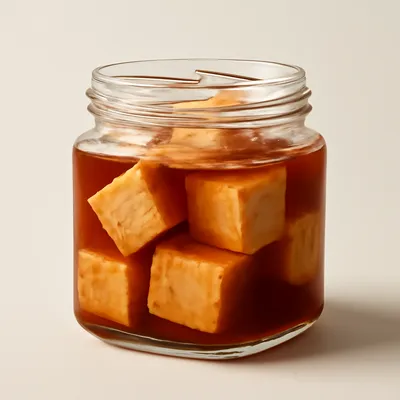
The broth arrives milk-white and gently steaming. Mutton tears apart rather than cuts—fibers soft enough to yield on the slightest pull but not reduced to mush. The taste is purely animal: deeply savory with a mild sweet lanolin-like warmth and absolutely no gamey edge if the lamb is young. Dip in the house sauce of fermented tofu and chili oil to finish.
Cangshu's milk-white broth results from vigorous fat emulsification: a sustained rolling boil forces fat droplets released from mutton tissue into micro-globules, which scatter visible light uniformly and turn the liquid opaque white. Soluble proteins—myosin fragments and collagen hydrolysis products—act as natural surfactants coating and stabilizing the fat globules. The traditional wooden-tub pot maintains extremely even high heat needed to sustain the rolling boil. Young lamb under one year contains type-I collagen with fewer cross-links, which hydrolyzes faster—explaining both quicker tenderization and the more delicate flavor compared to older mutton.
Variations
Cangshu mutton divides into two sub-styles: white-broth, seasoned only with salt and ginger, considered the purer and more representative Cangshu style; and red-braise, with soy sauce and rock sugar, bolder and better suited to deep winter. Most restaurants serve both. For service, a whole sheep is divided by cut and sold by the tael at a counter, allowing diners to compose their own bowl.
On the Palate
Where Cangshu Mutton sits in the Chinese flavor cloud
Ingredients
Serves 4How it's made
7 steps · 30 min active + 2 hours 10 min waiting
- 115 min
Clean whole young lamb; separate into bone-in cuts and organs (stomach, liver); rinse each part thoroughly.
- 210 min
Blanch all parts in a large pot of boiling water for 10 minutes; drain and rinse to remove blood and impurities.
- 35 min
Layer into the wooden tub pot: organs at the base, mutton cuts on top; add cold water to cover completely.
- 415 min
Bring to a vigorous rolling boil over high heat; maintain the rolling boil and skim foam every few minutes for the first 15 minutes.
Watch outBring it to a violent rolling boil and skim the foam — the churn emulsifies the fat and the skimming keeps the white broth clean.
- 530 min
Continue rolling boil for 30 minutes without reducing heat—the vigorous tumbling is essential for fat emulsification and the white broth.
Watch outHold the hard boil a full thirty minutes without dropping the heat — the moment it stops tumbling the broth loses its milk-white.
- 690 min
Reduce to a steady medium simmer; continue cooking 1.5 hours until mutton can be pierced with chopsticks yet still holds its shape.
- 75 min
Season with salt only; ladle broth into bowls; arrange sliced mutton; serve with ginger julienne, scallion, and a dipping sauce of fermented tofu and chili oil.
Archive tool suggestions — not reviewed
These legacy suggestions have not been evidence-reviewed and are not presented as required tools.