A Shanxi variation on the pao mo tradition from Jiezhou in Yuncheng: slow-simmered lamb bones yield a milky-white broth ladled over charcoal-roasted flatbread broken into chunks, producing a bowl where the bread is toothsome rather than dissolved — richer and more herb-fragrant than its Xi'an cousin.




Jiezhou, now part of Yancheng district in Yuncheng, sits beside the ancient Hedong salt flats, and lamb has been cooked here for millennia. Local texts call the dish by its classical name yanggeng (lamb broth). The most celebrated legend links it to General Guan Yu, who was born in Jiezhou: folk verse records that Guan Yu drank lamb soup after the day's smithwork and his whole body filled with strength; another version says he carried flatbreads into town, bought lamb broth, broke the bread into the bowl, and thereby created the dish. Both versions are folk legend, not documented history. Historically, the sixth-century agricultural treatise Qimin Yaoshu by Jia Sixie already records methods for slow-cooking sheep, and lamb soup was a recorded ration for Tang-dynasty garrison troops along the Hedong military frontier. Today's Jiezhou lamb pao mo is the accumulated product of that long culinary tradition.
The broth arrives milky-white and steaming; the first sip is rich and clean — lamb-sweet without a trace of gaminess, layered with faint star anise and tangerine warmth. The charcoal-roasted bread soaks up broth without turning to mush: each chunk is soft on the outside, still slightly chewy at the core, giving the bowl both body and texture.
The milky colour of the broth is a product of emulsification, not impurity: vigorous boiling shears bone-marrow phospholipids and triglycerides into micron-scale droplets suspended in the water, which scatter light uniformly and produce the opaque white appearance. Collagen from connective tissue and bones slowly hydrolyses into gelatin over the long simmer, increasing viscosity and the sensation of body on the palate. The charcoal-baked flatbread is cooked to very low moisture content, so it absorbs broth gradually rather than instantly — the outer starch re-gelatinises and becomes tender while the interior retains structure, producing the contrasting textures that distinguish the Jiezhou version from Xi'an pao mo, where raw-pinched bread dissolves completely.
Variations
The Jiezhou version uses charcoal-baked flatbread broken into large chunks rather than Xi'an's finely pinch-torn raw dough. Some Yuncheng restaurants serve a noodle variant where hand-pulled noodles replace the bread entirely. A winter version adds potato chunks to the broth for extra substance.
On the Palate
Where Jiezhou Lamb Pao Mo sits in the Chinese flavor cloud
Ingredients
Serves 4


How it's made
7 steps · 30 min
- 110 min
Place lamb bones and bone-in lamb shoulder in a large pot; cover with cold water; bring to a rapid boil. Drain off the grey water, rinse bones and meat under cold running water, and clean the pot thoroughly.
- 25 min
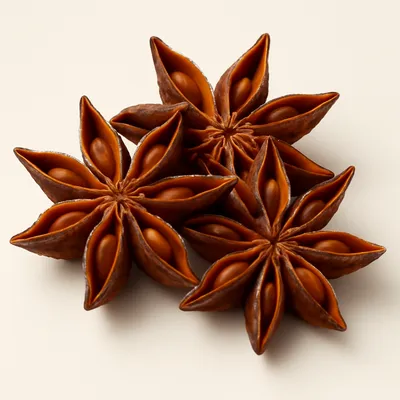
Return bones to the clean pot; add 3 litres of fresh cold water. Bring to a vigorous boil, then add ginger slices, whole scallion stalks, star anise, cinnamon bark, and dried tangerine peel.
- 3120 min
Maintain a vigorous rolling boil for 2 hours, skimming foam regularly. The broth will gradually turn milky white as bone-marrow phospholipids emulsify into the liquid.
Watch outHold a hard rolling boil a full 2 hours, skimming — the vigorous boil emulsifies the marrow fat into the milky white; a gentle simmer leaves it thin and clear.
- 4180 min
Add the lamb shoulder pieces; reduce to a steady simmer and cook for a further 3 hours until the meat is completely tender. Add salt in the final 30 minutes. Remove meat and slice thinly across the grain.
- 530 min
While the broth simmers, prepare the flatbread: combine 300 g flour with cold water and a pinch of salt; knead into a firm dough; rest 30 minutes; shape into palm-sized rounds about 2 cm thick. Bake in a 220 degree Celsius oven until deep golden on both sides.
- 65 min
Break two flatbreads per serving into walnut-sized chunks and arrange in a deep bowl. Fan out sliced lamb on top.
- 75 min
Bring the strained broth to a full boil. Ladle generously and boiling-hot over the bread and lamb. Garnish with fresh scallion rings and a drizzle of chilli oil. Serve immediately — the bread must absorb the hot broth at the table.
Watch outPour the broth over the bread boiling-hot at the table — the bread must drink the scalding broth then, not sit and go soggy.
Archive tool suggestions — not reviewed
These legacy suggestions have not been evidence-reviewed and are not presented as required tools.



