Tunisia's ancient preserved mutton — ribs and offal from the Eid al-Adha sacrifice, salted with coriander and garlic, sun-dried until brittle, then packed in oil for year-round use in couscous, chorba, and stews.
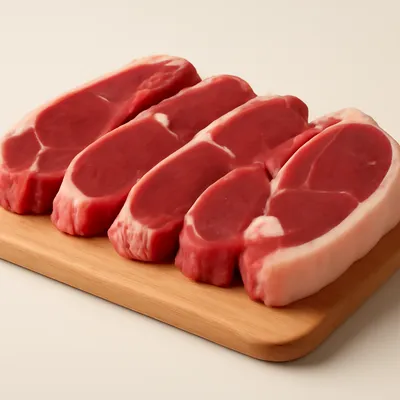




Kadid is rooted in pre-Islamic pastoral life across the Maghreb, where the absence of refrigeration made salt-air drying the primary method for preserving meat after the Eid al-Adha slaughter. In Tunisia it became inseparable from the Islamic calendar: households reserve the ribs and tripe of the sacrificial sheep specifically for kadid, processing them on the day of the sacrifice itself. The cured meat traditionally features in couscous served on the Islamic New Year (Ras al-Sana), binding the preservation practice to the liturgical year. Storage in sealed terracotta pots — or fully submerged in olive oil — extends shelf life for several months, the flavor deepening with time.
Intensely savory, with a concentrated gamey depth and dried-spice pungency; rehydrated in broth, the meat turns silky and imparts a rich, almost smoky complexity to couscous or stew.
Coarse salt draws moisture from muscle fibers through osmosis, reducing water activity below the threshold at which most spoilage bacteria and molds can survive. Solar drying accelerates dehydration and causes mild protein denaturation, forming a rigid outer crust. Fat oxidizes slowly during storage, generating concentrated flavor compounds. Oil-packing after drying creates an anaerobic barrier that prevents further oxidation and microbial ingress.
Variations
Some households add caraway or dried rose petals to the spice rub. Moroccan gueddid favors fatty shoulder cuts over ribs. Modern urban cooks use a refrigerator's dry-air zone in place of the sun when Mediterranean heat is unavailable.
On the Palate
Where Kadid (Gueddid) sits in the Tunisian flavor cloud
Ingredients
Serves 8
How it's made
8 steps · 20 min
- 110 min
Trim mutton ribs into individual pieces; cut tripe into large strips, approximately 10 cm long.
- 25 min
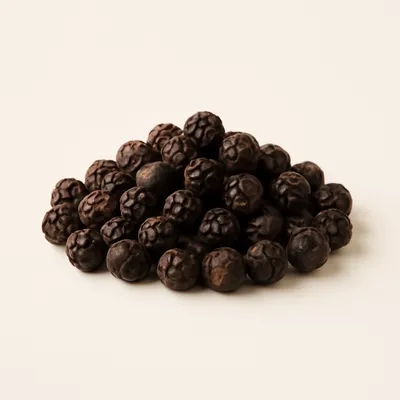
Combine coarse salt, crushed garlic, coriander seeds, and cracked black pepper in a wide bowl.
- 310 min
Rub the salt-spice mixture firmly into every surface of the meat, ensuring full coverage.
Watch outRub the salt-spice mix firmly into every surface — full coverage is what draws out the moisture and keeps spoilage off; a bare patch is where it rots.
- 4480 min
Pack into a deep bowl, cover tightly, and refrigerate overnight (8–12 hours) to marinate.
- 515 min
Thread meat onto strings or spread on drying racks in direct sunlight, spaced for airflow.
- 64320 min
Air-dry in full sun for 3–7 days depending on heat and humidity, bringing meat indoors each night.
- 75 min
Test dryness by snapping a piece — the interior must be completely dry with no give or moisture.
Watch outSnap a piece to test — the interior must be bone-dry with no give; any moisture left inside and it won't keep.
- 810 min
Pack tightly into sealed terracotta jars or glass jars fully covered with olive oil; store in a cool dark place.


