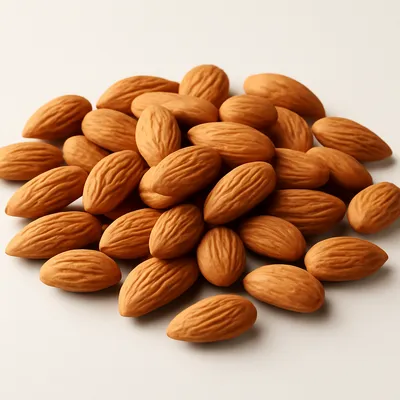
Soft-centred almond macaroons from the Savona hinterland, made without flour from ground sweet almonds, apricot-kernel seeds (armelline), egg whites, and sugar. The armelline deliver a clean, herbal bitterness that sets these apart from any crisp amaretto; beneath a lightly crackled sugar crust, the interior stays moist and yielding.


Production in Sassello is documented from 1860, when the innkeeper Gertrude served the cookies to summer visitors at her osteria; a customer reportedly coined the name 'Amaretti Virginia' from the shape of the Virginia cigars he was smoking. The recipe won a bronze medal at the Columbian celebrations (1892), silver at Arcachon (1897), silver at Genoa (1903), and gold at Paris (1911). The Italian Ministerial Decree of 22 July 2005 codified the Amaretto Morbido category—requiring a minimum of 35 % almond content by weight and a minimum of 8 % retained moisture—formally distinguishing Sassello's soft type from the crisp Saronno amaretto.
A thin, crackled sugar crust yields without resistance to a dense, moist paste that dissolves slowly on the tongue; the sweetness is round and full but never cloying, cut by a clean, herbal bitterness from the apricot-kernel seeds—the texture is closer to fresh marzipan than to any conventional biscuit.
The absence of flour means structure comes entirely from the protein matrix of whipped egg whites and the fat-protein interactions of finely ground almonds. The high sugar-to-almond ratio draws moisture to the surface during baking, forming a thin glassy crust via caramelisation, while the dense interior remains hydrated above the 8 % moisture threshold. Apricot-kernel seeds (armelline) contain amygdalin, which hydrolyses in contact with water to yield benzaldehyde—the source of the bitter-almond aroma. The meringue-based batter traps air that expands during baking, causing the characteristic surface crackle.
Variations
The Giacobbe and Sassellese families maintain a sweet-almond to apricot-kernel ratio of roughly 70:30; some producers use only sweet almonds with a trace of bitter-almond extract. A pine-nut variant exists locally but falls outside the protected recipe. The cookies are traditionally wrapped individually in coloured tissue paper—a presentation unchanged since the nineteenth century.
On the Palate
Where Amaretti di Sassello sits in the Italian flavor cloud
Ingredients
Serves 30How it's made
7 steps · 25 min
- 110 min
Finely grind sweet almonds and apricot-kernel seeds together in a mortar or food processor until the mixture reaches a uniformly fine, slightly oily meal.
Watch outGrind the almonds and kernels only until they turn oily and clump — go further and the released oil turns the meal to paste, and the cookie bakes greasy.
- 25 min
Combine the ground almond mixture with sugar in a bowl and mix thoroughly until homogeneous; set aside.
- 310 min
Whip egg whites to stiff peaks; fold gently into the almond-sugar mixture in two additions, working until a firm, cohesive dough forms.
Watch outFold just until the meringue and almond mix come together into a dough that holds — overfold and you knock out the air, and the tops bake flat instead of cracked.
- 410 min
Roll the dough by hand into balls of about 25 g each; roll each ball in vanilla-scented powdered sugar to coat, then press lightly to flatten one side.
- 515 min
Arrange on a parchment-lined baking tray, flat side down, spacing 3 cm apart; rest uncovered at room temperature for 15 minutes.
- 615 min
Bake at 180 °C (static oven) for 12–15 minutes until puffed, lightly crackled on top, and just beginning to colour at the edges—the centre must remain moist.
Watch outPull them when the tops crack and the edges just start to color — the centres must still feel soft, or they set hard as they cool.
- 75 min
Cool completely on the tray; the cookies will firm slightly as they cool but retain a soft, yielding centre. Wrap individually in tissue paper to store.
Archive tool suggestions — not reviewed
These legacy suggestions have not been evidence-reviewed and are not presented as required tools.


