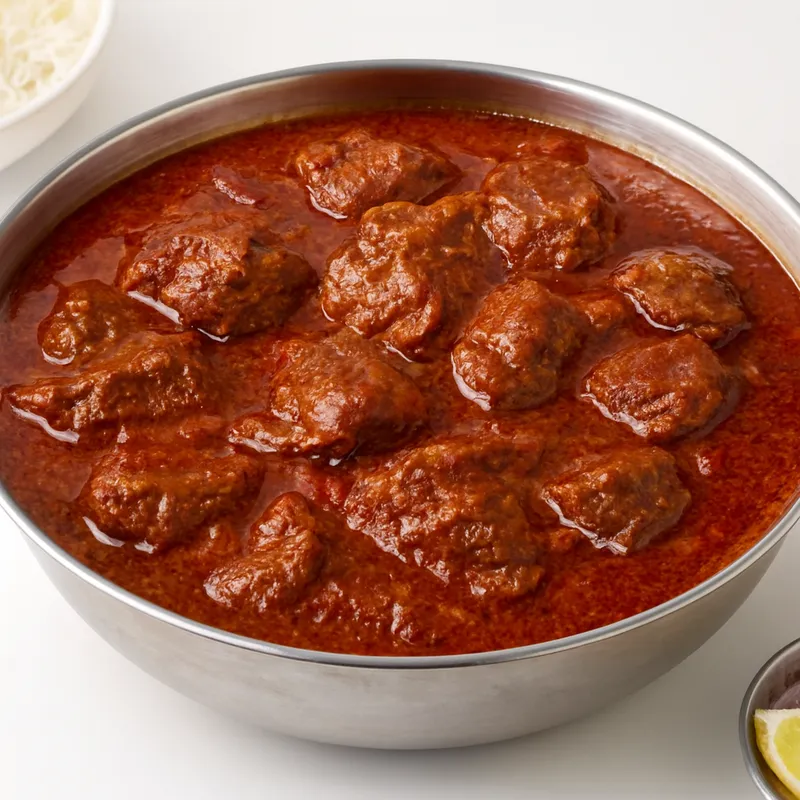
Fresh fenugreek leaves simmered in the Hyderabadi salan — a rich gravy of roasted peanuts, sesame seeds, and dried coconut, sharpened with tamarind. Unlike many green-vegetable curries, the leaves are not blanched beforehand: their bitterness is the point, set against the sour-nutty base in a contrast that defines Deccan vegetable cookery.





The salan tradition traces to the Qutb Shahi courts of Golconda, where Telugu-Deccani ingredients — peanuts, sesame, tamarind — were absorbed into courtly cooking from the late sixteenth century under rulers such as Muhammad Quli Qutb Shah. Under the Asaf Jahi Nizams (1724–1948), the salan base was codified into formal court cuisine; the nineteenth-century Nizam kitchen compendium Khwan-e-Nimat-e-Asafiya catalogued it among its 680-odd banquet recipes. Methi Ka Salan is a vegetable variant applying the same base to fresh fenugreek — a Deccani kitchen practice that deliberately leaves the leaves unblanched to preserve their alkaloid bitterness as the dish's flavor centerpiece.
A spoonful delivers roasted-nut sweetness from the peanut-sesame base first, then a clean tamarind tartness, and finally the deliberate bitter finish of the fenugreek leaf — the three flavors arriving in distinct sequence rather than merging into a single note.
Dry-roasting peanuts and sesame at around 150 °C triggers Maillard browning between their amino acids and reducing sugars, generating pyrazines and furans — the aromatic compounds responsible for the base's nutty toasted character. Grinding ruptures the cell walls, releasing oils that emulsify with proteins and cooking water into a smooth, stable gravy. As the fenugreek leaves simmer, heat volatilizes some of the more labile bitter alkaloids (primarily trigonelline) with steam, while tamarind's tartaric and malic acids, alongside the sweetness of the nut-seed paste, provide competing flavors that soften the remaining bitterness without eliminating it. Chlorophyll degrades to olive-green pheophytin during simmering, the color shift signaling that the leaves have fully cooked through.
Variations
Mirchi Ka Salan substitutes large mild green chilies for the fenugreek leaves and is the more widely known version traditionally served alongside biryani; Baingan Ka Salan uses whole baby eggplants in the same peanut-sesame-tamarind base; some households add poppy seeds to the roasted paste for extra body and a subtler creaminess.
On the Palate
Where Methi Ka Salan sits in the Indian flavor cloud
Ingredients
Serves 4



How it's made
8 steps · 15 min
- 18 min
Dry-roast 50 g raw peanuts, 2 tablespoons sesame seeds, 2 tablespoons desiccated coconut, and 3 dried red chilies in a wide pan over medium heat, stirring constantly, until the peanuts are golden and the sesame turns light brown, about 7–8 minutes.
Watch outDry-roast until the peanuts go golden and the sesame just turns light brown — stir constantly, since a shade too far turns the whole nutty base bitter.
- 25 min
Cool the roasted mixture completely, then blend with a 2 cm piece of ginger, 4 garlic cloves, and ½ cup water to a smooth paste.
- 32 min
Heat 3 tablespoons neutral oil in a heavy pot over medium-high heat. Add ½ teaspoon mustard seeds and let them crackle for 30 seconds, then add 10 curry leaves and stir for a further 10 seconds.
- 412 min
Add 2 medium onions, finely sliced, and fry, stirring often, until deep golden, 10–12 minutes.
- 55 min
Add the peanut-sesame paste, 1 teaspoon coriander powder, ½ teaspoon turmeric, 1 teaspoon red chili powder, and salt; stir-fry over medium heat until the oil begins to separate from the masala, about 5 minutes.
Watch outStir-fry the paste until the oil beads out at the edges — that split is the cue the masala is cooked through and no longer raw-tasting.
- 610 min
Stir in 3 tablespoons tamarind pulp diluted in 1½ cups water, bring to a boil, then reduce heat and simmer uncovered for 10 minutes until the gravy thickens slightly.
- 78 min
Add 200 g fresh fenugreek leaves (stems removed), stir to submerge, and simmer uncovered for 6–8 minutes until the leaves are tender and the gravy coats a spoon.
- 83 min
Taste and adjust salt; add a walnut-sized piece of jaggery if the tamarind is very sharp. Serve hot alongside Hyderabadi biryani or steamed rice.