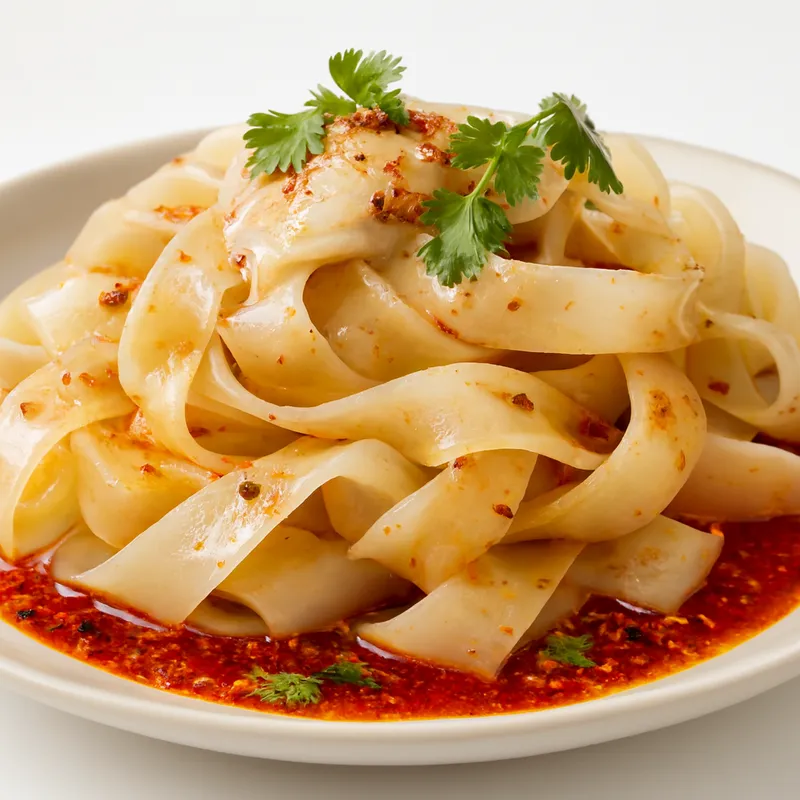
Wide, hand-pulled noodles with a fiery topping of chili and garlic.




A Shaanxi peasant noodle from the Guanzhong plain, dating back at least to the Qing dynasty and likely earlier — wheat country food, eaten by farmers and laborers who needed cheap, filling carbs. The character 「biáng」 has 57 strokes (in its traditional form), doesn't appear in standard dictionaries, and was likely invented to fit the slapping sound the dough makes on the board.
Guanzhong-plain peasant noodle, Qing or earlier. The 「biáng」 character has 58 strokes and isn't in any standard dictionary — likely invented to imitate the slap of dough on the board. High-gluten winter wheat, rested long, stretched belt-wide.
One belt-wide noodle per bowl, hand-slapped on the counter until it's a meter long and as thick as a thumb's edge. Topped with chopped scallion, minced garlic, ground chili, then doused with smoking-hot oil that hisses on contact. You toss it yourself with black vinegar and a spoon of soy. The chew is rubbery, almost too much — that's the point.
The texture comes from high-gluten winter wheat dough rested long, then stretched by hand against the board — the slapping aligns the gluten into long parallel strands. The oil-pour at the end isn't garnish: it's the cooking step for the raw garlic and chili, releasing aromatics in seconds without burning them. Vinegar cuts the oil; without it the bowl reads heavy.
Variations
Plain 油泼 with chili and scallion; 三合一 with ground pork, tomato-egg, and chili; 蘸水面 served with broth on the side for dipping; Xi'an chains like 魏家凉皮 sell a pre-cooked retail version that the 关中 home cook will refuse to eat.
On the Palate
Where BiangBiang Noodles sits in the Chinese flavor cloud
The chew is everything: rest a high-gluten dough long, then slap-and-stretch it against the board so the gluten aligns into long parallel strands — that slapping is the technique, not theater.
Ingredients


How it's made
4 steps · 2 hours
- 117 min
Mix wheat flour with water and salt to form a dough.
- 229 min
Roll out and hand-pull the dough into wide noodles.
Watch outStretch each strand thin and wide with a gentle whip against the board; if it resists and springs back, let the dough rest a few more minutes.
- 346 min
Boil noodles until al dente.
Watch outPull the noodles the moment they float and turn glossy — a minute or two; overcooked they go soft and lose the bite.
- 429 min
Top with a sauce of chili pepper, Sichuan pepper, garlic, soy sauce, and vinegar.
Watch outThe oil should hiss on contact with the garlic and chili; that quick sizzle is the aromatics cooking, so pour it hot and pour it fast.