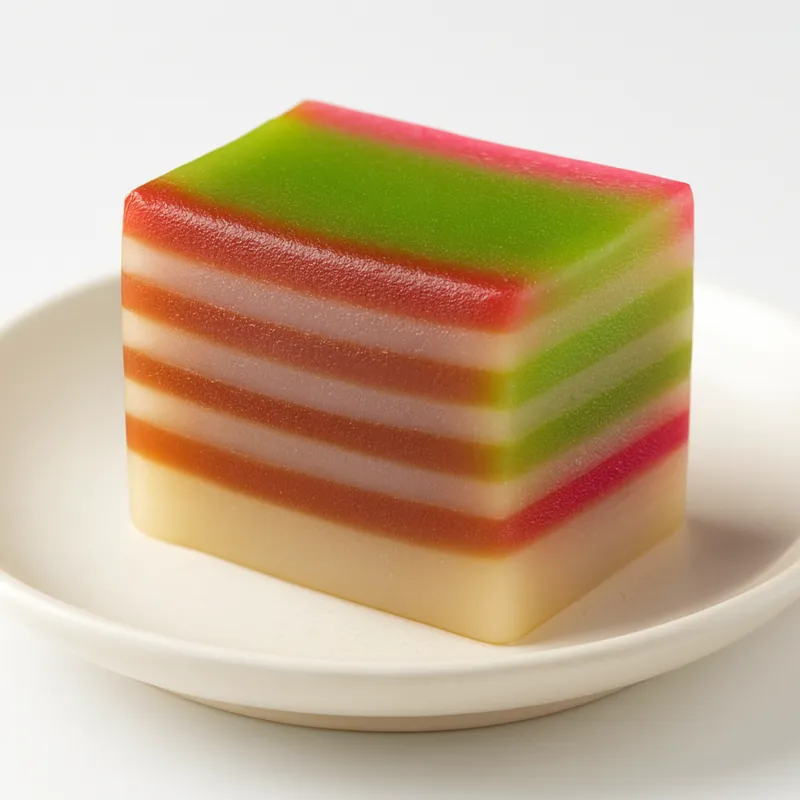
Nine stacked layers of coconut-milk pudding thickened with tapioca and rice flour, alternately tinted pandan green and white, steamed and peeled apart by hand.




Khanom chan is a classic kanom thai sai — a category of Central Thai sweets made of starch, coconut milk, and palm sugar, traditionally cooked in palace kitchens and noble households. The nine-layer version is auspicious because nine (kao) is a homophone for the word for stepping up or advancing (kao na): the word chan simply means layer, so stacking nine layers reads as steady promotion, step by step. It is served at weddings, housewarmings, and ordinations for that reason. The technique appears in Central Thai recipe books from the early 20th century.
Nine-layer steamed sweet from Central Thai palace cooking. Auspicious because chan (layer) sounds like promotion, kao (nine) like progress. The starch blend is engineered: tapioca for stretch, rice flour for body, arrowroot for sheen, mung bean for the tearing snap.
A 4cm diamond, nine bands of green and white, glossy and translucent like jade jelly. The texture is the point — it's chewy and slightly sticky, somewhere between mochi and steamed pudding, and you tear off one layer at a time with your fingers. Each strip is faintly sweet, coconut-rich, with a green-grass pandan perfume. If the layers fuse together you steamed too fast; if they crack apart you steamed too long. The proper version snaps into nine perfect ribbons.
The starch blend is engineered: tapioca for stretch, rice flour for body, arrowroot for sheen, mung bean for that distinct tearing snap. Substitute all-tapioca and the layers fuse rubbery; all-rice-flour and they crumble. The make-or-break is the steam timing — each new layer of liquid batter has to hit a fully set rubbery surface, not a still-tacky one, or capillary action pulls them into one slab. Confident makers run a fingertip over the previous layer; if it's matte and bouncy, pour next.
Variations
Pandan-and-coconut original (the palace standard); butterfly-pea-blue version for weddings; modern five-layer simplification at supermarkets like Tops; Phra Nakhon-style pulls each layer thicker; a Bangkok-Hong Kong fusion uses jasmine-tea infusion in white layers.
On the Palate
Where Khanom Chan sits in the Thai flavor cloud
Ingredients
Serves 6
How it's made
5 steps · 1 hour 15 min active + 45 min waiting
- 115 min
Whisk 200g tapioca starch, 80g rice flour, 60g arrowroot starch, 30g mung bean starch, 280g sugar, pinch salt with 600ml coconut milk and 400ml pandan water (10 pandan leaves blended with water and strained). Strain twice through a fine sieve.
Watch outEnsure the batter is smooth and free of lumps before straining.
- 25 min
Divide batter in two. Leave one half white; tint the other with 2 tablespoons concentrated pandan extract until deep grass green. Both halves should pour the same — adjust with a splash of coconut milk if needed.
Watch outToo much pandan extract can overpower the flavor; add gradually.
- 39 min
Set up a steamer over rolling water. Preheat a 20cm square steaming tin inside for 5 minutes. Ladle in 90ml green batter; cover and steam 4 minutes until the surface is set and rubbery to the touch.
Watch outFirst green layer is set when the surface turns matte and springs back to a fingertip — tacky still, and the next pour bleeds into it.
- 436 min
Ladle 90ml white batter directly on top of the set green layer; steam 4 minutes. Repeat alternating green-white-green-white-green-white-green-white-green for nine layers total. Each new layer must hit a fully set previous layer or they will fuse.
Watch outEvery new layer must land on a fully set one — run a finger over the last layer; matte and bouncy means pour, or they fuse into one slab.
- 515 min
After the ninth layer, steam an extra 8 minutes to fully set. Cool to room temperature in the tin — about 45 minutes; refrigerate 2 hours if you want clean cuts. Slice into 4cm diamonds with an oiled knife. Eat by peeling layers off one at a time.
Watch outCooling too quickly can cause the layers to crack when cutting.
Archive tool suggestions — not reviewed
These legacy suggestions have not been evidence-reviewed and are not presented as required tools.