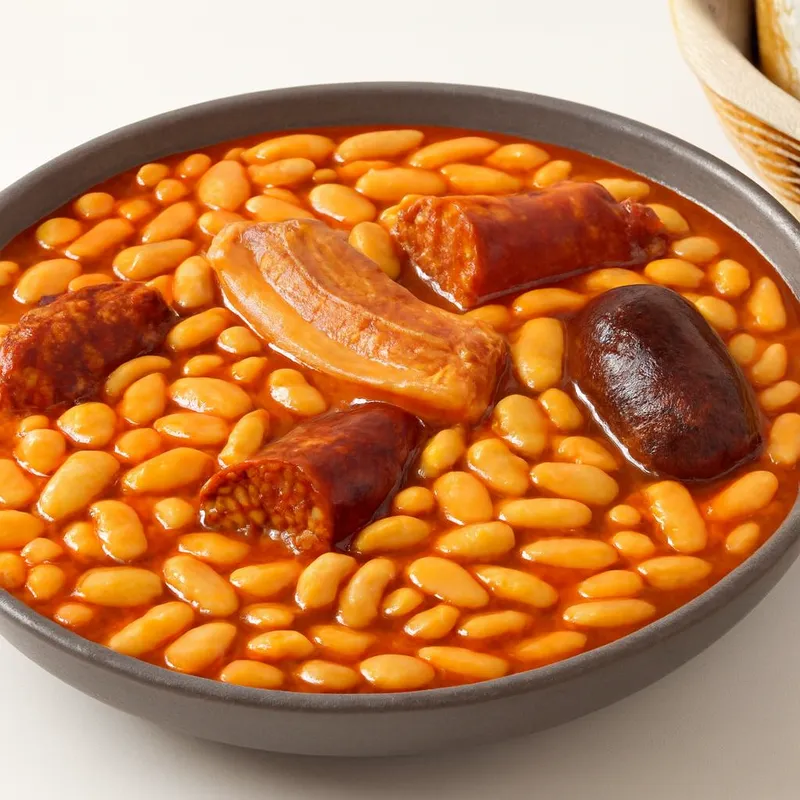


Berza is the Andalusian cousin of the Castilian cocido and the Catalan escudella — every region's one-pot meat-and-pulses winter stew. The Andalusian form, especially the Cádiz version, is distinguished by the use of collards (berza in old Spanish meant cabbage broadly) and the obligatory pumpkin chunk. It evolved as a labourer's meal in the 19th-century rural south where dried pulses and cured pork were the cheapest sustaining calories. The 'pringá' tradition of mashing the leftover meats onto bread is named into a tapas in its own right (see separate entry).
Cádiz one-pot built on collards and an obligatory pumpkin chunk, distinct from the Castilian cocido. Cold-water start with the cured meat is the rule — adding meat to hot water 'closes' the pork and gives watery stock. Morcilla goes in at the very end; over 30 minutes and it disintegrates.
A two-platter meal: a deep ochre broth with pulses, greens, and pumpkin softened almost to spoon-pressing point; alongside, a board of sliced chorizo, morcilla, pork belly, ham bone meat. You ladle broth, fork some meat, mash a piece into the broth with bread. Cumin and pimentón haunt the back of the broth; the morcilla brings clove and onion. A bad berza is washed-out — meaning the meats weren't cured aggressively enough, or the refrito was forgotten.
Three timing rules. (1) Chickpeas first because they take longest, beans 1 hour later, morcilla last (it disintegrates if cooked over 30 minutes). (2) Cold-water start with the cured meat builds the broth — adding meat to hot water 'closes' the pork and you get watery stock. (3) The refrito is non-negotiable — without that final off-heat pimentón-and-cumin oil, the broth tastes flat and grey. Cádiz cooks insist on chorizo bofe (lung-and-meat blend) for the meatiest broth.
Variations
Berza jerezana from Jerez de la Frontera — also called berza gitana, named for Jerez's large Roma (Gypsy) community — leans on chorizo bofe (lung-and-meat); other versions add green beans or feature wild thistles (tagarninas/cardillos); Sanlúcar version finishes with a glass of manzanilla into the pot; Huelvan cooks include sweet potato.
On the Palate
Where Berza Andaluza sits in the Spanish flavor cloud
Ingredients
Serves 6



How it's made
6 steps · 40 min active + 11 hours 20 min waiting
- 110 min
Soak 250g dried chickpeas and 200g dried white beans separately in cold water with 1 tbsp salt overnight (12 hours). Drain.
Watch outSoak the two pulses separately — chickpeas take longer to cook, and beans tend to fall apart if started together.
- 225 min
In a large pot, place 1 ham bone (about 300g), 200g chunk of cured pork belly (tocino), and the chickpeas. Cover with 3L cold water. Bring slowly to a simmer over 25 minutes — skim the foam.
Watch outSlow rise to simmer is what stops the chickpea skins from splitting — fast boiling shears them off.
- 390 min
Simmer covered 1 hour. Add the white beans and 200g pumpkin in 3cm chunks. Continue 30 minutes.
- 425 min
Add 200g chorizo (left whole, in 5cm pieces), 200g morcilla (Spanish blood sausage with rice or onion), and 300g collard greens or Swiss chard, sliced. Simmer 25 minutes.
Watch outAdd morcilla last — earlier and it disintegrates, dyeing the broth black.
- 53 min
In a small pan, heat 30ml olive oil. Fry 4 minced garlic cloves and 1 tsp cumin seeds 1 minute. Off heat, add 1 tsp pimentón. Stir into the pot — this is the refrito. Check salt (the cured meats will have salted the pot).
Watch outpimentón off heat — same scorch rule as everywhere else.
- 610 min
Rest off heat 10 minutes for the flavours to settle. Lift out the meats, slice the chorizo and morcilla, and serve them on a separate platter (the pringá tradition). Bowl the stew with greens, beans, and broth; let diners assemble.
Archive tool suggestions — not reviewed
These legacy suggestions have not been evidence-reviewed and are not presented as required tools.