
A whole chicken steeped — not boiled — to silky doneness, served cool with the skin taut and a glassy jelly layer hugging the bone, alongside a raw ginger-scallion dip. The Cantonese benchmark for tasting the chicken itself.



White-cut chicken is the plain-poached canon of Cantonese cooking, and its lineage as a dish reaches back further than Cantonese cuisine itself: in 1792 the Qing scholar-gourmet Yuan Mei (袁枚) recorded "white-sliced chicken" (白片鸡) as the very first entry in the poultry chapter of his Suiyuan Shidan (随园食单), praising plainly-cooked fat chicken as carrying "the flavor of the ancient ritual broth and unadorned wine" (太羹元酒之味) and warning that the water must not be too much. In Guangdong the technique became the everyday standard for chicken — at home, at banquets, and at the teahouse. Its most famous restaurant form is Qingping Chicken (清平鸡): in 1981, chefs Wang Yuan (王源) and manager Shao Gan (邵干) at Guangzhou's Qingping Restaurant (清平饭店, opened 1964) refined the white-cut method using a clear white brine and chilled chicken stock for cooling, earning the nickname "Guangzhou's number-one chicken."
Served at room temperature or lightly chilled, never piping hot. The skin is taut and faintly oiled, the flesh white and just-set, and between skin and meat sits a thin layer of translucent jelly. At the bone the marrow shows a thread of pink-red — the sign of a properly steeped bird, juicy rather than dried-out, not undercooked flesh. You dip each piece in ginger-scallion paste flashed with smoking-hot oil, or in sand-ginger and soy. Clean, sweet, unmistakably of the chicken.
The whole point is steeping, not boiling. The bird is held in water kept just below a simmer — around 90°C, the "shrimp-eye" stage where only fine bubbles cling to the pot — so the proteins set slowly and the muscle fibers never seize and squeeze out their juices. The classic "three-lift-three-dip" (三提三浸) — lowering the bird in, lifting it out, repeating — flushes the body cavity with hot water so the inside and outside cook evenly. Then the bird is plunged into ice water (过冷河, "crossing the cold river"): the skin and the gelatin just beneath it contract sharply, tightening the skin to a crisp snap and setting that signature translucent jelly. Because the heat reaches the flesh but never fully penetrates to the marrow, the bone keeps a thread of red — collagen and trace blood, not danger. Overshoot to a rolling boil and the skin splits and the meat goes dry and woody.
Variations
The dip splits two ways: Guangzhou-Hong Kong style favors ginger-scallion paste flashed with hot oil, while western Guangdong — Zhanjiang (湛江) especially — leans on sand-ginger (沙姜), often as a sand-ginger-and-oil or soy dip. The restaurant lineage gives Qingping Chicken (清平鸡), a white-cut bird cooked in clear brine and chilled, sometimes air-dried in the old Cantonese way for a tighter skin. The related but distinct Hainanese line runs through Wenchang chicken (文昌鸡), which is steamed rather than poached, and Hainanese chicken rice, where a poached-and-marinated bird is served with rice cooked in chicken fat. All are kept apart from salt-baked chicken (盐焗鸡) and soy-sauce chicken (豉油鸡), which are seasoned through, not plain.
On the Palate
Where White Cut Chicken sits in the Chinese flavor cloud
Ingredients
Serves 4

How it's made
8 steps · 20 min
- 115 min
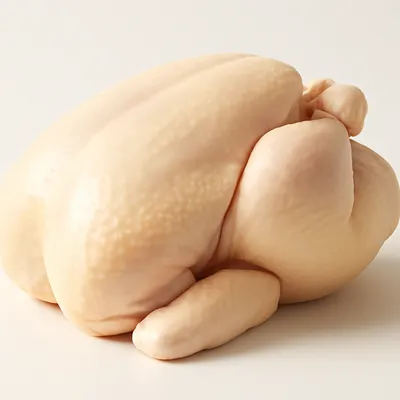
Choose a free-range bird (~1.5 kg, ideally under 1.25 kg net), rinse, and rub the cavity and skin with a little salt; let it come to room temperature.
- 25 min
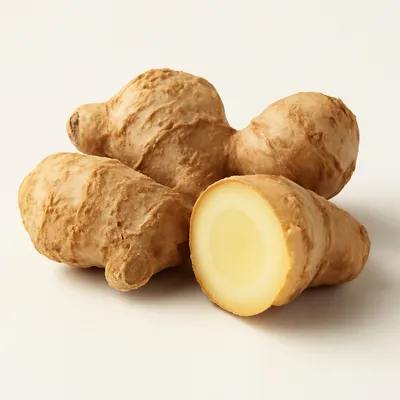
Bring a deep pot of water with a few slices of ginger and scallion to just below a boil — the 'shrimp-eye' stage, around 90°C, fine bubbles only.
Watch outBring the water only to the 'shrimp-eye' stage — around 90 degrees, fine bubbles clinging to the pot but no rolling boil; a hard boil seizes the meat and squeezes out the juices.
- 32 min
Holding the chicken by the neck, lower it fully into the water, lift it out after a few seconds, and repeat three times to flush hot water through the cavity ('three-lift-three-dip').
- 425 min
Submerge the whole bird and steep at a bare tremble for 20-30 minutes depending on size; do not let it reach a rolling boil.
Watch outSteep at a bare tremble, never a boil — the surface should barely quiver for 20 to 30 minutes so the flesh sets slow and silky.
- 52 min
Test for doneness: a skewer in the thigh runs clear, with only a thread of pink at the bone — pull it the moment it's just set, never longer.
- 68 min
Lift the bird out and plunge it straight into a basin of ice water until the skin is taut and the flesh is cold through ('crossing the cold river').
Watch outPlunge the bird straight into ice water — the sharp cold contracts the skin taut and gives it that signature crisp, jelly-like bite.
- 75 min
Brush the cooled skin with a little chicken fat or oil for shine, then chop into bite pieces and arrange on the plate.
- 85 min
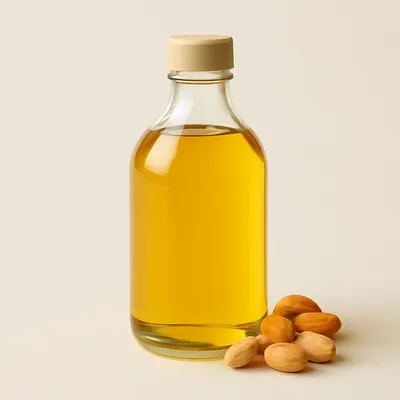
Make the dip: pound ginger and scallion whites with salt, then pour smoking-hot peanut oil over to bloom the aroma (or mix sand ginger with soy); serve alongside.
Archive tool suggestions — not reviewed
These legacy suggestions have not been evidence-reviewed and are not presented as required tools.


