
The king of Shanghai's 本帮 cold dishes: a whole chicken gently poached, cooled, chopped on the bone and served at room temperature, eaten dipped in shrimp-roe soy sauce (虾子酱油). Restaurant versions use the local 浦东三黄鸡 — a yellow-beaked, yellow-footed, yellow-skinned bird — poached by a scald-and-rest method (sometimes summed up as 三起三落, dipping and lifting the bird through near-boiling water) rather than a hard boil, so the meat just sets juicy and the skin tightens into a thin, taut, slightly jellied layer. It should be cooked just to doneness, with a faint blush of pink at the bone. It is distinct from Cantonese 白切鸡 — a different bird, a ginger-scallion oil dip, and a different poach.
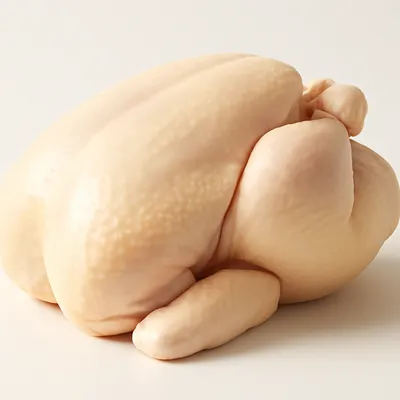
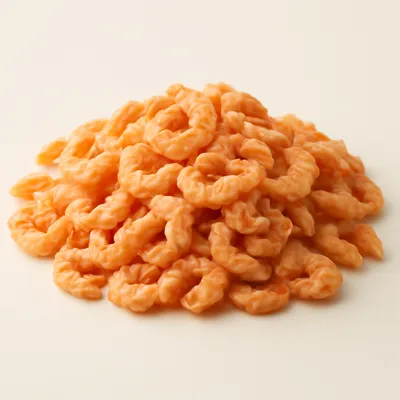




Shanghai white-cut chicken is the signature of 小绍兴, a Shanghai house founded in 1943 on 云南南路 whose name ("little Shaoxing") came to stand for the dish; it is widely told that the founders were a Shaoxing-born father and son, the 章 family, who began selling cooked chicken parts on the street. The shop built the dish around the live-killed, freshly cooked 浦东三黄鸡 and a cold-hot setting method that gives the crisp skin and tender meat; its preparation was listed as a Shanghai municipal intangible cultural heritage in 2011. White-cut and white-cooked chicken is of course much older and far more widespread than any one shop; what 小绍兴 fixed was the Shanghai rendition — the local bird, the poaching method, and above all the 虾子酱油 dip. It must not be confused with Cantonese 白切鸡, which uses a different chicken and a ginger-scallion dip.
Cool to room temperature, the meat is firm but juicy, never dry or stringy, with a clean, sweet chicken flavor that the gentle poach preserves. The skin is the prize: thin, taut and slightly gelatinous, with a hair-thin layer of set jelly between skin and flesh from the poaching liquid. At the bone the meat may show a faint pink — a sign of just-doneness in a good yellow bird, not of rawness. The dip makes it Shanghai: shrimp-roe soy sauce, savory-sweet and deeply umami with the briny pop of the roe, completely unlike the fresh, sharp ginger-scallion oil that dresses a Cantonese 白切鸡. Done well the skin snaps clean and the meat is silky; done badly the chicken is overcooked grey and dry, the skin slack and greasy, or under-set and unpleasantly raw.
The whole craft is poaching off the boil. Chicken muscle proteins begin to set well below boiling and toughen and squeeze out juice if pushed to a rolling boil, so the bird is held in water kept just below the boil; the scald-and-rest 三起三落 — lowering and lifting the bird, then letting it steep in the cooling, just-off-boil water — heats it evenly and gently, setting the meat to a juicy doneness while the dissolved skin collagen forms a thin gelatin layer that, once chilled, becomes the prized taut, faintly jellied skin. A cold-water (or iced) plunge after cooking contracts the skin and locks that texture, which is why a 三黄鸡 with its yellow fat and skin reads so glossy and tight. There is little seasoning in the meat itself; the dish leans on a good bird and on the dip, where the dried shrimp roe contributes concentrated glutamates and nucleotides for a deep umami the plain poached chicken sets off.
Variations
Within Shanghai the constants are the 三黄鸡 and the 虾子酱油 dip, but cooks vary the poach (steep-only versus repeated scalds) and how pink they leave the bone; the classic pairing is 鸡粥, a chicken congee made with the poaching broth. The far better-known cousin is Cantonese 白切鸡 (white-cut chicken), which uses a different, often free-range bird, the same off-boil poaching idea but finished with an ice bath for an even firmer jellied skin, and a fresh ginger-scallion oil dip rather than shrimp-roe soy — a genuinely different dish that is easy to confuse by name. Hainan and other regional white-cooked chickens differ again in bird and dip.
On the Palate
Where Shanghai White-Cut Chicken sits in the Chinese flavor cloud
Ingredients
Serves 4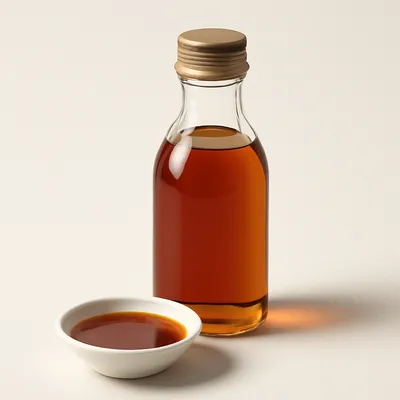

How it's made
7 steps · 40 min
- 110 min
Choose a whole 浦东三黄鸡 (yellow-skinned chicken), clean it and rub the cavity and skin with a little salt; bring a deep pot of water with ginger and scallion to a boil.
- 23 min
Holding the chicken by the neck, dip it fully into the near-boiling water and lift it out two or three times so the cavity fills and drains and the skin tightens (the 三浸三沸).
- 325 min
Lower the chicken fully into the pot, return just to a bare simmer, then turn off or keep the heat very low and let it steep, covered, off the boil for about 20 to 30 minutes until just cooked through.
Watch outKeep the water at a bare shiver, never a rolling boil — a hard boil toughens the meat and squeezes out the juice.
- 42 min
Lift the chicken out and immediately plunge it into cold or iced water to contract and set the skin, then drain.
Watch outPlunge straight into ice water the second it's cooked — the cold snap is what contracts the skin taut and springy.
- 530 min
Rub the skin lightly with sesame oil for gloss and let the chicken cool to room temperature so the jelly under the skin sets.
- 65 min
Make the dip: warm shrimp roe in a little oil, then combine with light soy sauce and a touch of sugar (and a little of the chicken broth) to make 虾子酱油.
- 75 min
Chop the cooled chicken through the bone into bite pieces, reassemble on the plate, and serve cool with the shrimp-roe soy sauce alongside.
Watch outChop only after it's fully cooled so the jelly under the skin has set — hot, the skin slips and the pieces fall ragged.
Archive tool suggestions — not reviewed
These legacy suggestions have not been evidence-reviewed and are not presented as required tools.


