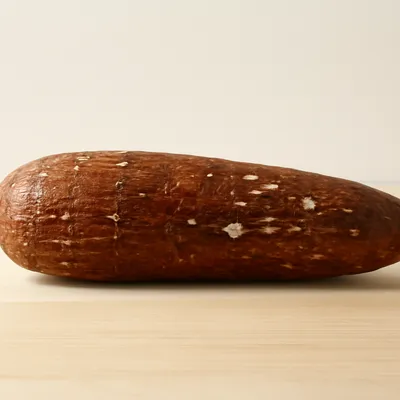
Juane de yuca is the cassava-based member of the Amazonian juane family: grated yuca worked into a dough that wraps a piece of desalted dried fish, bound in bijao leaves and boiled until firm. Where the famous juane de gallina is built on turmeric rice and chicken, this version trades rice for cassava and meat for river fish, giving a denser, more rustic parcel. It is daily food across San Martín and the Peruvian selva, served with roasted plantain or boiled yuca and a sharp onion salsa. The leaf perfumes the pale dough as it cooks.



Juane de yuca is documented as a traditional dish of the Peruvian Amazon, especially the San Martín region, eaten as everyday fare and traced to the area's indigenous communities. It sits within the broader juane tradition, a pre-Columbian leaf-wrapping technique later linked by Catholic missionaries to Saint John the Baptist and tied to the June 24 San Juan festival, though the yuca version is an everyday food rather than only a feast-day one. Cassava and salted river fish are both long-standing staples of the selva, making this a practical, ingredient-driven variant rather than a dish with a single dated origin.
The leaf opens to a firm, pale dome of cassava with a piece of flaked salt fish at its heart. The yuca dough is dense and faintly sweet, smoother and chewier than the rice juane, and carries the same grassy bijao perfume. The fish reads salty-savory against the bland starch, the two balancing each other. Eaten warm by hand, it is filling and homely, lifted by the bite of raw onion salsa alongside.
The grated cassava must be rinsed in a sieve to wash out some of its starch, or the cooked dough turns gummy and sticky rather than tender; this is the defining prep step. Boiling inside a sealed bijao leaf gelatinizes the cassava starch evenly in moist heat, setting the dough firm while keeping it moist, and the leaf's chlorophyll oils scent the pale interior. The fish is desalted by soaking before it goes in, so it seasons the bland yuca without being harsh. As with all juanes, a tight wrap and full immersion in boiling water are essential so the parcel holds and cooks through.
Variations
The filling fish is usually a salted dried Amazonian species such as paiche, doncella, dorado or maparate, and fresh fish can be used when available. Some cooks enrich the dough with egg or a little fat, and banana leaf replaces bijao outside Loreto. It is served with roasted or boiled plantain, boiled yuca and salsa criolla; portion sizes vary from a single hearty parcel to several small ones.
On the Palate
Where Juane de Yuca sits in the Peruvian flavor cloud
Ingredients
Serves 4How it's made
9 steps · 40 min active + 1 hour 10 min waiting
- 11 min
Soak the salted dried fish overnight, then boil briefly, drain and flake it.
- 212 min
Peel, wash and finely grate the cassava.
- 36 min
Rinse the grated cassava in a sieve to remove excess starch, then drain well.
Watch outRinse the grated cassava in a sieve to wash out excess starch — this is the defining step; skip it and the cooked dough turns gummy and sticky instead of tender.
- 48 min
Work the cassava into a pliable dough, seasoning with salt and a little oil.
- 58 min
Soften bijao (or banana) leaves over a flame until pliable and wipe clean.
- 65 min
Place a portion of dough on a leaf, set flaked fish in the center, and enclose it.
- 74 min
Fold into a tight bundle and tie firmly with twine.
Watch outFold into a tight bundle and tie it firmly — a loose wrap lets the dough leak out into the boiling water instead of setting in the leaf.
- 860 min
Boil the parcels in salted water about 1 hour until firm, then drain.
- 95 min
Serve warm with roasted plantain, boiled yuca and onion salsa.
Archive tool suggestions — not reviewed
These legacy suggestions have not been evidence-reviewed and are not presented as required tools.


