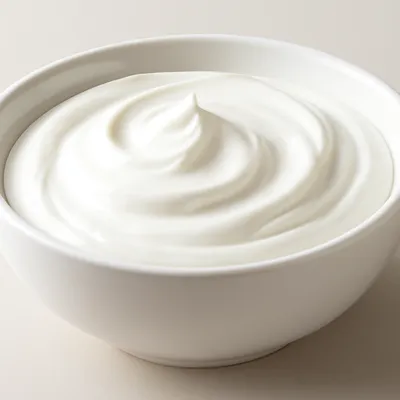
Dried, fermented whey — the tangy by-product of yogurt and buttermilk, cooked down, salted and dried hard — that is soaked and ground back into a thick, savory, sour cream to finish Persian dishes. Traditionally sold as chalky white balls or a paste, it reconstitutes into a pungent, protein-rich sauce drizzled over eggplant dips, swirled into ash soups, or thinned over rice. Its deep, funky, salty-sour flavor is unmistakable and central to a whole register of Iranian home cooking. A little carries a lot of savor.



Kashk is one of the oldest forms of dairy preservation in the Iranian world, a thrifty way to keep the sour whey left over from making butter and yogurt long past the season of plenty. Versions of it — under names like qurut, chortan and kashk — stretch across Iran, the Caucasus, Central Asia and beyond, a shared invention of pastoral peoples with milk to spare and no refrigeration. In Iranian cooking it is indispensable to a cluster of named dashes: kashk-e bademjan, the eggplant dip, and ash-e kashk among them. Once entirely homemade and sun-dried, it is now widely sold ready as a liquid or paste.
Sharp, salty and deeply tangy, with a fermented, almost cheesy funk that reads savory rather than sour-sweet. Reconstituted it is thick and creamy, coating the tongue like a dense sour cream, its pungency mellowing the longer it cooks into a dish. Drizzled raw over fried eggplant it stays bright and bracing; stirred into a hot soup it turns rounder and richer. Assertive on its own, it is built to season, not to be eaten by the spoonful.
Kashk works as a preserve because cooking down and drying the whey strips out the water that microbes need, while its salt and lactic acidity hold spoilage at bay — the same logic as aging a hard cheese. The fermentation that sours it builds the deep, funky flavor, concentrated further as the whey reduces. To use it, soaking rehydrates the dried curd and grinding breaks it back into a smooth suspension; gentle heat in a dish loosens it into a creamy sauce without curdling, and its acidity and salt do the seasoning.
Variations
Liquid kashk comes ready to use; dried kashk in balls or powder must be soaked and ground first. Qaraqurut, a near-black version made from more acidic whey, is harsher and more sour. Quality and saltiness vary widely, so cooks taste and dilute to suit the dish. Modern jarred kashk is milder and more uniform than the intensely funky homemade or village kind, which purists prize for its depth.
On the Palate
Where Kashk sits in the Persian flavor cloud
Ingredients
Serves 20How it's made
7 steps · 40 min
- 15 min
Set aside the sour whey and buttermilk left over from making yogurt or butter.
- 260 min
Simmer the whey gently, skimming, until it thickens and the curds concentrate.
Watch outKeep it at a bare quiver, never a boil — a rolling boil scorches the whey and turns it bitter; you want it just barely trembling as the curds tighten.
- 330 min
Stir in salt and continue cooking down to a dense, spreadable mass.
- 41440 min
Shape the thick curd into small balls or spread it to dry in the sun or a low oven until rock-hard.
Watch outDry it until a pressed ball feels rock-hard with no give — any soft, damp core will mold instead of keeping.
- 530 min
To use, soak the dried kashk in water until softened, then grind or blend it smooth.
- 65 min
Thin the paste with a little water to the consistency you need, tasting for salt.
- 73 min
Warm gently when adding to a dish, or drizzle raw over eggplant dips and soups.
Watch outWarm it low and slow when adding to a dish — high heat splits the reconstituted curd into grainy specks.
Archive tool suggestions — not reviewed
These legacy suggestions have not been evidence-reviewed and are not presented as required tools.