Glutinous rice steamed then pounded in stone mortars by rotating teams until it becomes a dense, shimmering, elastic mass—shaped into cakes and eaten plain, grilled, fried, or coated in sweet toppings. The ritual festival food of southern China's lunar New Year season.


Glutinous rice cakes have been eaten in China for at least 2,000 years. The Wei-Jin period culinary text Shici (《食次》), preserved in quotations within Jia Sixie's Northern Wei agricultural encyclopedia Qimin Yaoshu (齐民要术), includes a preparation called báijiǎntáng (白茧糖) in which cooked glutinous rice is pressed into compact blocks—cited as one possible early documentary ancestor of 糍粑. A widely repeated legend connects the dish to King Goujian of Yue (越王勾践, reigned 496–465 BCE): soldiers reclaiming territory from Wu discovered that the city walls had been built with compressed cooked rice, re-steamed it, and ate it together—framing 糍粑 as food of collective resilience. Ming-Qing local gazetteers across Guizhou, Hunan, Sichuan, Jiangxi, Guangdong, and Fujian document the 糍粑-making ritual in near-identical terms: during 腊月 (the last lunar month), the whole family or village gathers, with adults pounding in rotating shifts through cold winter mornings to prepare enough cakes for the New Year. The communal labor itself—the rhythmic thudding of wooden mallets, the clouds of steam, the rotating shifts—is as much the point as the finished product.
Smooth, dense, faintly sweet—the sticky pull when you tear off a piece is deeply satisfying. Grilled, it forms a thin crackling skin over a molten center; fried, it turns golden and crackles. Coated in yellow bean flour and brown sugar, it tastes like edible silk.
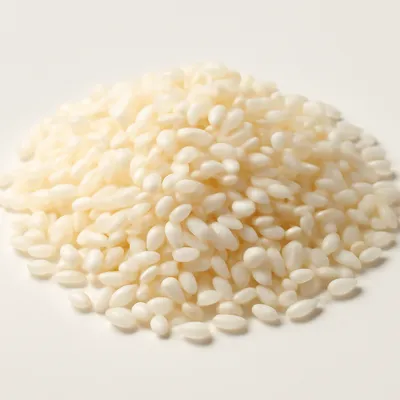
Glutinous rice is composed of almost 100% amylopectin, unlike regular milled rice which contains 20–25% linear amylose. Amylopectin's highly branched molecular architecture—with branch points approximately every 20–25 glucose units—enables far more intermolecular hydrogen bonding when the starch gelatinizes, which is why cooked glutinous rice is dramatically stickier than regular rice. Repeated pounding in the stone mortar does something simple steaming cannot: the mechanical force ruptures every grain's cell wall, releasing the gelatinized amylopectin network from its cellular packaging and physically entangling the polymer chains into one continuous, visco-elastic mass with no granular structure remaining. This is why pounded 糍粑 has fundamentally different texture from steamed glutinous rice—it is no longer a collection of discrete grains but a single unified gel.
Variations
Meizhou Hakka 糍粑 is pounded extra smooth and served dipped in a mixture of ground peanuts, sesame, and sugar. Sichuan 糍粑 is often skewered and grilled over charcoal until it puffs and chars at the edges, then brushed with chili sauce. Hunan 糍粑 is filled with red bean paste before sealing. Guizhou's Xingyi region presses 糍粑 into large flat slabs, air-dries them for months, then slices and pan-fries as needed. Taiwan's 麻糬 and Cantonese 汤圆 share the same amylopectin science with different shaping traditions.
On the Palate
Where Pounded Glutinous Rice Cake sits in the Chinese flavor cloud
Ingredients
Serves 6How it's made
7 steps · 15 min
- 1360 min
Soak glutinous rice in cold water for at least 6 hours or overnight; drain thoroughly.
- 228 min
Spread soaked rice in a steamer basket lined with damp cheesecloth; steam over high heat for 25–30 minutes until grains are fully cooked, translucent, and starting to clump.
- 33 min
Immediately transfer hot steamed rice into a stone mortar or large, heavy wooden bowl; begin pounding vigorously with a wooden mallet or pestle.
- 420 min
Pound continuously for 15–20 minutes, turning and folding the mass back to the center between strikes; dampen hands or tools with warm water as needed to prevent sticking.
Watch outKeep folding the mass back to the center and wet your mallet whenever it drags — pound cold spots in and you'll be left with hard grainy lumps you can't smooth out.
- 55 min
Continue until no individual grains are visible and the mass is completely smooth, shiny, and stretches like taffy when pulled.
Watch outIt's ready only when no grains remain and it pulls into long strands like taffy — stop early and it tears short instead of stretching.
- 65 min
With lightly oiled hands, divide the mass into portions; shape into discs, cylinders, or bite-sized rounds.
- 78 min
To serve: grill on a wire rack over charcoal until puffed and lightly charred, or pan-fry in oil until golden on all sides; coat finished pieces in yellow soybean powder mixed with brown sugar.
Archive tool suggestions — not reviewed
These legacy suggestions have not been evidence-reviewed and are not presented as required tools.


