
A deep-green Hakka steamed cake made each Qingming from fresh mugwort that is boiled, pounded smooth, and worked into a dough of glutinous and plain rice flour. The grass turns the cake jade-green and gives it a faint herbal scent and a clean bitterness that fades to a sweet finish. The rounds are left plain or wrapped around a filling — sweet ground peanut, sesame, and brown sugar, or savoury dried radish, bamboo shoot, and cured pork — then often pressed in a carved wooden mould or set on a leaf and steamed. Eaten cold from the steamer, it is soft, chewy, and faintly springy, and is thought in Hakka country to warm the body and dispel damp.



Mugwort rice cake belongs to the hill country the Hakka settled after their southward migration — Meizhou, Heyuan, and Huizhou in Guangdong, southern Jiangxi (Gannan), and western Fujian (Minxi). The Qingming season there is wet and humid, and mugwort is held to warm the stomach and drive out damp, so families gather the tender spring leaves to make a cake for the festival, which is why it is also called Qingming ban (清明粄). A long-standing Hakka saying holds that eating mugwort cake around Qingming keeps one free of illness all year. Because some versions fold in a dozen-odd wild herbs alongside mugwort — cudweed, fish-mint, and others — the cake is also known as "medicine ban" (药粄). It is close kin to the Cantonese-Teochew ai ci and to Jiangnan's qingtuan, but the Hakka cake is its own tradition, steamed rather than pan-fried and pressed in the household mould.
The cake is soft and yielding but never sticky-gummy, with a gentle chew and a slight spring when pressed. Mugwort gives it a clean herbal scent and a faint bitterness up front that turns sweet on the swallow; a sweet filling brings the toasty crunch of peanut and sesame against the smooth skin, while a savoury one is salty and aromatic with cured pork and dried radish. The mould stamps a tortoise-shell pattern into the top, and the leaf set beneath leaves its own faint print and scent on the base.
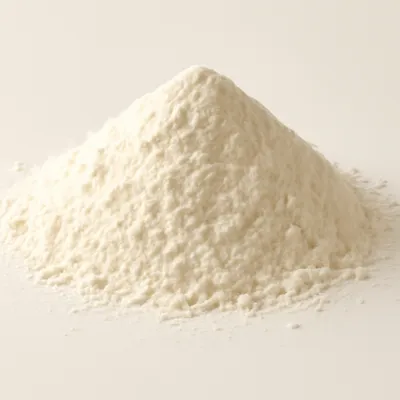
Mugwort is bitter and astringent raw, so it is blanched before use; adding a pinch of food alkali (sodium carbonate) or baking soda (sodium bicarbonate) does two jobs at once — it strips the harsh bitterness and keeps the colour vivid, because in an alkaline bath the chlorophyll resists the oxidation and acid-driven browning that would otherwise turn the cake a dull yellow-brown. The boiled leaves are pounded to a fine paste so no fibre breaks the smooth skin. Texture is set by the flour ratio: glutinous rice flour makes it soft and chewy, plain rice flour firms it up, and Hakka cooks tune anywhere from 1:1 to 3:1 or 4:1 glutinous-to-plain for the body they want. Steaming gelatinises the starch — the glutinous amylopectin gives the chew while the plain rice keeps each bite clean rather than glue-like, and the cake is eaten cooled, when the set starch holds its shape.
Variations
The basic split is sweet versus savoury: sweet fillings are toasted peanut, sesame, and sugar (sometimes red bean), while savoury ones vary by locale — cured pork, dried radish, shredded turnip, dried shrimp, bamboo shoot, or pickled greens. Many households leave the cake plain and unfilled as a simple round. Shape ranges from a flat disc set on a leaf to a piece pressed in a carved wooden mould — round or peach-shaped, stamped with a tortoise-shell pattern or auspicious characters — to make a "stamped ban" (印粄). Where a dozen wild herbs go in beside mugwort, it becomes the herbal "medicine ban"; some districts use cudweed (shu-qu grass) or field mugwort in place of, or alongside, true mugwort.
On the Palate
Where Mugwort Rice Cake sits in the Chinese flavor cloud
Ingredients
Serves 6
How it's made
8 steps · 40 min
- 110 min
Pick and wash tender spring mugwort leaves, discarding tough stems.
- 25 min
Blanch the leaves in boiling water with a pinch of food alkali or baking soda, then drain.
Watch outBlanch the mugwort with a pinch of alkali — it strips the raw bitterness and keeps the green vivid; skip it and the cake turns dull yellow-brown.
- 35 min
Pound or blend the blanched mugwort into a fine smooth paste.
- 48 min
Work the mugwort paste into glutinous and plain rice flour with a little warm water to a smooth green dough.
- 510 min
Divide into rounds; leave plain or wrap each around a sweet or savoury filling.
- 65 min
Press in a carved wooden mould or set each on a banana-leaf square.
- 715 min
Steam over high heat for about 15 minutes until set and glossy.
Watch outSteam over high heat about 15 minutes until set and glossy — that sheen means the starch has gelatinized and the cake will firm to a springy chew.
- 830 min
Cool before eating, when the cake firms to a soft, springy chew.
Archive tool suggestions — not reviewed
These legacy suggestions have not been evidence-reviewed and are not presented as required tools.


