A tiny brown-violet mountain lentil, 2–5 mm across, grown without irrigation between 1,150 and 1,600 m on the Gran Sasso plateaux around Santo Stefano di Sessanio in the province of L'Aquila. A distinct local biotype with a thin seed coat, it needs no soaking and holds its shape when cooked, and is classically simmered into a plain garlic-and-bay soup finished with raw olive oil over toasted country bread. Its cultivation is documented from the 10th century; today it is a Slow Food Presidium and an Abruzzo PAT.
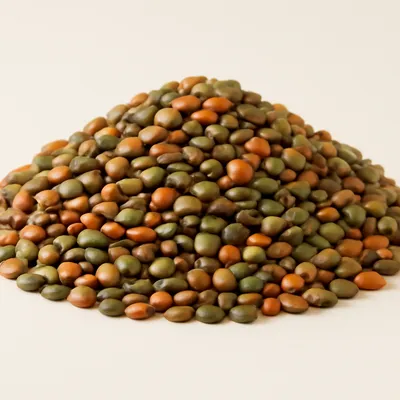





The lentil is tied to the high plateaux of Santo Stefano di Sessanio, Barisciano, Calascio, Castel del Monte and Castelvecchio Calvisio, all in the province of L'Aquila, where it is sown in March and harvested by hand in July and August. Its cultivation on the Gran Sasso is recorded from the 10th century in the Chronicon Vulturnense of the abbey of San Vincenzo al Volturno, pre-dating the founding of the village itself in the 12th–13th century, and it appears again in Teodoro Bonanni d'Ocre's 1888 survey of the old industries of the Aquila province. Grown on poor, unwatered mountain soils, it was long the 'meat of the poor' of these highlands. In 2008 the growers formed a consortium; the lentil is now protected as a Slow Food Presidium and listed as an Abruzzo PAT.
Cooked whole and unbroken, the lentils give a tender, faintly floury bite with a thin skin that barely resists; the broth is earthy and mild, deepened by garlic and bay and lifted by a thread of raw olive oil poured over at the table.
Because the seeds are small and thin-skinned, water penetrates the whole lentil quickly, so no pre-soaking is needed and cooking is even. Their low starch and high protein content means the starch granules swell only modestly and rarely burst, so the cotyledon cells stay bound by the pectin of the middle lamella and the lentil keeps its shape instead of collapsing into purée. Starch gelatinises at around 60–70°C and the storage proteins denature and set soon after, while soluble sugars and amino acids leach from the intact seeds to build the broth. Frying the garlic gently first converts its allicin into milder, sweeter sulphur compounds, and bay contributes eucalyptol that carries through the simmer.
Variations
The plainest version is only lentils, garlic, bay and oil, spooned over toasted country bread. Many cooks add a soffritto of celery, or a peeled tomato and a dried chilli, for a fuller soup. The lentils are also served drained as a side to sausages or cotechino, especially at New Year, and mashed into a thick purée for winter tables.
On the Palate
Where Lenticchia di Santo Stefano di Sessanio sits in the Italian flavor cloud
Ingredients
Serves 4

How it's made
7 steps · 15 min
- 15 min
Pick over the lentils to remove any grit, then rinse them under cold running water; this variety needs no soaking.
- 24 min
Warm the extra-virgin olive oil in a heavy pot over low heat and gently fry the whole garlic cloves until fragrant and pale gold, without letting them colour deeply.
Watch outFry the garlic only to pale gold — let it brown and it turns bitter and drags the whole pot of lentils sour-bitter with it.
- 32 min
Add the rinsed lentils, bay leaves and a dried chilli, and stir for a minute to coat them in the aromatic oil.
- 43 min
Pour in cold water to cover the lentils by about three fingers and bring slowly to a gentle simmer.
- 535 min
Simmer uncovered over low heat for 30–40 minutes, stirring occasionally, until the lentils are tender but still whole; add a little hot water if the soup thickens too much.
Watch outSimmer just until the lentils are tender but still whole — a hard boil bursts these thin skins and collapses them to purée.
- 62 min
Season with salt only towards the end, so the skins stay soft, then discard the bay leaves and the chilli.
Watch outSalt only near the end — add it early and the skins toughen and stay firm no matter how long you cook.
- 73 min
Ladle over slices of toasted country bread in warm bowls and finish each with a thread of raw extra-virgin olive oil.