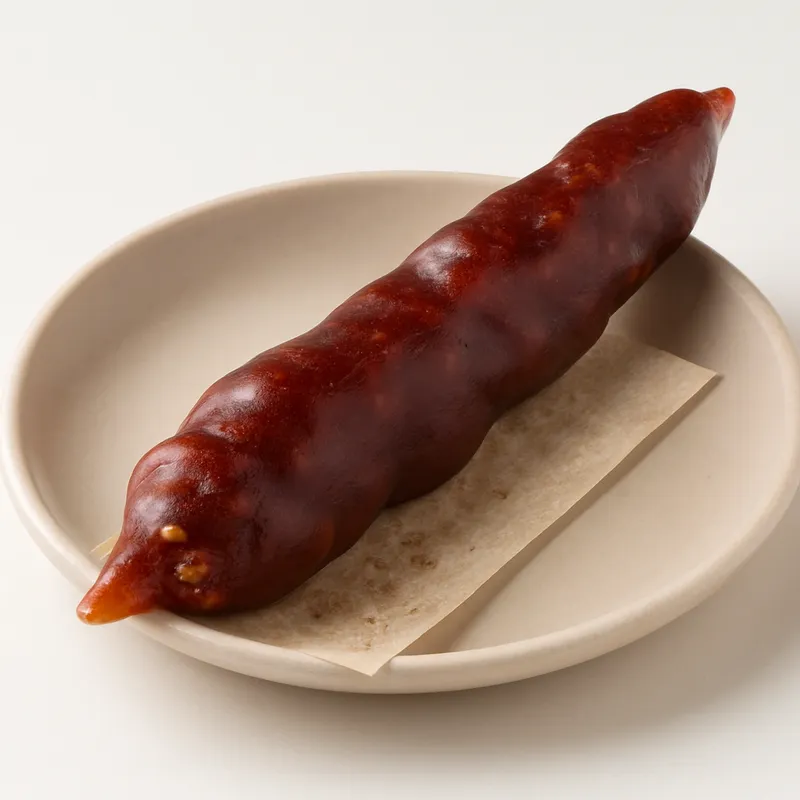
Georgian candy of walnuts threaded on a string and dipped in thickened grape juice, dried into a chewy, sweet snack.




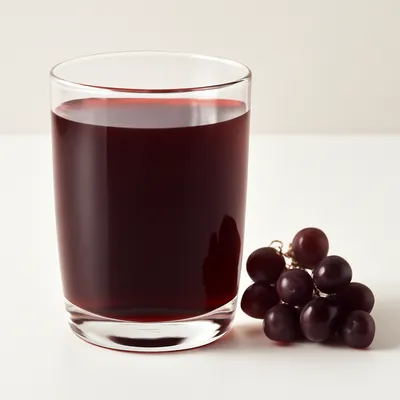

Documented in Kakheti (eastern Georgia) and Racha since at least the 12th century — chronicles describe Georgian soldiers carrying churchkhela on campaign as a high-calorie ration. It's a wine-region byproduct: every fall after harvest, leftover grape must was thickened and used to preserve the year's nuts. The Kakhetian version uses red Saperavi must (deep purple); the Imeretian uses white wine must (amber).
Documented in Kakheti and Racha since the 12th century — chronicles list it as Georgian campaign rations. Kakhetian uses red Saperavi must (deep purple); Imeretian uses white wine must (amber). Walnuts on string, dipped 5-8 times in flour-thickened tatara.
Chewy almost-leather outside; the inside reveals a row of whole walnuts perfumed by reduced grape must. Sweetness that builds slowly, not the syrup-hit of factory candy.
Grape must reduced with flour creates tatara, a thickened paste that solidifies on the strung nuts as it cools and dries. Hung in the air for two weeks, the outer skin develops a fruit-leather texture while the interior stays slightly soft.
Variations
Kakhetian churchkhela uses Saperavi grape must (deep purple); Imeretian uses Tsitska or Tsolikouri (paler amber) — same technique, very different color and flavor.
On the Palate
Where Churchkhela sits in the Georgian flavor cloud
Ingredients
How it's made
3 steps · 15 min active + 3 days waiting
- 110 min
In a large saucepan, bring grape juice to a simmer over medium heat. Gradually whisk in flour and sugar until the mixture thickens to a smooth, glossy consistency, about 10 minutes.
Watch outStop when the paste turns smooth and glossy and coats the back of a spoon in a clinging layer — that sheen means it's thick enough to grab the nuts.
- 25 min
Thread walnuts onto a string, leaving a small gap between each nut. Dip the walnut string into the thickened grape mixture, ensuring each nut is fully coated.
Watch outEach nut should come out fully sheathed in an even coat; if the paste sheets off thin, cook it down a little more before dipping again.
- 30 min
Hang the coated walnut strings in a cool, dry place to dry. Allow them to set until the coating is firm and no longer sticky to the touch, about 3-5 days.
Watch outIt's ready when the surface is firm and dry to the touch, no longer tacky — usually three to five days depending on the air.
Archive tool suggestions — not reviewed
These legacy suggestions have not been evidence-reviewed and are not presented as required tools.

Hand-held wire loop tool for beating eggs, whipping cream, emulsifying dressings, and incorporating air into batters. Balloon whisks (large round head) for whipping cream and meringues; French whisks (narrow tear-drop) for sauces in pots; flat whisks (gravy) for pan sauces. Stainless steel is universal; silicone-coated for non-stick pans.

Round metal pot, 14-26 cm diameter, with vertical walls and a long handle, designed for sauces, soups, oatmeal, rice, boiled vegetables. The vertical walls minimize evaporation (vs. a sauté pan). Sizes: 1 qt for melting butter, 2-3 qt for sauces, 4 qt for soups. Stainless-steel-clad aluminum or copper is best for conduction; cast-iron is too thick for delicate sauces.