




Documented in Swabia (southwest Germany) since at least the 18th century, with a 1725 reference by physician Rosino Lentilius. The name comes from the Swabian dialect for 'little sparrow' — variously attributed to the small, ragged bird-like shape and to the motion of flicking blobs of batter into the pot. Eggs were a wealth marker in pre-industrial farming villages — Spätzle's high egg ratio (often one per 100g flour) made it a Sunday dish that became everyday once eggs got cheap.
Documented in Swabia by physician Rosino Lentilius in 1725; the name is Swabian dialect for 'little sparrow.' Dough is wetter than pasta — too loose to roll, too thick to pour — pushed through a Spätzlebrett straight into boiling water for the ragged sauce-grabbing edges.
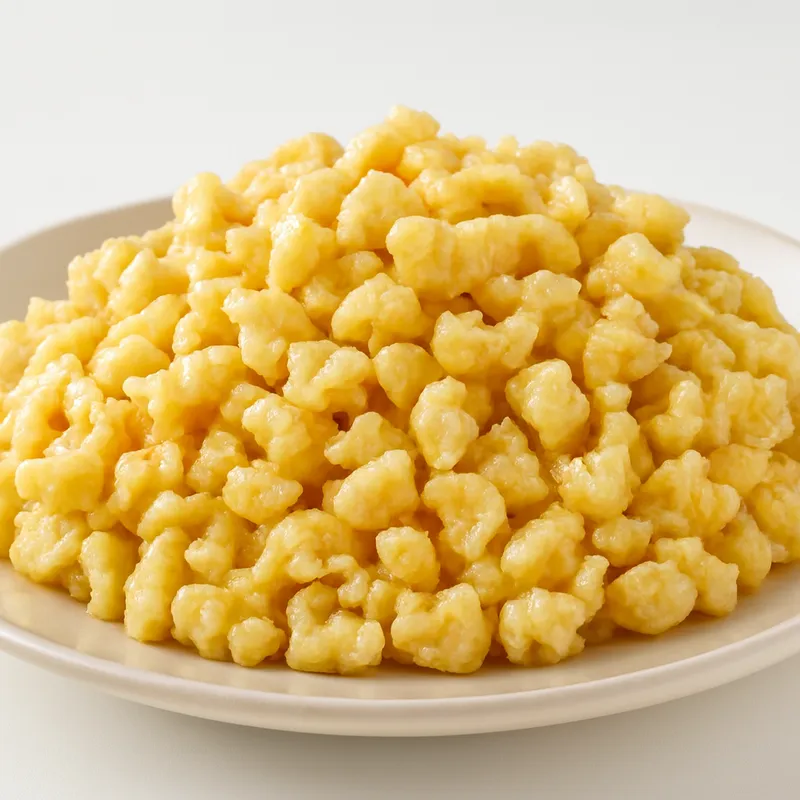
Short, irregular egg noodles with frilly edges, boiled then often pan-tossed in butter. The texture is the tell: tender but with bite, never uniform like extruded pasta. Served as a side under braised meat, or finished with browned butter and parsley. Good Spätzle tastes of egg yolk first, wheat second.
Dough hydration is wrong on purpose — wetter than pasta, too loose to roll, too thick to pour. Pushed through a Spätzlebrett (board) or Spätzlehobel (press) directly into boiling water; ragged edges trap sauce. A smooth pasta machine version misses the point. The egg yolk content keeps it tender even after a second pan-fry — eggless flour-water versions go rubbery.
Variations
Knöpfle (smaller, button-shaped, Allgäu); Käsespätzle (layered with Bergkäse + fried onion); Kratzete (Black Forest, torn-up sweet pancake cousin); Hungarian nokedli is the same dough across the border.
On the Palate
Where Spätzle sits in the German flavor cloud
Mix the batter wetter than pasta dough on purpose — too loose to roll, too thick to pour — so the ragged blobs pushed into the water keep their bird-like tails that catch butter and sauce.
Ingredients


How it's made
3 steps · 12 min active + 10 min waiting
- 15 min
In a bowl, mix flour, eggs, and water until smooth and runny, resembling a thick batter. Let it rest for 10 minutes.
Watch outThe batter should slowly ribbon off the spoon and mound softly — thick and sticky, not pourable, not a stiff ball. Rest it 10 minutes so it relaxes.
- 25 min
Bring a large pot of salted water to a rolling boil. Using a Spätzle maker or a colander, press the dough into the boiling water. Cook until the noodles float to the surface, about 2-3 minutes.
Watch outKeep the water at a hard rolling boil as you press — the noodles bob up within 2–3 minutes and that's your cue they're cooked.
- 32 min
Using a slotted spoon, transfer the cooked Spätzle to a colander to drain. Optionally, toss them in a little melted butter before serving.
Archive tool suggestions — not reviewed
These legacy suggestions have not been evidence-reviewed and are not presented as required tools.