Wiener Schnitzel is Viennese, codified by the 19th century and protected under Austrian law (real Wiener Schnitzel must be veal — pork is Schnitzel Wiener Art). Wiener Schnitzel first appears in print in the 19th century (around 1831); by legend Field Marshal Radetzky brought the breaded-cutlet recipe back from Milan, where the closely related cotoletta alla Milanese had long existed, though this account is generally treated as apocryphal. Schnitzel spread through the Habsburg Empire; the German pork version is the everyday one outside Austria.
Austrian law restricts the name Wiener Schnitzel to veal — pork is Schnitzel Wiener Art. The puffed-wave breading (das Souffle) needs at least 1cm of 170°C fat and a shaking pan; pressed breading is the supermarket tell.
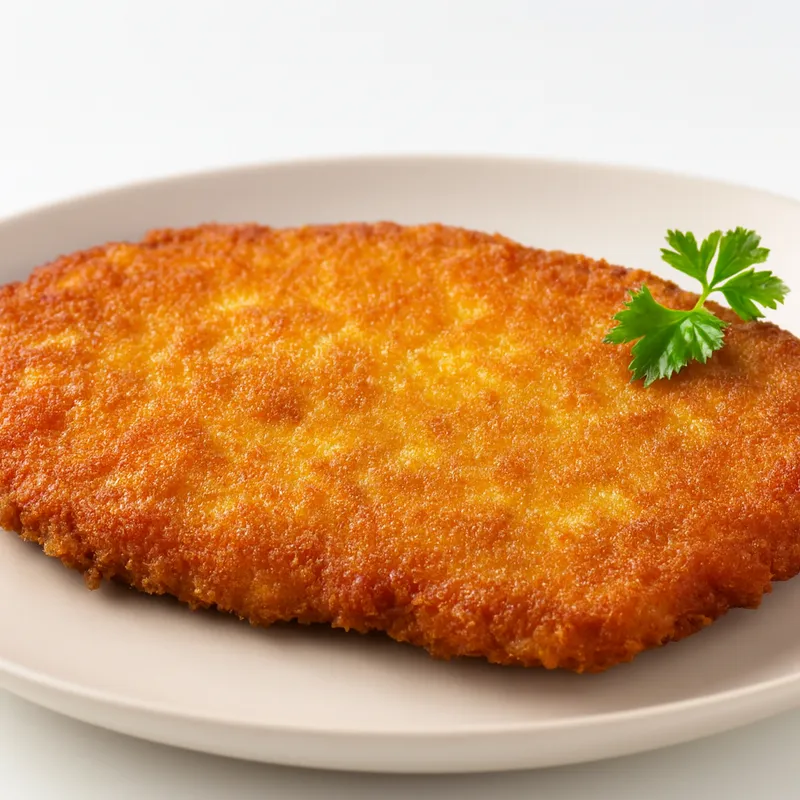
A thin pounded cutlet (veal for Wiener Schnitzel; pork for Schnitzel Wiener Art or Jägerschnitzel), breaded in flour-egg-breadcrumbs and shallow-fried in hot fat — clarified butter or lard for the proper version — until the breading puffs into golden, wrinkled waves. Served plain with lemon and parsley potatoes, or with mushroom cream. The breading should lift away from the meat in spots; tight breading means it was pressed.
The wave (das Souffle) in the breading is the technical signature. Achieve it by frying in enough fat that the cutlet floats — at least 1cm deep, 170°C — and shaking the pan continuously. The hot fat slides under the breading, lifting it off the meat in pockets. Crowded pans, low oil, or a stationary cutlet give you a flat, tight crust — technically passable, technically wrong.
Variations
Wiener Schnitzel (veal, lemon, parsley potatoes — Figlmüller in Vienna serves the plate-overhang version); Jägerschnitzel (pork, mushroom-cream); Holsteiner (veal topped with fried egg, anchovy, capers); Cordon Bleu (ham + Emmental folded inside).
On the Palate
Where Schnitzel sits in the German flavor cloud
Fry in enough hot fat that the cutlet floats (at least 1cm deep, ~170°C) and shake the pan the whole time, so the fat slides under the crumb and puffs it into the loose, wavy soufflé crust that defines a proper schnitzel.
Ingredients



How it's made
3 steps · 27 min
- 15 min
Place pork cutlets between two sheets of plastic wrap and pound with a meat tenderizer until they are about 1/4 inch thick.
Watch outPound until the cutlet is an even quarter-inch and the fibers relax — thin and uniform is the goal, not shredded.
- 210 min
Dredge each cutlet in flour, shaking off excess, then dip in beaten egg, and finally coat with breadcrumbs, pressing gently to adhere.
Watch outPress the crumbs on gently but let them stay loose — a light, even coat puffs better than a packed-on shell.
- 312 min
Heat a generous amount of oil in a large skillet over medium-high heat. Fry the schnitzels until golden brown and cooked through, about 3 minutes per side.
Watch outThe fat is hot enough when a crumb sizzles instantly; keep shaking and the crust should balloon and turn golden.
Archive tool suggestions — not reviewed
These legacy suggestions have not been evidence-reviewed and are not presented as required tools.
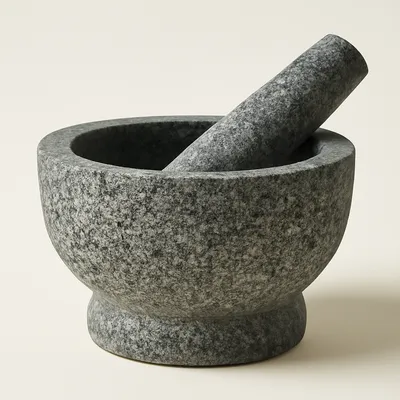
The simplest tool in any kitchen: a heavy bowl and a club to bash things in it. Different cuisines use different stones — Thai cooks pound green papaya in a tall granite mortar (krok hin); pesto Genovese requires the soft-pored Carrara marble; Indian masalas grind down on rough basalt. The bash-don't-cut motion releases volatile oils that a blade keeps sealed in the cell wall.
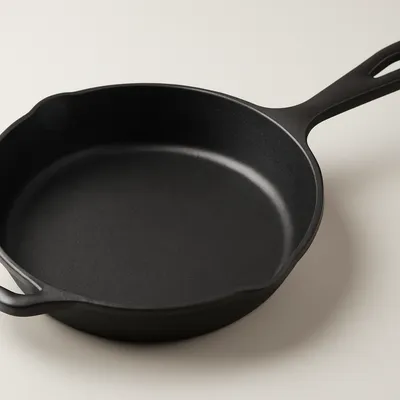
A heavy, single-piece cast iron pan, 25-30 cm across, weighing 1.5-2.5 kg. Once preheated, the thick mass holds 230°C+ even when a cold steak hits the surface — that's the secret to a deep crust. A well-seasoned skillet (multiple thin layers of polymerized oil baked into the iron) is essentially nonstick, gets better with use, and lasts a century. Lodge skillets from Tennessee have been in continuous production since 1896.