



Eaten across Egypt, Sudan, Syria and Saudi Arabia, the dish descends from tharid, the pre-Islamic Arabian bowl of torn bread soaked in broth, and was first recorded in the 10th-century Baghdadi cookbook of Ibn Sayyar al-Warraq. Its documented heyday was the Fatimid era (10th–12th century), when the Egyptian form was known as 'the people's meal' and Fatimid caliphs distributed meat fattah to the public after the Eid prayers. It remains a celebratory dish — served at Eid al-Adha (after the sacrifice), to new mothers after the 40-day confinement, and at weddings. The garlic-vinegar broth derives from the Egyptian habit of tempering rich meat dishes with sharp acid.
Mamluk-era kitchen records (14th–15th century) document fattah at Eid al-Adha, weddings, and 40-day post-partum meals. The taqlia is structural — garlic sizzled hard in samna, then crashed with vinegar to lock the allicin before it browns past the edge.
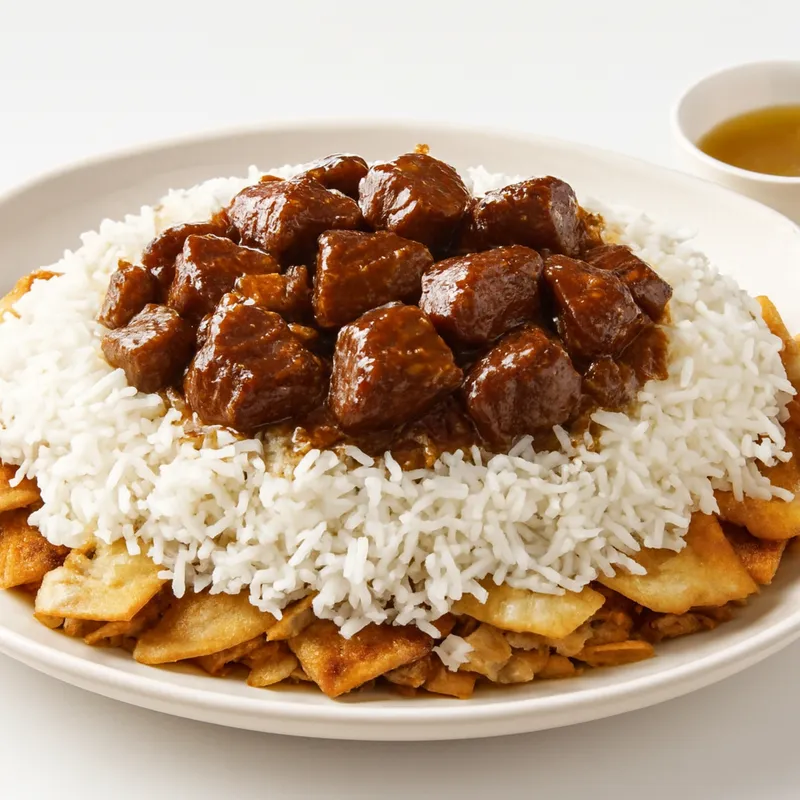
A layered dish built from the bottom up: torn pieces of toasted baladi bread, then a layer of seasoned rice, then chunks of long-simmered beef or lamb, all soaked through with a sharp garlic-vinegar broth (taqlia). A drizzle of meat fat goes over the top. Eaten with a spoon that breaks through all layers in one dig. The bread should still hold a little crunch under the broth; if it dissolves into mush, too much liquid was poured.
The taqlia is the structural element. Garlic is sizzled hard in samna (clarified butter) until just past golden, then white vinegar is poured in to crash the temperature and stop the browning at the edge — that vinegar bloom carries the volatile garlic compounds (allicin) through the broth and into the bread. Pre-mixed garlic-vinegar without the sizzle gives raw heat instead of the rounded bite. The pour temperature has to be still hissing.
Variations
Egyptian (beef or lamb shank, baladi bread base, sharp vinegar-garlic taqlia); Sudanese fatta (chicken or lamb, peanut sauce, harder bread); Saudi fattah (camel or lamb, drier, with dibs); Syrian fatteh is yogurt-based and served at breakfast — a different dish on the same template.
On the Palate
Where Fattah sits in the Egyptian flavor cloud
Get the taqlia right: sizzle garlic in the clarified butter just past golden, then hit it with vinegar while the pan is still hissing — that flash of acid on hot fat is what carries the rounded garlic bite through the whole bowl.
Ingredients
How it's made
5 steps · 30 min active + 5 min waiting
- 15 min
Tear the pita bread into bite-sized pieces and toast them in a dry skillet over medium heat until golden and crisp, about 5 minutes. The bread should be dry and crunchy to hold up in the dish.
Watch outToast the pita until it's uniformly golden and crackles when you break a piece — no soft spots, or they'll go gummy.
- 215 min
Cook the rice according to package instructions, using broth instead of water for added flavor. The rice should be tender and fluffy, absorbing the savory broth.
- 33 min
Crush garlic cloves with a pinch of salt, then sauté them in a tablespoon of olive oil over low heat until fragrant, about 2 minutes. Add a splash of vinegar to the pan and let it simmer briefly.
Watch outThe moment the vinegar hits, the pan should hiss and steam — that's the acid catching the hot fat; if it just puddles quietly, the pan is too cool.
- 42 min
Layer the toasted pita pieces in a serving dish, followed by the cooked rice. Pour the garlic-vinegar mixture evenly over the top, ensuring it soaks into the layers.
- 55 min
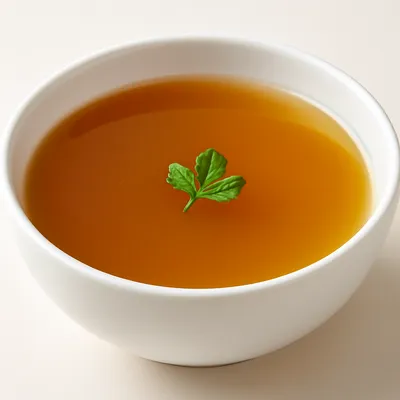
Gently heat the broth until steaming, then pour it over the rice and bread layers. Let the dish sit for a few minutes to allow the flavors to meld and the bread to soften slightly.
Watch outPour the broth while it's visibly steaming, then let it rest a few minutes so the bread drinks it in but still keeps a little chew.
Archive tool suggestions — not reviewed
These legacy suggestions have not been evidence-reviewed and are not presented as required tools.
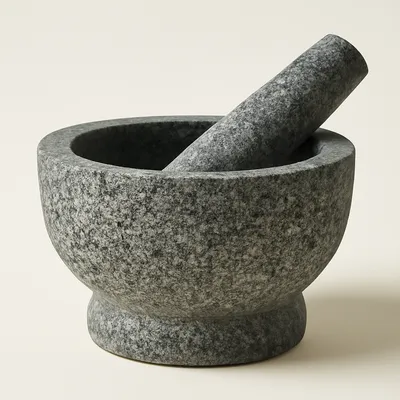
The simplest tool in any kitchen: a heavy bowl and a club to bash things in it. Different cuisines use different stones — Thai cooks pound green papaya in a tall granite mortar (krok hin); pesto Genovese requires the soft-pored Carrara marble; Indian masalas grind down on rough basalt. The bash-don't-cut motion releases volatile oils that a blade keeps sealed in the cell wall.
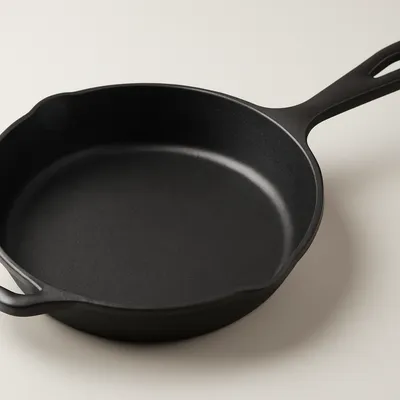
A heavy, single-piece cast iron pan, 25-30 cm across, weighing 1.5-2.5 kg. Once preheated, the thick mass holds 230°C+ even when a cold steak hits the surface — that's the secret to a deep crust. A well-seasoned skillet (multiple thin layers of polymerized oil baked into the iron) is essentially nonstick, gets better with use, and lasts a century. Lodge skillets from Tennessee have been in continuous production since 1896.