
The layered, stacked style of okonomiyaki native to Hiroshima, built up on the griddle rather than mixed in a bowl. A thin crêpe of batter is spread first, then piled high with finely shredded cabbage and bean sprouts, slices of pork belly, a layer of fried yakisoba or udon noodles, and a fried egg, before the whole stack is flipped and pressed together. Unlike the Osaka style, where cabbage and pork are folded into the batter and cooked as a single thick disc, here every component keeps its own layer. It is finished with sweet-savory okonomiyaki sauce, aonori, and bonito flakes, and eaten off the iron plate with a small spatula.


Hiroshima okonomiyaki and the Osaka style share a common ancestor in issen-yoshoku ('one-cent Western food'), a prewar children's snack sold at candy stalls: a thin disc of water-thinned wheat batter griddled with green onion and bits of fish paste, folded over and brushed with Worcestershire-style sauce. After the 1945 atomic bombing, vendors rebuilt griddle stalls amid food shortages, thinning scarce American-relief flour with extra water and adding whatever was available — cabbage, bean sprouts, pork, and noodles. Stacking these on the thin batter rather than mixing them gradually produced the layered Hiroshima form. A cluster of postwar stalls on Naka-dori became the seed of the Okonomimura food hall, formally organized in 1965. The local company Otafuku began shipping a dedicated okonomiyaki sauce in 1952, and the dish became so central to the city that Hiroshima Prefecture has the highest number of okonomiyaki shops per capita in Japan.
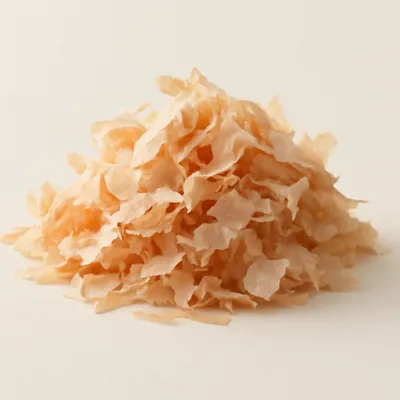
Cut through and the layers reveal themselves: a thin browned skin of batter, a deep band of cabbage steamed soft and turned sweet, a chewy seam of sauced noodles, a slip of rendered pork belly, and the slick of a soft fried egg. The cabbage is the heart of it — packed several times higher than in the Osaka style and gently steamed inside the stack until it collapses to a fraction of its bulk and tastes almost sugary. Dark okonomiyaki sauce, marine aonori, and warm-fluttering bonito flakes sit on top. Eaten in spatula-cut squares straight off the hot iron.
The trick of the Hiroshima build is that the thin batter crêpe and the ingredients piled on top act as a lid, trapping the cabbage's own moisture so it steams in place without added water. On a griddle held around 200°C the bottom browns while the dome of shredded cabbage softens; as it cooks, glucosinolates that give raw cabbage its sharp note break down and its sugars (sucrose and raffinose) come forward, so the volume drops and the sweetness concentrates. This is why the cabbage is shredded fine — roughly 1-2mm — and the stack is pressed only lightly, leaving channels for steam to circulate. The noodle layer is griddle-fried separately so it crisps at the edges rather than going soggy under the sauce. This is the opposite logic to the Osaka style, where grated nagaimo (mountain yam) is beaten into a mixed batter to give one thick disc a custardy lift.
Variations
Soba is the default noodle layer; ordering udon instead is sometimes called udon-style or modan-yaki. Common add-ins include extra egg, cheese, mochi, oysters (a Hiroshima specialty), squid, or scallion. The contrast pair is the Osaka mixed-batter style; modan-yaki more broadly means okonomiyaki with a noodle layer; negiyaki swaps most of the batter for scallion; and Tokyo's runnier monjayaki is the Kanto cousin.
On the Palate
Where Hiroshima Okonomiyaki sits in the Japanese flavor cloud
Pile the shredded cabbage high and let the batter crêpe on top act as a lid — the cabbage steams in its own moisture and sweetens, so resist the urge to press it flat or add water.
Ingredients
Serves 2

How it's made
7 steps · 25 min
- 13 min
Thin sauce-bottle batter (flour, water, a little dashi) and ladle a small pool onto a griddle heated to about 200°C; spread it into a thin round crêpe and dust the top with a pinch of bonito powder.
- 23 min
Pile a tall mound of finely shredded cabbage and a handful of bean sprouts onto the crêpe; do not press hard, so steam can circulate, and lay slices of pork belly flat over the top.
Watch outMound the cabbage taller than looks sensible — it will collapse to a third of the volume; keep the pile loose, not packed.
- 36 min
After a few minutes, flip the whole stack so the pork crisps and the cabbage steams under the batter lid; let it cook down until the cabbage softens and sweetens.
Watch outFlip only after the batter side has set and browned; the cabbage is done when the mound has slumped soft and smells sweet, not sharp.
- 44 min
On a clear area of the griddle, fry the soba (or udon) noodles, season with a little sauce, and shape them into a round bed.
- 51 min
Slide the cabbage-and-pork stack on top of the noodles, keeping the layers intact.
- 63 min
Fry an egg on the griddle, break the yolk lightly, and flip the entire okonomiyaki onto the egg so it bonds as the top layer.
Watch outBreak the yolk lightly and flip the whole stack onto the egg while it's still runny so it sets as a bonding top layer.
- 72 min
Brush generously with okonomiyaki sauce, scatter with aonori and bonito flakes, and serve on the hot plate, cut into squares with a spatula.
Archive tool suggestions — not reviewed
These legacy suggestions have not been evidence-reviewed and are not presented as required tools.



