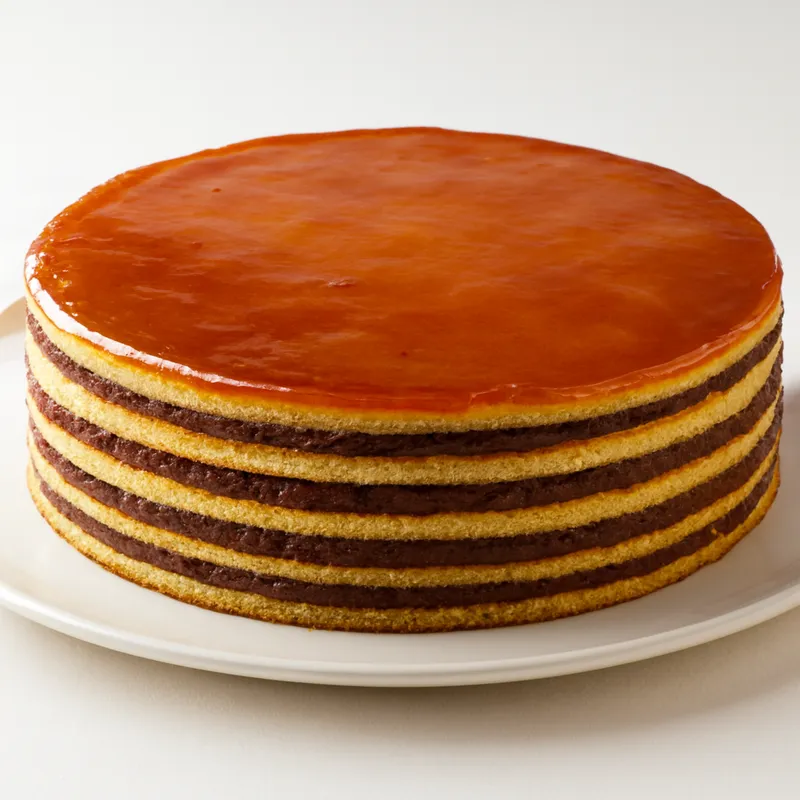




Created in 1884 by József C. Dobos, a Budapest pastry chef, and unveiled at the 1885 Budapest National Exhibition, where Emperor Franz Joseph I and Empress Sisi were among the first to taste it. The cake debuted two novelties: the chocolate buttercream layered between its thin sponges — a technique Dobos had encountered in France, still little known in Hungarian pastry — and the flat, unadorned sheet of hard caramel sealing the top. Together they let the cake outlast other pastries of the day: 1880s Hungary had no reliable refrigeration, butter fillings spoiled fast, and the caramel sealed the cake against air so it could keep and travel across Europe. Dobos kept the recipe secret until 1906, when he handed it to the Budapest pastry guild.
József C. Dobos, Budapest, 1884. The hard-crack caramel top wasn't decoration — it sealed the buttercream from air in pre-refrigeration Hungary. Recipe stayed secret until Dobos handed it to the pastry guild in 1906.
Five thin sponge layers stacked with chocolate buttercream between each, the whole thing capped with a glass-hard sheet of mirror-bright caramel scored into wedge portions. The caramel cracks under a fork and shatters into the buttercream; the sponge is firm, almost biscuit-like, not airy. A slim cake — taller than wide, in cross-section.
The caramel sheet is poured at exactly the hard-crack stage (~155 °C) onto an oiled board, then portioned with a knife while still warm-pliable but not soft — wait too long, it shatters at the cut; cut too soon, the cuts close back up. Buttercream uses real butter, not shortening: only butter sets to a sliceable density at room temperature against a sponge that's been baked thin (5 mm) for layer count, not loft.
Variations
Original 5-layer Dobos with chocolate buttercream; modern Gerbeaud-café version pipes a hazelnut cream variant; mini-Dobos squares (kockás) are the bakery cut, not the original cake.
On the Palate
Where Dobos Torta sits in the Hungarian flavor cloud
Score the caramel top the instant it stops flowing but is still warm-pliable — that narrow window is what lets you cut clean wedges instead of a shattered slab.
Ingredients


How it's made
6 steps · 43 min
- 15 min
Preheat your oven to 180°C. Separate the eggs and beat the yolks with sugar until pale and creamy, about 5 minutes.
- 23 min
Fold in sifted flour gently into the egg mixture to maintain airiness, creating a light batter.
- 35 min
Whip the egg whites to stiff peaks and gently fold them into the batter, being careful not to deflate the mixture.
Watch outWhites at stiff peaks — the tip stands straight when you lift the whisk; fold in three additions so you don't knock the air out.
- 415 min
Grease and line cake pans, then divide the batter evenly. Bake until golden and a skewer comes out clean, about 15 minutes per layer.
- 510 min
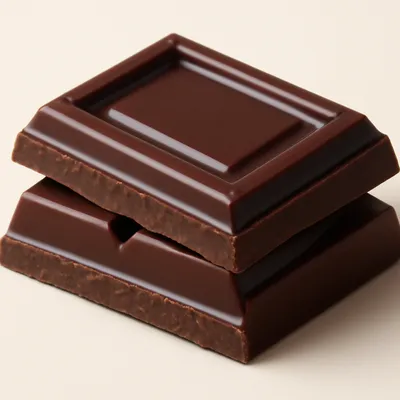
Cool the cake layers completely. Meanwhile, melt chocolate and butter over a double boiler until smooth, then let it cool slightly before spreading between layers.
Watch outLet the melted chocolate-butter cool to just-warm before spreading; hot mixture melts the cream and slides off the sponge.
- 65 min
For the caramel topping, melt sugar until golden brown and pour over the top layer, spreading quickly before it hardens.
Watch outMelt sugar only to a golden amber (~155°C, hard-crack); pour and spread in one pass — it sets in seconds.
Archive tool suggestions — not reviewed
These legacy suggestions have not been evidence-reviewed and are not presented as required tools.