





Cape Dutch, 17th century. After the Dutch East India Company founded a Cape of Good Hope refreshment station in 1652, settlers — many of them dairy farmers — brought their Dutch milk-and-egg pastries to the Cape, where milk was easier to come by than eggs, and dusted the tart heavily with cinnamon drawn from the Company's spice trade. The tart is widely held to descend from the Dutch mattentaart, a cheesecake-like pastry sometimes traced to Thomas van der Noot's 1510 recipe book Een notabel boexcken van cokeryen; exactly which recipe first set down the modern milk tart is not firmly documented.
Cape Dutch, 17th century. First printed in Catharina Allegonda van Lier's 1741 South African manuscript cookbook. The cornflour-thickened stovetop custard is what splits it from a French tarte au lait — no oven custard step.
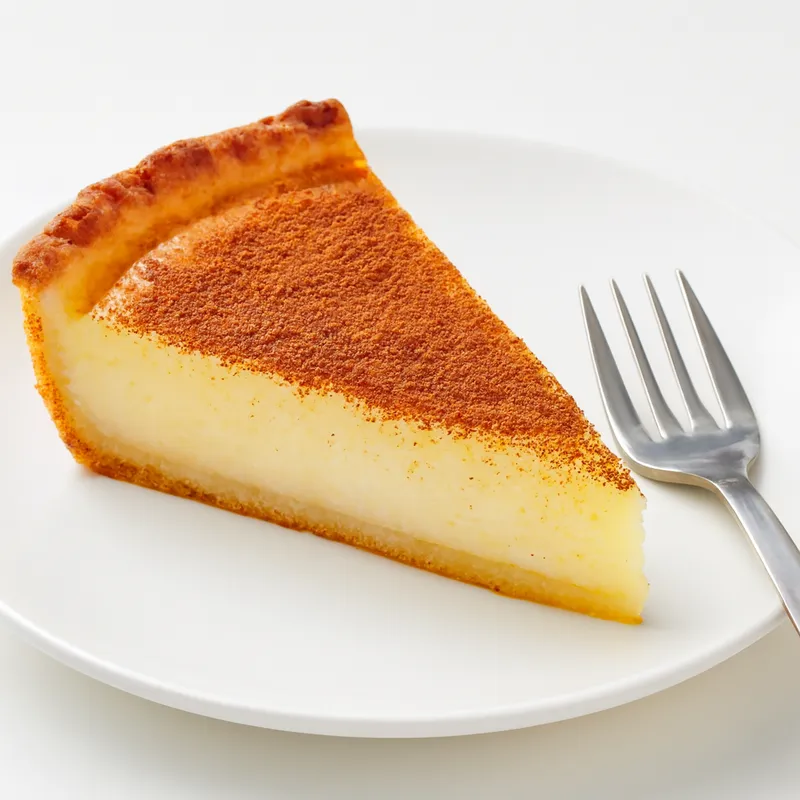
A milk tart: thin shortcrust shell filled with a cooked custard of milk, sugar, eggs, and a little flour or cornflour, then dusted with cinnamon. Lighter than a custard tart — more milk, fewer yolks — so the filling wobbles between set and pourable. Served cold, sliced thin. The cinnamon top is the only spice, and it's heavy.
The flour-thickened custard is the crucial split from a French tarte au lait. French custard sets through eggs alone, requiring careful baking; melktert uses cornflour or wheat flour to thicken the milk on the stovetop, then pours it into a pre-baked shell to set in the fridge. No oven custard step. This is what gives it the wobbly, less rich, more dairy-forward texture — and lets a farm cook with no thermometer make it reliably.
Variations
Tannie Maria's tutorial-book version is the Afrikaner home benchmark; condensed-milk shortcut versions in many township home kitchens; baked melktert (no pre-cooking the custard); melkkos is the cousin without a crust, eaten as porridge.
On the Palate
Where Melktert sits in the South African flavor cloud
Ingredients


How it's made
5 steps · 50 min
- 115 min
Preheat the oven to 180°C (350°F). Roll out the pastry and line a tart tin, trimming any excess. Prick the base with a fork and blind bake until golden, about 15 minutes.
Watch outEnsure the pastry is golden and firm to the touch before removing the baking weights to prevent a soggy bottom.
- 25 min
In a saucepan, gently heat milk with a cinnamon stick until just simmering. Remove from heat and let it infuse for 5 minutes, then discard the cinnamon stick.
- 35 min
In a separate bowl, whisk together sugar, flour, and eggs until smooth. Gradually add the warm milk, whisking continuously to prevent curdling.
Watch outWhisk continuously while adding the milk to avoid curdling the eggs.
- 410 min
Return the mixture to the saucepan and cook over low heat, stirring constantly until thickened. Pour the custard into the baked pastry shell.
Watch outStir constantly to prevent the custard from sticking to the bottom of the pan and burning.
- 515 min
Sprinkle cinnamon over the surface of the tart and bake for an additional 15 minutes until set. Let cool before serving.
Watch outCheck for doneness; the tart should be set but still slightly jiggly in the center.
Archive tool suggestions — not reviewed
These legacy suggestions have not been evidence-reviewed and are not presented as required tools.

Hand-held wire loop tool for beating eggs, whipping cream, emulsifying dressings, and incorporating air into batters. Balloon whisks (large round head) for whipping cream and meringues; French whisks (narrow tear-drop) for sauces in pots; flat whisks (gravy) for pan sauces. Stainless steel is universal; silicone-coated for non-stick pans.

Round metal pot, 14-26 cm diameter, with vertical walls and a long handle, designed for sauces, soups, oatmeal, rice, boiled vegetables. The vertical walls minimize evaporation (vs. a sauté pan). Sizes: 1 qt for melting butter, 2-3 qt for sauces, 4 qt for soups. Stainless-steel-clad aluminum or copper is best for conduction; cast-iron is too thick for delicate sauces.