In Suzhou, these are never called buns—they are 'fried mantou.' The hallmark: a crackling golden base, a thin semi-fermented wrapper dusted with sesame seeds and scallion green, and a pork filling laced with dissolved pork-skin gelatin. One bite and scorching broth rushes out—concise, fierce, and unmistakably Suzhou. The deaf cook Yu Eryuan's Yaba Shengjian shop has defined this style for decades.




Suzhou's pan-fried buns trace to the city's early 20th-century teahouses; Wu Yuan Tea House, opened in 1911, was among the first to serve them as a tea-side snack. They reached Shanghai and Zhejiang by the 1920s. Suzhou retains the 'mixed-water' (混水) style—pork-skin gelatin folded into the filling, semi-fermented dough—while Shanghai's dominant 'clear-water' (清水) style, popularized by Dahu Chun (est. 1932), uses fully leavened dough with no gelatin. The deaf cook Yu Eryuan's Yaba Shengjian shop became the emblem of Suzhou's painstaking fire control.
The crisp base shatters; a surge of scalding pork broth meets sesame and scallion aromas—the definitive Suzhou breakfast bite.
The soup inside begins as a solid: pork skin simmered above 80 °C hydrolyzes its collagen into soluble gelatin; cooled, it sets into a firm jelly diced and folded into the raw filling. When the bun heats during cooking, the gelatin reliquefies at approximately 60 °C and pools as broth inside the sealed wrapper—the signature 'soup burst' (爆汁). The semi-fermented dough (紧酵, minimal yeast) builds a tighter gluten network than fully leavened dough: the base withstands 180 °C dry frying to crisp without cracking, while the steam-moistened top stays supple and intact.
Variations
A vegetarian version substitutes winter bamboo shoots and shepherd's purse for pork and omits the gelatin. Autumn editions stir crab roe and crab meat into the filling for the premium 'crab shengjian.' Shanghai's rival 'clear-water' style—fully leavened, softer, no gelatin—is a textural world apart and worth trying as a counterpoint.
On the Palate
Where Suzhou Pan-Fried Pork Buns sits in the Chinese flavor cloud
Ingredients
Serves 4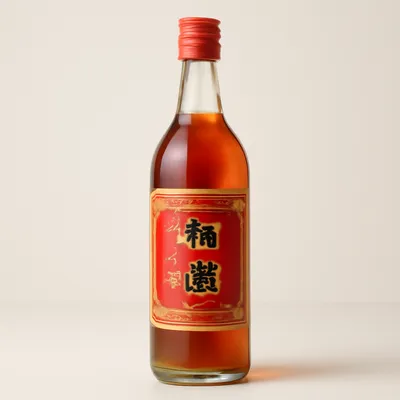



How it's made
7 steps · 45 min active + 1 hour 15 min waiting
- 145 min
Make pork skin gelatin: simmer pork skin strips with ginger and scallion in water for 40 minutes until the liquid thickens; strain, refrigerate until firmly set (at least 2 hours), then dice into small cubes.
Watch outSimmer the pork skin until the liquid turns visibly sticky and thick — that's the collagen melting to gelatin, and only then will it set into the diceable jelly that becomes the soup.
- 210 min
Prepare filling: combine ground pork with the diced pork-skin gelatin, soy sauce, Shaoxing rice wine, sesame oil, minced ginger, salt, and sugar; stir vigorously in one direction until the mixture turns sticky and cohesive; refrigerate 30 minutes.
- 330 min
Make the dough: dissolve a very small amount of yeast in warm water and knead into flour to form a smooth, slightly firm dough (紧酵); cover and rest 25–30 minutes until it rises just slightly—do not wait for a full proof.
- 410 min
Shape the buns: divide dough into 20g pieces; roll each into a circle thicker in the center and thinner at the edge; place a generous tablespoon of filling in the center and pleat tightly to seal.
- 510 min
Proof and rest: place the shaped buns seam-side down in an oiled flat-bottomed pan; let rest 10 minutes at room temperature.
- 612 min
Pan-fry and steam: heat oil over medium-high; once hot, add enough water to come one-third up the sides of the buns, cover immediately, and steam over medium heat for 8–10 minutes until water evaporates completely.
Watch outAdd water a third up the buns, cover at once, and steam till it's fully gone — lift the lid too early and the tops stay pasty and raw.
- 73 min
Remove the lid, scatter sesame seeds and scallion rings over the buns, and fry uncovered for 1 further minute until bases are deeply golden and crackling; serve immediately, base side up.
Watch outFry the last minute until the bases go deep gold and crackle audibly — that crisp shell is what holds the soup burst inside when you bite.
Archive tool suggestions — not reviewed
These legacy suggestions have not been evidence-reviewed and are not presented as required tools.


