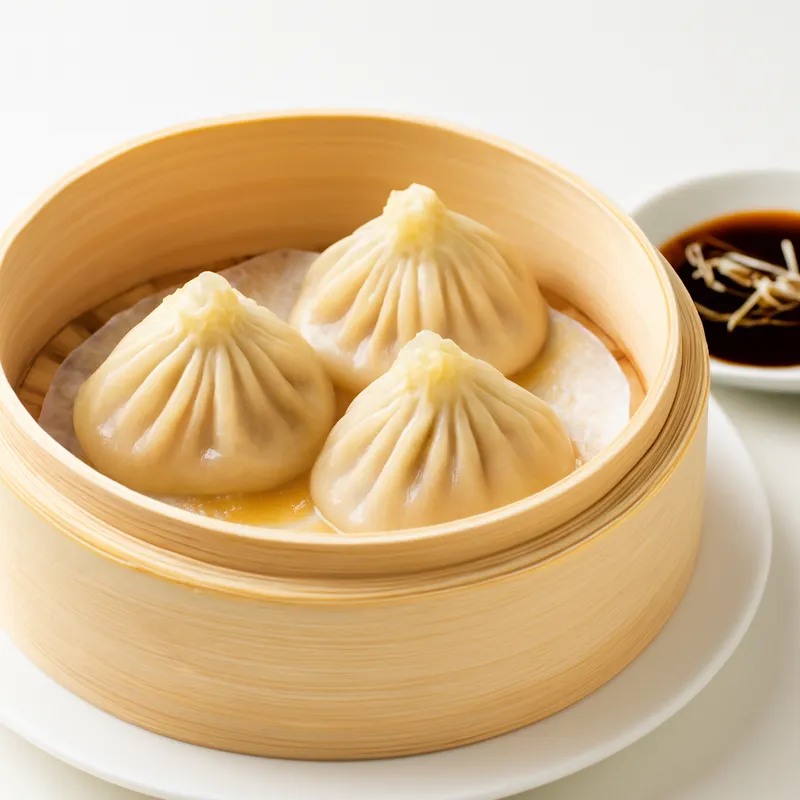
Hand-pinched translucent lamb dumplings from the Gannan Tibetan plateau — small as walnuts, spiral-topped, steamed until the pale skin reveals agate-red meat and jade-green herbs beneath. Tradition demands you sip the pooled broth from the top before biting in, or the rich lamb juice will splash and leave you in an embarrassing state.



Gannan's Tibetan communities have made these buns as a hospitality dish on the high plateau for generations. The earliest versions reportedly used qingke (highland barley) flour as the wrapper with yak or lamb filling; today white wheat flour has largely replaced barley flour, though the hand-pinching technique and lamb-fat filling remain unchanged. No written date of origin survives — the dish is embedded in the oral tradition of Gannan Tibetan hospitality and recorded only in regional culinary surveys as a representative Gannan ethnic specialty.
The thin skin gives way to a burst of savory lamb broth — rich with fat and Sichuan pepper — followed by tender, lightly gamey meat and the fresh cut of scallion. The gelatin in the lamb fat pools at the base, so the last sip is the richest.
The dough is made with hot-water scalding (烫面 technique), which partially gelatinizes the wheat starch before shaping: scalded dough is more extensible and less elastic than cold-water dough, allowing paper-thin hand-pinching without tearing, and turning translucent after steaming when gelatinization completes. Inside, lamb fat and added broth melt during steaming and pool at the base of the bun — hence the ritual first sip. Sichuan pepper water disperses fat-soluble hydroxy-alpha-sanshool uniformly through the filling before cooking, ensuring an even numbing tingle with each bite.
Variations
Classic lamb-and-fat filling; beef and scallion variant using yak-style seasoning common in pastoral areas; a vegetarian filling of potato and wild mushroom for Buddhist feast days; in some families a touch of hand-pounded wild garlic (熊葱) is added in spring when it grows on the grassland margins.
On the Palate
Where Gannan Tibetan Steamed Buns sits in the Chinese flavor cloud
Ingredients
Serves 4



How it's made
7 steps · 40 min
- 110 min
Prepare the filling: finely mince 300 g lamb shoulder, combine with 50 g diced lamb fat, 2 sliced scallions, 1 tsp soy sauce, 1/2 tsp salt, and 2 tbsp Sichuan-pepper water (steep 1 tsp peppercorns in 2 tbsp just-boiled water for 5 minutes, then strain). Stir in one direction until sticky.
- 28 min
Make the scalded dough: place 250 g all-purpose flour in a bowl. Pour 130 ml just-boiled water in a thin stream, stirring continuously with chopsticks. When cool enough to handle, knead into a smooth, pliable dough. Cover and rest for 20 minutes.
Watch outPour the just-boiled water in a thin stream while stirring — scalding the flour is what makes the dough stretch paper-thin without tearing.
- 38 min
Hand-pinch the wrappers: divide dough into walnut-sized pieces. Using fingers only — no rolling pin — press and rotate each piece into a thin round about 8 cm wide, thicker at center, thinner at edges.
- 47 min
Fill and pleat: place a heaped teaspoon of filling at the center, then gather and fold the edges upward into a tight spiral top seal. Each bun should be uniformly walnut-sized with a neat pleated crown.
- 52 min
Arrange in steamer: line the steamer basket with parchment or lightly oiled cloth. Place buns 2 cm apart. Bring the water in the steamer pot to a rolling boil before loading the basket.
- 618 min
Steam over high heat for 16–18 minutes until the skins turn translucent and the pleated tops feel set. Do not lift the lid during steaming.
Watch outDon't lift the lid mid-steam — one blast of cold air and the thin skins seize and go tough instead of turning translucent.
- 72 min
Rest 1 minute off heat, then serve immediately. Provide small dipping bowls of garlic paste, aged vinegar, soy sauce, and chili oil. Remind guests to sip the top first before biting in.
Archive tool suggestions — not reviewed
These legacy suggestions have not been evidence-reviewed and are not presented as required tools.