Harbin's adaptation of Russian borscht — a deep-garnet beef-and-beet soup carried east after 1917 by White Russian refugees and slowly remade into a northeastern Chinese household staple. Local cooks added炝锅 (blooming aromatics in a hot wok before adding liquid), soy sauce for savory depth, and swapped the bread accompaniment for steamed rice, producing a soup redder and less sour than the original, yet unmistakably rooted in the Sino-Russian culture that defines Harbin.





Borscht reached Harbin after the 1917 Russian Revolution, when tens of thousands of White Russian émigrés settled along the Chinese Eastern Railway corridor and turned the city into the most cosmopolitan settlement in East Asia. Heilongjiang's climate closely mirrored Russia's, and red beets grew readily in its black-soil farmland, making faithful recreation of the original possible — unlike Shanghai, where beet-scarce cooks had to substitute tomato paste and cabbage. Over decades, local Chinese kitchens adapted the recipe: they炝锅 to build a savory aromatic base, added soy sauce, reduced the sour-cream element in favor of cleaner broth, and served it over rice. The dish was renamed 苏伯汤 — a phonetic rendering of the Russian word for soup (суп) — a linguistic relic of the city's multilingual street life that stuck long after the Russian community had dispersed.
The first sip carries an earthy sweetness from the beets, then a round beef-and-tomato umami floods in, finished by a quiet acidity — a thread of rice vinegar added at the end — that brightens the whole bowl. The broth is thick enough to coat the spoon without being heavy. Potato cubes have absorbed the beet pigment and turned deep magenta. A faint warmth from star anise and black pepper lingers last.
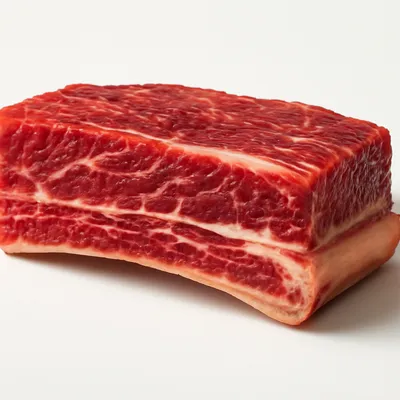
Beet's vivid red comes from betacyanins (principally betanin), a nitrogen-bearing betalain pigment stable in the mildly acidic environment of a tomato-enriched broth. At cooking temperatures below 90°C, betanin degrades slowly; prolonged vigorous boiling destroys it and turns the broth brown — which is why a gentle simmer is essential throughout. Collagen from beef short rib dissolves slowly into gelatin during the 90-minute braise at around 85°C, creating the characteristic body that coats the palate; bone-in cuts release substantially more gelatin than boneless. Tomatoes contribute both organic acids (citric, malic) that heighten flavor perception and free glutamate that deepens savory character. The炝锅 step — frying onion and ginger in hot oil until the Maillard reaction generates melanoidins — transfers aromatic and umami-active compounds into the broth, darkening it and adding a layer of flavor above the raw-vegetable baseline.
Variations
A lighter weeknight version substitutes chicken for beef, reducing cooking time to 40 minutes. Some families omit tomatoes entirely, relying on pure beet sweetness offset by vinegar at the table. The Binjiang Guanshan restaurant style (滨江官膳) follows Russian proportions more closely — higher beet ratio, stronger sourness, served with a dollop of sour cream — to replicate the original flavor for Russian guests.
On the Palate
Where Harbin Borscht (Subo Soup) sits in the Chinese flavor cloud
Ingredients
Serves 4



How it's made
7 steps · 20 min
- 18 min
Dice beef short rib into 3 cm cubes; place in a pot of cold water, bring to a boil, blanch 5 minutes to remove impurities; drain and rinse clean.
- 212 min
Peel and cut beets into 2 cm dice; dice potatoes and carrots similarly; coarsely chop cabbage; slice onion into half-moons and mince ginger.
- 35 min
Heat 2 tbsp oil in a heavy pot over medium-high heat; stir-fry onion and ginger until golden and fragrant, about 3 minutes.
- 450 min
Add blanched beef and pour in 2 liters of water; bring to a boil, skim foam carefully, then reduce to the gentlest simmer and cook 45 minutes.
Watch outSkim the foam then drop to the gentlest simmer — a hard boil above 90 degrees browns the beet's red pigment and dulls the broth.
- 530 min
Add beets, carrots, and diced fresh tomatoes; continue simmering 30 minutes until beets are fully tender and the broth has turned deep garnet.
Watch outSimmer the beets thirty minutes until the broth turns deep garnet — the color deepening tells you the pigment has released.
- 620 min
Add potatoes and cabbage; season with soy sauce, salt, and black pepper; simmer a further 20 minutes until potatoes are soft.
- 73 min
Taste, add a small splash of rice vinegar to lift the flavor; ladle into deep bowls and serve alongside steamed white rice.


