A tiered ceremonial tea ritual of the Bai people of Dali, Yunnan, progressing through three cups: first a bitter roasted thunder tea, then a sweet walnut-sesame-milk-fan brew, and finally a spiced aftertaste cup of pepper, ginger, and honey — each course a metaphor for life's journey from hardship to sweetness to reflection.


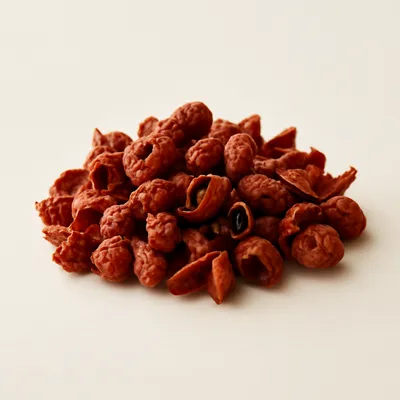

The Bai Three-Course Tea ceremony traces to the Southern Zhao kingdom (8th–9th century) as a court ritual for welcoming honored guests and transmitting teachings to disciples, spreading through Buddhist monasteries in the Dali region before taking root among common Bai households by the Song-Yuan period, flourishing further through the Ming Dynasty. The ceremonial progression — bitter, sweet, aftertaste — is said to encode a teaching on perseverance: one must first endure hardship before earning sweetness, and only after both can one reflect with wisdom. In 2014, the practice was formally recognized as a national intangible cultural heritage (fourth batch), affirming its place as a living cultural institution of the Bai people.
The ceremony opens with a sharp, almost austere bitterness from heavily roasted dry-leaf tea, then pivots to a rounded sweetness laced with creamy milk fan and walnut richness, before the final cup delivers a tingly warmth of pepper and honey that lingers long after the cup is set down.
The first cup's bitterness is concentrated by dry-roasting tea leaves in a superheated clay pot, which drives off volatile aromatics while intensifying catechins and gallic-acid-derived tannins. The dramatic crackling thunder sound occurs as cold water contacts the superheated ceramic, causing flash steam expansion. The second cup uses fat from roasted milk fan and walnut oil to coat taste receptor cells, dulling residual bitter signals and amplifying sweetness perception. The third cup's Sichuan pepper activates the mouth's vibration-sensitive mechanoreceptors at roughly fifty oscillations per second, producing the characteristic numbing sensation; ginger's gingerols add thermogenic warmth through heat-sensing channels; honey's fructose releases slowly under residual cup temperature.
Variations
Some households substitute aged Pu-erh for the first roasted cup, adding a fermented earthiness. Festival versions of the third cup may include pine pollen or dried osmanthus blossoms. Since the 1980s, tourist venues in Dali Ancient Town have formalized the ceremony with Bai folk music and traditional dress performances, pairing each cup with explanatory verses.
On the Palate
Where Bai Three-Course Tea sits in the Chinese flavor cloud
Ingredients
Serves 4


How it's made
8 steps · 10 min
- 15 min
Place a small clay pot (or thick-walled ceramic vessel) on a charcoal brazier over medium heat; heat the dry pot for 5 minutes until a drop of water flicked inside evaporates immediately.
- 28 min
Add 10g Yunnan mountain tea leaves to the dry heated pot; shake and rotate the pot continuously for 6–8 minutes until leaves turn amber and release a toasted, lightly smoky fragrance — this is the critical step that determines the bitterness depth.
Watch outShake the dry pot and roast the leaves six to eight minutes until amber and toasty-fragrant — this step alone sets how bitter the first cup runs, so don't rush it.
- 33 min
Carefully pour 100ml boiling water into the roasted-leaf pot — the dramatic crackling thunder sound (雷响茶) signals the first brew is ready; steep 1 minute for an orange-yellow, bitter concentrate.
Watch outPour the boiling water in the instant the leaves are roasted — the loud thunder-crack of water hitting the superheated pot is the cue the first brew is ready.
- 42 min
Pour the first brew into small ceramic cups to 80% capacity; present with both hands raised to eye level (举案齐眉), saying '请喝茶'; guests receive with both hands and taste the austere roasted bitterness fully before proceeding.
- 55 min
For the second course: place walnut pieces, toasted sesame seeds, shredded roasted milk fan, and red sugar in individual bowls; pour 150ml freshly brewed hot tea over each and stir; serve warm as sweet tea (甜茶).
- 63 min
For the third course: add a pinch of Sichuan pepper, 2 thin ginger slices, a pinch of cinnamon, and one teaspoon honey to each cup; pour 120ml very hot tea over and stir until honey fully dissolves; serve immediately as aftertaste tea (回味茶).
- 75 min
Present all three courses in succession over 20–30 minutes; accompany with roasted peanuts, Bai puffed rice, or other light snacks between courses.
- 85 min
For formal ceremonies, the host circles the room with the tea tray, offering each guest individually; Bai folk music may accompany the service, and each cup is presented with a spoken blessing.
Archive tool suggestions — not reviewed
These legacy suggestions have not been evidence-reviewed and are not presented as required tools.


