Pressed in one decisive squeeze through a wooden 饸饹床, these firm buckwheat noodles have fed the Loess Plateau for over a thousand years. In Qingyang, they mark every life milestone — births, weddings, funerals, harvests — and the saying goes: a person's life amounts to three bowls of press noodles.





Press-noodle technology — dough forced through a perforated board — is recorded in northern China as 'he lou' (河漏): the Yuan dynasty agronomist Wang Zhen's Book of Agriculture (Nongshu, c. 1313) notes that buckwheat was 'milled into flour and made into soup noodles called he lou,' and the Ming dynasty Compendium of Materia Medica repeats the same description. Qingyang sits on the Dongzhi Plateau, one of the cradles of Chinese dryland farming, where the Zhou ancestor Gong Liu is said to have 'taught the people to sow and reap'; here the dish was first made from wild buckwheat and later from wheat, with the wooden press bed remaining its defining tool. Built with mortise-and-tenon joinery, the press bed was by local custom passed from mother to daughter as part of a bride's dowry, a kitchen heirloom across generations — a folk saying holds that 'a three-inch tenon and five-inch mortise keep the press bed sound for a hundred years.' In 2024 the craft of Qingyang heihe noodles entered Gansu province's intangible cultural heritage list.
Dense and springy — these noodles push back with satisfying resistance. Buckwheat's earthy, faintly bitter backbone cuts through the fatty lamb broth, and the chew is long and grounding in a way hand-rolled noodles rarely match. The broth carries wood ear and daylily that soften into silky ribbons, balancing the noodle's density.
Buckwheat contains rutin (a quercetin glycoside) concentrated in the husk, contributing the characteristic earthy-bitter note and a pale grey-green hue. Extrusion through the press bed's die holes subjects the dough to high shear stress, aligning starch granules longitudinally and stretching the gluten network in the direction of flow — producing a denser, more resilient strand than rolling achieves. The 'three-smooth' principle — hands, bowl and dough all lump-free — ensures uniform hydration for consistent extrusion pressure and even strand diameter.
Variations
Traditionally pure buckwheat, modern variants use millet, oat, sorghum, corn or elm bark flour — each shifting the flavor register. Spinach juice turns the noodles jade green; pumpkin puree produces a golden version. The broth shifts seasonally: clear lamb stock in winter, pork-and-vinegar broth in summer for brightness.
On the Palate
Where Qingyang Buckwheat Press Noodles sits in the Chinese flavor cloud
Ingredients
Serves 4
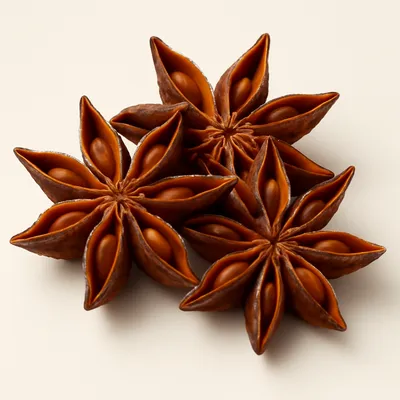
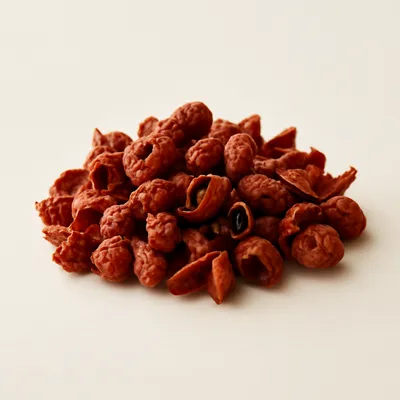

How it's made
7 steps · 40 min
- 130 min
Mix buckwheat flour and all-purpose flour in a 7:3 ratio; add warm water gradually while kneading, following the 'three smooth' principle until the dough is stiff, smooth and lump-free across hands, bowl and surface. Cover and rest 20–30 minutes.
Watch outKnead until hands, bowl and dough are all lump-free — uneven hydration makes the press stick and the noodles come out ragged.
- 242 min
Simmer lamb pieces in water with ginger, star anise, fennel seeds, Sichuan pepper and cinnamon for 40 minutes; skim foam thoroughly; strain broth into a clean pot and return the lamb pieces.
- 315 min
Rehydrate dried daylily flowers and wood ear mushrooms; add to the lamb broth along with potato chunks; simmer 15 minutes until vegetables are just tender.
- 43 min
Set the 饸饹床 press over the pot of vigorously boiling broth; load a portion of dough and press firmly and steadily in one stroke, extruding noodles directly into the boiling broth below.
- 53 min
Boil the noodles in the broth for 2–3 minutes until cooked through with a firm bite; cut a strand to verify no white core remains.
Watch outCut a strand to check no white core remains — buckwheat noodles look done outside before the center is through.
- 62 min
Swirl in beaten eggs to form egg ribbons; season the broth with salt and chili oil to taste.
- 73 min
Ladle noodles and broth into bowls; arrange lamb pieces and vegetables; finish with cilantro and a drizzle of chili oil.
Archive tool suggestions — not reviewed
These legacy suggestions have not been evidence-reviewed and are not presented as required tools.


