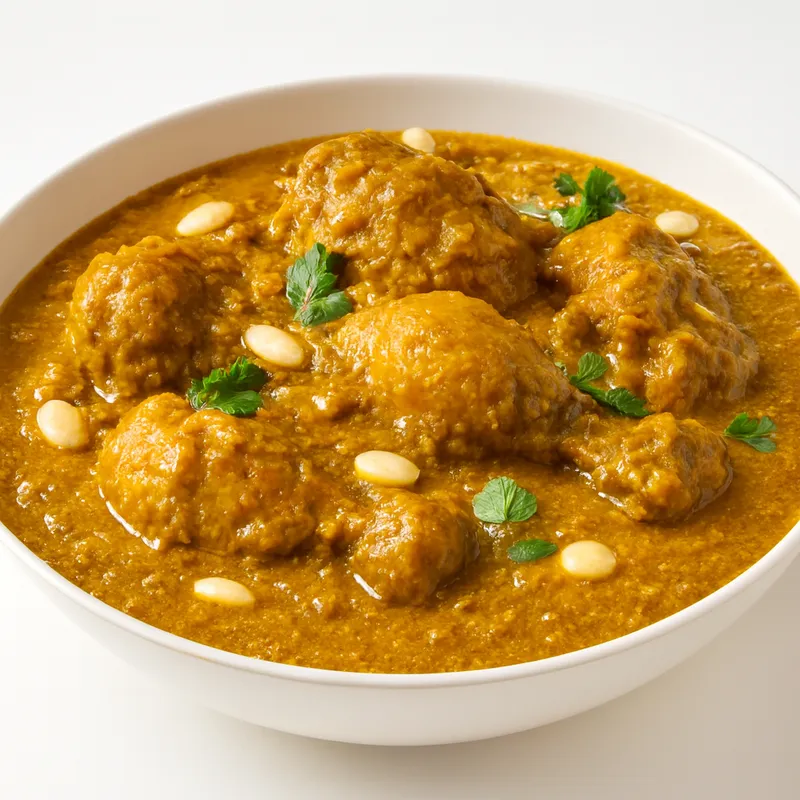
Chital macher muitha are Bengal's most labour-intensive fish dish: dumplings hand-shaped from the flesh of the chital, or clown knife fish, scraped clean off its dense cage of fine bones, worked with boiled potato, mustard oil and spices into a sticky paste, then poached, browned, and simmered in a red onion-tomato gravy. The name comes from the Bengali word for fist, because the mince is squeezed into shape in the palm. Chital flesh binds and turns springy on its own, without egg or flour, so no other fish reproduces the result, and the dish is kept for weddings and festive tables.




The chital, known in English as the clown knife fish or Indian featherback and classified as Chitala chitala, is among the most prized freshwater fish of the Gangetic plains of Bengal. Its flesh is firm and sweet but laced with a dense lattice of fine intramuscular bones, which historically forced Bengali cooks to devise preparations that separated flesh from bone entirely. Two classic dishes emerged from a single fish: the thick belly and upper body were cut into steaks for a kalia, while the tail and back, too bony to eat off the bone, were scraped down to a paste and shaped into muitha. The name derives from the Bengali word for fist, describing how the seasoned mince is squeezed into shape in the cook's palm. Muitha is remembered across Bengali households as a dish of patient labour, prepared chiefly for weddings and religious feasts, because the deboning alone can occupy the better part of an afternoon.
Each dumpling has a distinct springy resilience: the tooth meets a gentle bounce before the flesh gives way, closer to a firm fish cake than to flaked fish. The exterior, browned before simmering, carries a faint fried savour, while the interior stays moist and finely textured from the mashed potato. The gravy clings in a warm, tangy, mustard-oil-scented film. There is no muddiness and no stray bone, only clean, sweet fish.
The dish is a domestic expression of surimi science. Chital flesh is exceptionally rich in myofibrillar proteins, and when the scraped mince is worked with salt, the salt solubilises its myosin and actin into a tacky sol of actomyosin, the source of the paste's natural cohesion, achieved without egg or flour. Kneading develops this sticky network; a little mashed boiled potato is folded in, its gelatinised starch granules tenderising the matrix so the dumpling does not turn dense. When the shaped muitha is slid into simmering water, the interior climbs past about 50 ℃ and the solubilised myosin heavy chains unfold and cross-link into a continuous three-dimensional elastic gel, exactly as in a fish cake, which is why chital sets springy where flakier fish crumble. The cook lifts the dumplings the moment they float; prolonged boiling pushes the protein past its optimal set, expelling water and turning the gel rubbery. A brief shallow-fry then dehydrates and Maillard-browns the surface into a resilient skin that holds shape through the final simmer in gravy.
Variations
Some cooks poach the seasoned paste as a single thick slab, then cut it into diamonds before frying, which is faster than rolling individual dumplings. Ghoti kitchens of West Bengal often keep the gravy lighter and sweeter, while Bangal styles from the east lean on more mustard oil and green chilli. A velvety Mughlai-inflected version enriches the gravy with cashew and poppy-seed paste and a swirl of cream, and pairs the dumplings with a saffron pulao. Where chital is unavailable, cooks substitute pabda or bhetki, but the signature spring is lost.
On the Palate
Where Chital Macher Muitha sits in the Indian flavor cloud
Ingredients
Serves 4

How it's made
8 steps · 40 min
- 125 min
Ask the fishmonger for a cleaned chital, or scrape the flesh yourself: lay each piece skin-side down and, with the bowl of a metal spoon drawn firmly from tail to head along the grain, scrape the flesh away from its lattice of bones. Spread the mince on a plate and run your fingers through it repeatedly to remove every fine bone.
- 210 min
Add mashed boiled potato, finely chopped onion, ginger-garlic paste, chopped green chilli, turmeric, a little sugar and salt to the mince. Mash and knead by hand for several minutes until the mixture turns sticky and cohesive; if it is slack, work in a spoon of flour.
Watch outKnead the fish mince until it turns sticky and cohesive — that tackiness is the myosin binding; slack paste falls apart in the water.
- 38 min
Bring a wide pan of water to a gentle boil. Oil your palms, take a small amount of paste, and squeeze it into a smooth 4-5 cm dumpling or a flat disc, sliding each gently into the water.
- 45 min
Poach until the dumplings float, about 2-3 minutes, then lift them out immediately with a slotted spoon; do not let them boil on, or they will toughen. Cool slightly (slab versions are cut into diamonds now).
Watch outLift the dumplings the instant they float, about 2-3 minutes — let them boil on and they toughen and turn rubbery.
- 58 min
Heat mustard oil until it just smokes, then shallow-fry the dumplings in batches until golden-brown on all sides. Set aside.
- 610 min
In the same oil, temper bay leaf, dried red chilli and whole cumin; add sliced onion and fry to golden, then ginger-garlic paste and chopped tomato, cooking down until the oil separates.
- 75 min
Stir in turmeric, cumin, coriander and red chilli powders with a splash of water; braise briefly, then add enough hot water to make a gravy and season with salt and sugar.
- 86 min
Slip the fried muitha into the simmering gravy, cover, and cook on low for 4-5 minutes until the gravy thickens and clings. Finish with a spoon of ghee and a pinch of garam masala; rest a few minutes and serve hot with rice or pulao.
Watch outSlip the fried dumplings into the gravy only at the end and simmer briefly until it clings — long stewing turns them dense and dry.