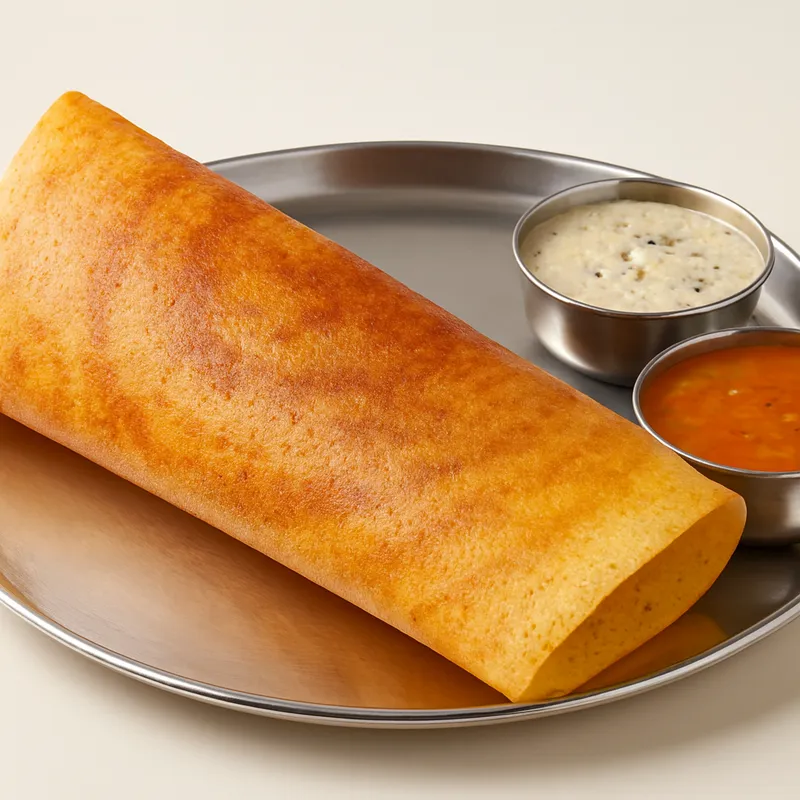
A fiery, coconut-rich chicken curry from Malvan on the Konkan coast of Maharashtra, built on a fresh-ground masala of 15–16 whole spices and dual-form coconut — freshly grated and dry-roasted — with kokum (Garcinia indica) as the souring agent. Traditionally paired with vade, the fried jowar-and-rice flatbreads of the region.



Malvani cuisine took shape along the Sindhudurg and Ratnagiri coastline of Maharashtra no later than the 16th century, shaped by maritime communities — Koli fishermen, Konkanastha Brahmins, and Chandraseniya Kayastha Prabhu peoples — who traded across the Arabian Sea. The regional spice vocabulary shifted permanently after 1510, when the Portuguese colonisation of adjacent Goa introduced the dried red chilli as a culinary staple across the Konkan belt; Malvani cooks wove it into an existing base of black pepper, cumin, coriander, clove, and cinnamon. The Malvani masala — 15 to 16 dry spices coarsely ground — crystallised as the cuisine's defining blend. Kombdi Vade, the chicken curry paired with fried jowar bread, became the most emblematic preparation, served at weddings and seasonal festivals throughout coastal Sindhudurg.
A deep coconut warmth arrives first, then the layered heat of the Malvani masala builds slowly; a fruity, faintly floral sourness from kokum cuts through the richness, and the chicken — cooked on the bone — yields with the gentle pull of a fork.
Dry-roasting the grated coconut generates Maillard-browned compounds that deepen the base paste with nutty, caramelised notes; fresh grated coconut contributes emulsifying lipids and globulin proteins that bind the gravy into a silky suspension rather than a watery broth. Kokum's hydroxycitric acid (approximately 23% HCA by dry weight, pH 1.5–2.0) brightens the sauce with tartness and exerts a bacteriostatic effect. Braising chicken on the bone at a gentle simmer of 90–95°C gradually dissolves joint collagen into gelatin, thickening the gravy naturally and enriching its mouthfeel. Blooming whole spices in hot oil at the start releases fat-soluble volatiles — terpenoids, cinnamaldehyde, eugenol — that water-based cooking alone cannot extract.
Variations
Mutton Malvani: same masala base with bone-in goat meat, requiring 40–50 additional minutes of braising. Seafood Malvani: king fish or mackerel replace chicken; the curry is thinner and finished with extra kokum. Dry Malvani chicken (sukka): the gravy is fully reduced until the masala coats each piece with no liquid remaining, served as a snack or bar accompaniment. Vegetarian: raw banana and tender jackfruit replicate the meaty texture.
On the Palate
Where Malvani Chicken Curry sits in the Indian flavor cloud
Ingredients
Serves 4

How it's made
8 steps · 30 min
- 15 min
Dry-roast grated coconut in a pan over medium heat until evenly golden brown; remove and set aside.
Watch outDry-roast the coconut to an even golden-brown — that toasted color is the nutty depth of Malvani masala; stop while golden, since a shade darker turns it bitter.
- 23 min
In the same pan, dry-roast Malvani masala spices — coriander seeds, cumin, black peppercorns, cloves, cinnamon, dried red chillies, and cardamom — for 2 minutes until fragrant.
- 35 min
Grind the toasted coconut and spices with garlic and ginger into a smooth, thick paste with a little water.
- 412 min
Heat oil in a heavy pot and fry sliced onions until deep brown; add the coconut-spice paste and sauté 8–10 minutes until oil separates around the edges.
Watch outSauté the paste until the oil separates around the edges — that ring of oil is the cue the masala is cooked through before the chicken goes in.
- 55 min
Add bone-in chicken pieces and coat well in the masala; cook on high heat 5 minutes to sear.
- 63 min
Pour in 300 ml water, add kokum pieces and salt; bring to a boil.
- 733 min
Reduce to a low simmer, cover, and cook 30–35 minutes until the chicken is cooked through and the gravy thickens.
- 83 min
Adjust salt and sourness; garnish with fresh coriander and serve with vade flatbread or steamed rice.