"Tadpole noodles" of Jeongseon — a cooked cornmeal-and-water dough dripped through a holed ladle into cold water, forming short tadpole-shaped noodlets, dressed cold with a seasoned-soy sauce of soy, gochugaru, green chili, garlic, scallion and sesame, often topped with young-radish kimchi (yeolmu kimchi) and shredded gim.
Olchaengi guksu is a Jeongseon County dish from the Joseon-era famine period, when the Taebaek mountain valleys could grow corn but not rice. "Olchaengi" means tadpole — the noodle shape produced by the perforated-ladle technique. Cornmeal entered Korean staples after Joseon's 17th-18th century introductions from Qing China, and Gangwon's marginal soil made corn the dominant grain in Jeongseon. The dish was famine fare for centuries; it was rebranded as a regional specialty around the 1980s when Jeongseon's traditional Five-Day Market drew domestic tourists, and it's now a fixture there.
A Jeongseon County famine dish from Gangwon's Taebaek valleys, where corn grew where rice couldn't. Olchaengi means tadpole — the noodle shape produced by dripping cooked cornmeal through a perforated ladle into ice water. Rebranded as regional specialty around the 1980s when Jeongseon's Five-Day Market drew domestic tourists; the dough has to hit slow-falling-polenta viscosity or the drips dissolve.
Pale-yellow comma-shaped noodlets, soft and slippery — slip off chopsticks, which is why the local convention is a spoon. Texture between soft polenta and silken tofu; the corn taste is gentle and slightly sweet, not popcorn-loud. Cold soy-anchovy broth catches in the curve of each tadpole; gochugaru reds the surface. Aged kimchi cuts through. Eaten as a hot-day lunch in Jeongseon's market stalls. If the noodlets fall apart in the broth, the dough was undercooked; if they're rubbery, overcooked.
The cooked-cornmeal dough has to hit a precise viscosity — about that of slow-falling polenta. Too thin and the drips dissolve in the cold water; too thick and they don't drip at all. The 18-20 minute cook is what gelatinizes the corn starch enough to set on cold contact. The ice-water bath is non-negotiable: room-temperature water won't shock-set the drops, and they'll merge into a porridge layer at the bottom of the bowl.
Variations
Jeongseon Five-Day Market stalls run the canonical version; Yeongwol-style adds aged kimchi to the broth; Pyeongchang's runs more sesame oil; modern restaurant variants serve it warm in winter rather than cold; Hoengseong subs in millet for some of the cornmeal.
On the Palate
Where Olchaengi Guksu sits in the Korean flavor cloud
Ingredients
Serves 4








How it's made
5 steps · 35 min active + 5 min waiting
- 15 min
Whisk 200g fine cornmeal (oksusu garu, ideally Gangwon mountain-corn) into 800ml cold water in a heavy pot, no lumps. Add ¼ tsp salt.
- 220 min
Set over medium-low heat, stirring constantly with a wooden spoon. Cook 18-20 minutes until the slurry thickens to a glossy, slow-falling porridge — should ribbon off the spoon like loose polenta. This step is non-negotiable: under-cooked dough doesn't form noodlets.
Watch outCook until the mush ribbons off the spoon like loose polenta — thinner and the drips dissolve in the water, thicker and they won't drip at all.
- 38 min
Set up a bowl of iced water under a perforated ladle (olchaengi teul) — a wide ladle with 4-6mm holes. Hot dough goes in the ladle; with a smaller spoon, press it through the holes. Drips fall into ice water and freeze instantly into curved tadpole shapes ~2cm long.
Watch outWater must be ice-cold so each drip shock-sets into a firm little tadpole — in tepid water they merge into porridge at the bottom.
- 45 min
Rest noodlets 5 minutes in cold water to firm, then drain gently — they are fragile. Make broth: 4 tbsp soy sauce, 200ml chilled anchovy-dasima stock, 1 tbsp rice vinegar, 1 tsp sugar, 1 tsp gochugaru, 1 minced scallion, ½ tsp sesame seeds.
Watch outMix the broth ingredients well to ensure the sugar dissolves completely.
- 52 min
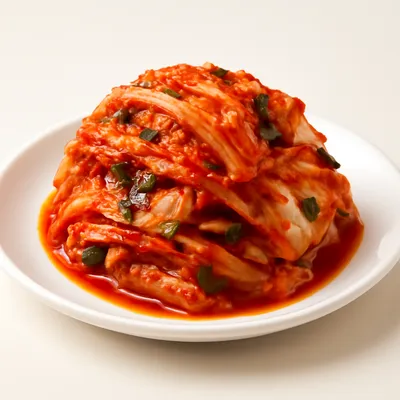
Divide noodlets among 4 bowls. Top with 2 tbsp shredded mature kimchi, half a sliced cucumber, a few strips of toasted gim. Pour broth around the edge — not over the top — to keep the noodlets visible. Eat with a spoon, not chopsticks.
Archive tool suggestions — not reviewed
These legacy suggestions have not been evidence-reviewed and are not presented as required tools.