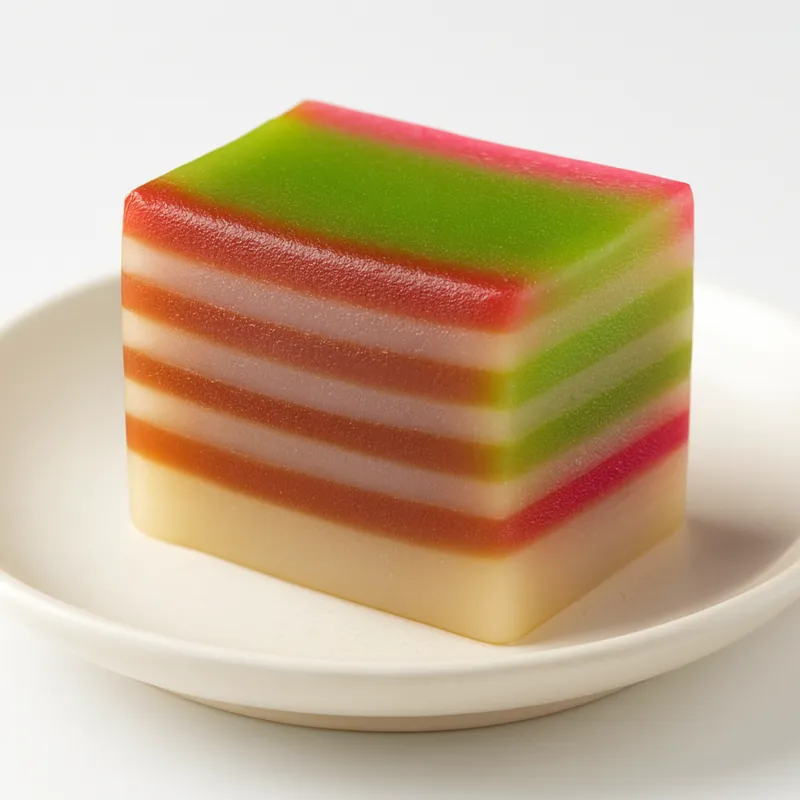
A steamed pudding of alternating green pandan and yellow mung-bean layers bound with tapioca and rice flour; jelly-firm, gently sweet, glossy with coconut — the name means pig-skin cake for its layered look.





Banh da lon is a Mekong Delta sweet, common throughout southern Vietnam since at least the early 20th century. The name (literally pig-skin cake) refers to the visual stratification, not pork — it's vegan. The pandan-mung-bean pairing is ubiquitous in Southeast Asian Buddhist sweets across Vietnam, Cambodia, Thailand, and Malaysia, but the multi-layer steam-build technique is specifically Vietnamese. Sold by the wedge from glass-fronted display cases at southern bus stations, ferry crossings, and pagoda festivals.
Mekong Delta sweet from at least the early 20th century — the name (literally pig-skin cake) refers to the visual stratification, not pork; vegan. Each layer steams 5 minutes — past starch gelatinization at ~70°C but tacky enough that the next layer fuses. Tapioca starch is what makes it springy, not crumbly.
A wedge stands like a striped agate — alternating jade green and pale yellow, each layer 4-5mm thick, surfaces glossy. The bite is bouncy-jellied with a fine pull (tapioca chew, not gummy). Pandan reads grassy-vanilla; mung bean is starchy-sweet and cooler on the tongue. Coconut milk is the through-line. You peel layers with your teeth or fingers — the ritual is half the point. Best at room temperature, never warm.
The layered look depends on each layer setting — but not fully drying — before the next pours on. 5 minutes of steam takes each batter past starch gelatinization (around 70°C for tapioca-rice mix) so it holds its shape, but the surface is still tacky enough that the next layer fuses to it without sliding. Fully cooked underneath, tacky on top — the band you must hit. Tapioca starch is what makes it springy rather than crumbly; using only rice flour gives a powdery cake.
Variations
Soc Trang Khmer households add durian to the yellow layer; Can Tho ferries sell coconut-and-taro stripes; modern Saigon bakeries do nine-layer rainbow versions with butterfly pea and beet for natural blues and reds.
On the Palate
Where Banh Da Lon sits in the Vietnamese flavor cloud
Ingredients
Serves 8
How it's made
6 steps · 40 min active + 1 hour 20 min waiting
- 130 min
Soak 150g split mung beans 2 hours, then steam 25 minutes until soft. Blend with 100ml coconut milk and 80g sugar to a smooth puree.
Watch outEnsure the mung beans are fully softened before blending for a smooth puree.
- 25 min
Mix the mung-bean puree with 200g tapioca starch, 50g rice flour, and 250ml coconut milk. Whisk smooth — the consistency should be like thin pancake batter.
Watch outIf the batter is too thick, it may not steam properly; adjust with a little more coconut milk.
- 36 min
Blend 30g pandan leaves with 200ml water; strain. Mix the pandan extract with 200g tapioca starch, 50g rice flour, 100g sugar, 200ml coconut milk. Whisk smooth — same consistency as the yellow.
Watch outMake sure to strain the pandan extract well to avoid any fibrous bits in the batter.
- 46 min
Oil a 22cm round cake tin. Set up a steamer over rolling boil. Pour 100ml of the green batter in; steam 5 minutes until set and tacky.
Watch outSteam each layer just until it sets firm but the top stays tacky to a fingertip — bone-dry and the next layer slides off instead of fusing.
- 535 min
Pour 100ml yellow batter on top; steam 5 minutes. Continue alternating green-yellow-green-yellow — 6 to 8 layers total. Stir each batter before pouring; it settles fast.
Watch outStir each batter right before you pour — the starch sinks fast, and an unstirred scoop pours thin on top and thick underneath, so the layers come out uneven.
- 68 min
Final layer: steam 8 minutes to set fully. Cool to room temperature 30 minutes — must not be cut hot, layers tear. Refrigerate 30 minutes for clean slicing. Cut into wedges with an oiled knife.
Watch outLet it cool right down before you cut — slice it warm and the soft layers drag and tear; a chilled cake gives clean, separate bands.
Archive tool suggestions — not reviewed
These legacy suggestions have not been evidence-reviewed and are not presented as required tools.