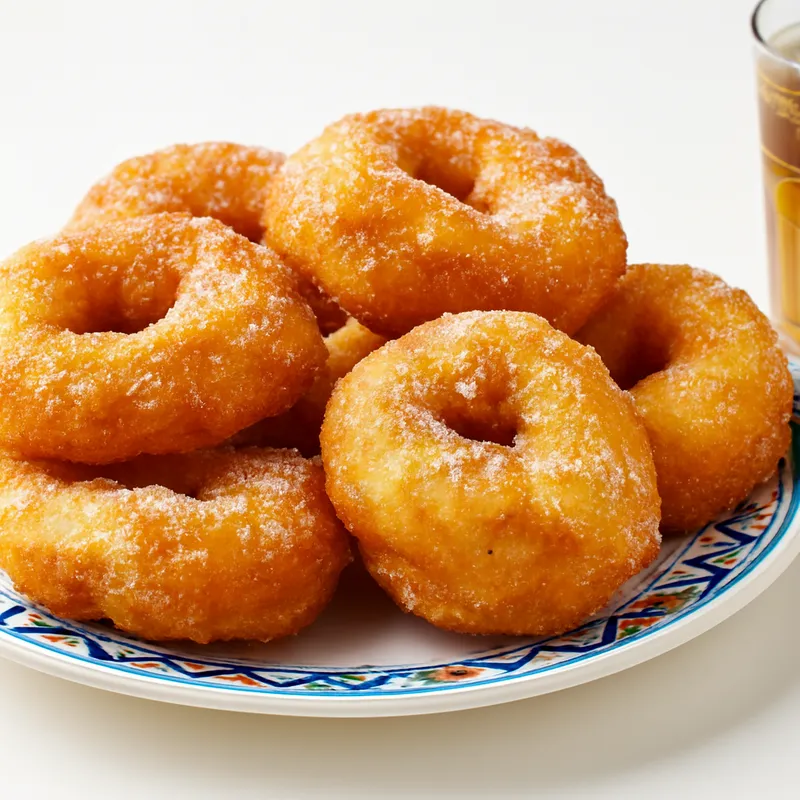
Sesame-coated yeasted dough fried into hollow puffy rounds, eaten plain or split open and stuffed with banh bo (steamed rice cake) — a Saigon morning-market snack of Chinese-Vietnamese lineage.





Banh tieu came into Vietnam through Chinese (Teochew and Cantonese) immigration into Cho Lon, Saigon's Chinatown, in the 19th and 20th centuries — it is essentially a Vietnamese-Chinese yeasted sesame fritter, cousin to the Cantonese sesame ball but worked into local market culture. Today it is a Saigon street-cart morning food, often paired with banh bo (a separate Vietnamese-Chinese steamed rice cake) by stuffing one inside the other — a 1960s-1970s Saigon vendor invention that is now standard.
Saigon street-cart morning food brought into Cho Lon by Teochew and Cantonese immigrants in the 19th-20th centuries — a Vietnamese-Chinese yeasted sesame fritter. The hollow puff is a two-fluid trick: yeast generates many small bubbles in the second proof; 170°C oil sets the surface fast; gentle pressing as it floats coalesces them into one large central bubble.
A sesame-studded golden ball the size of a tennis ball, weightless in the hand. Tear it open and there's nothing inside but a faint membrane — pure puff. The crust is shatter-crisp on contact, then chewy where the yeasted dough has set; sesame is toasted-nutty, and the inside has a clean wheat-yeast sweetness. Compare to a Cantonese xian dui (deep-fried sesame ball): same Chinese-Vietnamese lineage, but xian dui is glutinous-rice with a lotus-paste filling; banh tieu is wheat-yeast and intentionally hollow.
The hollow puff is a steam trick. The yeasted dough is rolled into a thin disc; when you lower it into 170°C oil, the surface sets fast and seals the interior. The moisture trapped inside flashes to steam and expands violently, blowing the now-rigid shell out into a hollow sphere. A thin enough disc in hot enough oil is what lets the steam balloon the whole shell; roll it too thick or fry too cool and it stays a dense bun.
Variations
Cho Lon's Hai Co cart on Tran Hung Dao is the named generations-old reference; Saigon banh tieu kep banh bo (sandwich-stuffed with banh bo steamed cake) is a 1960s-70s vendor invention now standard; Cantonese xian dui is the glutinous-rice cousin with lotus paste inside.
On the Palate
Where Banh Tieu sits in the Vietnamese flavor cloud
Ingredients
Serves 4
How it's made
6 steps · 40 min active + 1 hour 50 min waiting
- 18 min
Bloom 7g instant yeast in 250ml warm water (38°C) with 60g sugar for 5 minutes — a foamy crown forms.
Watch outEnsure the water is not too hot, as it can kill the yeast.
- 2100 min
Mix 400g all-purpose flour, 1/4 tsp salt, 1/2 tsp baking powder, 2 tbsp neutral oil, then add the yeast water. Knead 8 minutes until smooth and slightly tacky. Cover and rise 90 minutes at warm room temperature — should double.
Watch outKnead until the dough is smooth; under-kneaded dough may not rise properly.
- 312 min
Punch down. Divide into 12 pieces of 60g. Roll each into a smooth ball, then press into a 1cm-thick disc 8cm across. Press both sides into a plate of white sesame seeds — they must coat fully, or the dough won't puff cleanly.
Watch outPress both faces firmly into the sesame so they coat completely — bare patches on the dough are where the shell splits instead of ballooning into a hollow puff.
- 420 min
Rest discs covered 20 minutes — second proof. They should look slightly pillowy, not flat.
- 518 min
Heat 5cm of neutral oil in a wok to 170°C. Lower one disc in carefully — it sinks, then within 20 seconds rises to the surface. Press down very gently with the back of a slotted spoon (this is the puff trick): pressing while it floats kicks the trapped CO2 into one large bubble and the disc inflates into a hollow ball. Fry 90 seconds total, flipping once, to deep gold.
Watch outOnce the disc floats, press it under gently with the spoon back and hold — this is the whole trick; the trapped gas balls up and blows the shell hollow. Oil must stay hot enough to sizzle briskly around the edge.
- 65 min
Drain on a rack. Eat warm, whole; or for the Saigon street version, slit open with scissors and stuff a 4cm cube of banh bo (steamed rice cake) inside.