
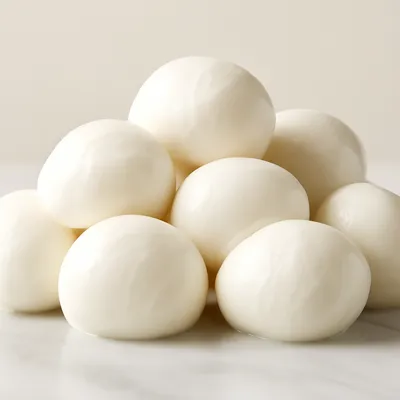
Quebec's gift to global comfort food. Crisp double-fried fries piled in a bowl, scattered with squeaky fresh cheese curds, drowned in hot brown gravy that melts the curds slightly without dissolving them. The squeak of fresh curds against teeth is essential — anything else is impostor poutine.





1957 in rural Quebec — multiple towns claim invention (Warwick, Drummondville, Princeville). The story: a customer asked the cook to throw cheese curds onto his fries, and the cook said 'ça va faire une maudite poutine' (it'll make a damn mess). It went from rural diner to global icon in 60 years.
Fork stabs all three: crisp fry exterior with potato-fluff interior, the squeak of warm-but-not-melted curd, glossy savory beef gravy coating everything. Salt + starch + cheese-squeak + meaty gravy. The textural contrast — crisp + chewy-squeak + saucy — is the entire dish.
Double-frying is essential: low-heat first fry cooks potato interior; high-heat second fry blisters and crisps the surface. Fresh curds (under 24 hours old, at room temp) are stretchy not melty — they squeak against teeth from the casein protein structure. Gravy must be hot enough to soften curd edges but not so hot it dissolves them.
Variations
Poutine Galvaude (with chicken + green peas). Poutine au Smoked Meat (Montreal style, with Schwartz's smoked meat). Italian Poutine (Bolognese sauce instead of gravy). Poutine Foie Gras (Pied de Cochon Au Pied de Cochon's luxury version). Lobster Poutine (Maritimes coastal).
On the Palate
Where Poutine sits in the Canadian flavor cloud
Double-fry the potatoes — a low fry to cook the inside, a hot fry to crisp the outside — and top with fresh room-temperature curds so they soften and go stretchy under hot gravy without dissolving.
Ingredients
Serves 4


How it's made
8 steps · 40 min active + 10 min waiting
- 14 min
Make gravy first: melt 3 tbsp butter in a saucepan over medium. Add 3 tbsp flour; whisk into a roux — cook 3 minutes until golden.
- 29 min
Whisk in 1 cup beef stock + 1 cup chicken stock + 1 tbsp Worcestershire + 1/2 tsp pepper. Simmer 8 minutes until gravy-thick. Season + keep warm.
- 311 min
Cut 4 large russet potatoes into 1 cm × 1 cm × 8 cm sticks. Soak in cold water 10 minutes (removes surface starch = crispier fries).
- 43 min
Drain and pat completely dry with kitchen towels (wet fries spatter oil).
- 58 min
Heat oil to 150°C in a deep pan. First fry: cook fries 6 minutes until pale and cooked through but not browned. Drain on rack.
Watch outThe first fry should leave the fries pale and cooked-through, never browned — browning now means no crunch later.
- 64 min
Increase oil to 190°C. Second fry: cook fries 3 minutes until deep gold and crisp. Drain + immediately salt.
Watch outSecond fry to deep gold and crisp, then salt the moment they come out of the oil.
- 73 min
Layer hot fries in 4 bowls; scatter 1/2 cup fresh cheese curds over each (must be ROOM TEMP fresh curds — refrigerated curds lose squeak).
- 82 min
Pour hot gravy generously over fries and curds — enough to slightly melt curd surfaces but not dissolve them. Eat immediately with a fork.
Watch outPour the gravy hot enough to just glaze and soften the curd edges — you want them slumping, not vanishing.
Archive tool suggestions — not reviewed
These legacy suggestions have not been evidence-reviewed and are not presented as required tools.

Hand-held wire loop tool for beating eggs, whipping cream, emulsifying dressings, and incorporating air into batters. Balloon whisks (large round head) for whipping cream and meringues; French whisks (narrow tear-drop) for sauces in pots; flat whisks (gravy) for pan sauces. Stainless steel is universal; silicone-coated for non-stick pans.

Round metal pot, 14-26 cm diameter, with vertical walls and a long handle, designed for sauces, soups, oatmeal, rice, boiled vegetables. The vertical walls minimize evaporation (vs. a sauté pan). Sizes: 1 qt for melting butter, 2-3 qt for sauces, 4 qt for soups. Stainless-steel-clad aluminum or copper is best for conduction; cast-iron is too thick for delicate sauces.


