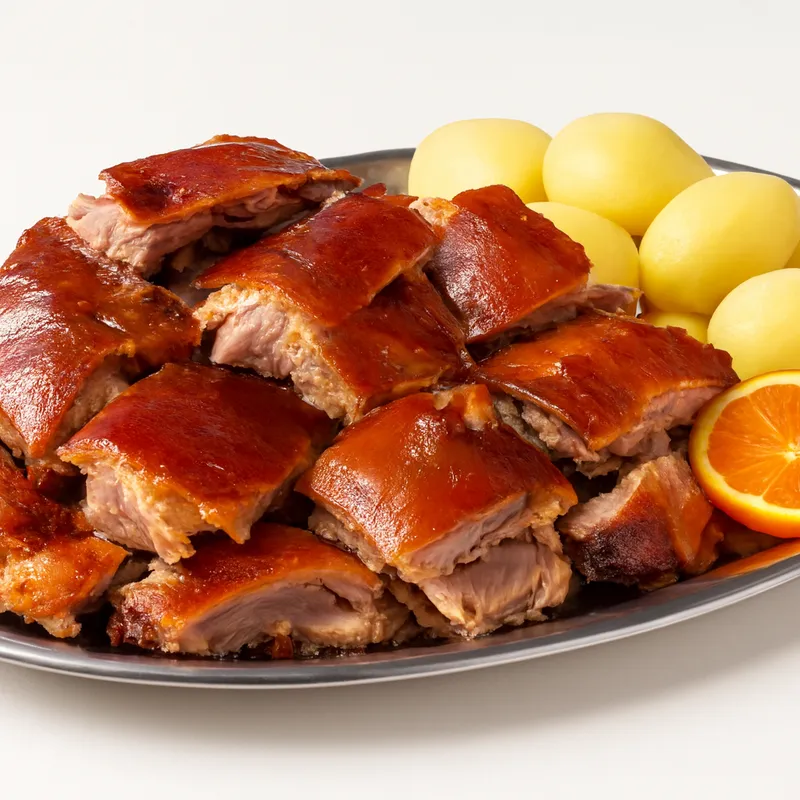
Roasted suckling pig with crispy skin and juicy meat.




A Bairrada-region tradition documented from 1743 (records tied to the Lorvão and Vacariça monasteries), and a Seven Wonders of Portuguese Gastronomy winner in 2011, concentrated around Mealhada north of Coimbra, where a strip of roadside restaurants on the old Lisbon-Porto N1 highway ("the corridor of leitão") built reputations on it. The technique — clay forno a lenha at very high heat — predates the road, but the highway turned a village dish into a national one in the 1950s–70s.
Mealhada's strip of N1-highway restaurants—the corridor of leitão—turned a Bairrada village dish national in the 1950s–70s. A 6 kg suckling pig gets a paste of garlic-lard-bay, then the wood-fired clay forno hits 250–300 °C; that high initial heat is what makes the skin glass.
A roasted suckling pig — three to six weeks old, around 6 kg — carved table-side. The skin is mahogany, glass-thin, shatters under the knife. The meat underneath is white, almost milky, barely seasoned beyond salt, garlic, lard, and white pepper. Served with orange slices, potato chips, and sparkling Bairrada red. The skin-to-meat ratio is the whole point.
Skin crackle is engineered: the cavity is rubbed with a paste of garlic, lard, salt, pepper, and bay; the outside is dried, then roasted in a wood-fired clay oven, typically over vine-wood, at around 200–250 °C for 1.5–2.5 hours. High initial heat blisters the skin; lower finishing heat renders the fat without burning the surface. Domestic ovens rarely hit the temperature, which is why home leitão has chewy skin instead of glass.
Variations
Pedro dos Leitões in Mealhada is the most cited; Restaurante Mugasa runs a slightly leaner pig; Galician cochinillo (Segovia-Castilian style) is the Iberian cousin, served with sherry instead of sparkling Bairrada red.
On the Palate
Where Leitão à Bairrada sits in the Portuguese flavor cloud
Glass-crisp skin is engineered by drying and high heat — rub the cavity with the garlic-lard paste but keep the outside skin dry, then finish at 220°C so the surface blisters and shatters instead of turning chewy.
Ingredients

How it's made
4 steps · 35 min active + 3 hours waiting
- 110 min
Preheat your oven to 160°C (320°F). Rinse the suckling pig under cold water and pat dry with paper towels. Generously rub the pig inside and out with crushed garlic and ground pepper, ensuring the flavors penetrate the skin.
Watch outThe skin should look and feel matte-dry before roasting; any sheen of moisture will steam it soft.
- 25 min
Melt the lard until it becomes a clear liquid. Using a brush, coat the pig with the melted lard, ensuring every inch is covered to help the skin crisp up beautifully.
Watch outUse the lard only once it's melted clear, not cloudy, and brush right into every fold of skin.
- 3180 min
Place the pig on a roasting rack in a deep baking tray. Add a few sprigs of rosemary inside the cavity for aromatic infusion. Roast the pig in the preheated oven.
Watch outCheck the skin periodically to ensure it is crisping evenly; adjust the oven temperature if necessary to prevent burning.
- 420 min
Increase the oven temperature to 220°C (430°F) for the last 20 minutes of roasting. This will give the skin a final crisp, golden finish.
Watch outIn the final blast the skin should bubble and crackle audibly and turn deep amber — that snap is the whole point.
Archive tool suggestions — not reviewed
These legacy suggestions have not been evidence-reviewed and are not presented as required tools.
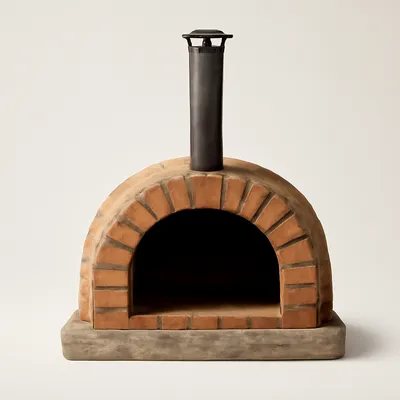
A domed wood-fired oven, brick or stone-lined, that reaches 450-500°C in the floor and 350-400°C in the dome. A Neapolitan margherita cooks in 60-90 seconds — the floor scorches the bottom while radiant heat from the dome flash-blisters the top. Building one requires three insulating layers (firebrick floor, refractory dome, ceramic-fiber jacket); a proper Neapolitan version is a multi-tonne fixture, not a backyard kit.

Flat rectangular metal pan (sheet pan, half-sheet, quarter-sheet), 33×23 cm to 45×33 cm, with a low rim. The flat surface gives even heat for cookies, biscuits, roasted vegetables, sheet-pan dinners. Heavy aluminum sheets conduct heat fastest; non-stick coatings make cleanup easier but can warp over 200°C; rimmed half-sheet is the modern American restaurant standard.