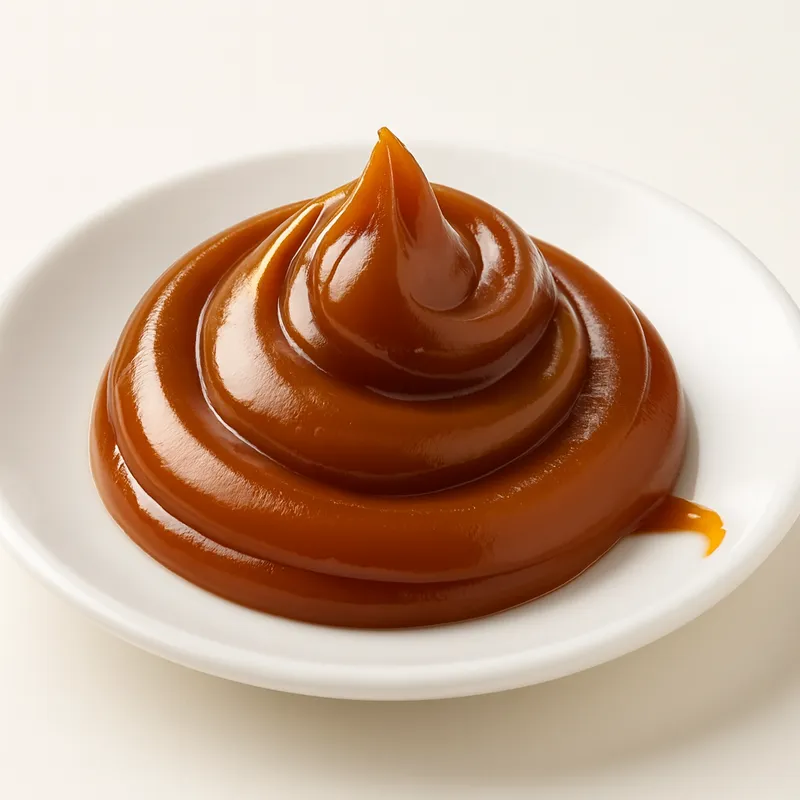
Sweet milk caramel used in various desserts.




Argentina claims the canonical version, dated by legend to 1829 in Cañuelas: a maid forgot a pot of sweetened milk on the fire during a meeting between Juan Manuel de Rosas and Juan Lavalle. True or not, the technique — slow-reducing milk and sugar — predates the story and exists across Latin America (Mexico's cajeta, Chile's manjar, the Philippines' dulce de leche by way of Spain).
Argentine legend dates it to 1829 in Cañuelas — a maid forgot a pot of sweetened milk on the fire during a meeting between Rosas and Lavalle. It's a Maillard reaction, not just caramelization: milk proteins and lactose at 95-105°C over hours, which is why pure sugar caramel tastes flat by comparison.
A glossy mahogany-brown spread, thick enough to hold a spoon upright but slumps if you tilt the jar. Tastes like condensed-milk caramel — toffee on the front, light burnt-sugar bitterness on the back, dairy weight underneath. Eaten on toast, between cookies (alfajores), folded into ice cream, or just by the spoonful straight from the jar.
It's a Maillard reaction, not just caramelization — milk proteins react with lactose at 95–105°C over hours, generating the brown color and the toffee notes. Pure sugar caramel tastes one-dimensional by comparison. Industrial versions cheat with added glucose or baking soda (soda raises the pH and accelerates browning); the long, slow version is darker, less sweet, and tastes more of milk than candy.
Variations
Dulce de leche repostero (firmer, holds shape in alfajores); dulce de leche colonial (softer, for spreading); Mexican cajeta (goat's milk); Chilean manjar (slightly thinner); Filipino dulce de leche (via Spain); Brazilian doce de leite (firmer set).
On the Palate
Where Dulce de Leche sits in the Argentinian flavor cloud
Keep it low and slow so it browns by Maillard, not by scorching: hold a bare simmer at 95–105°C, stir constantly, and pull it a shade before you think it's done — it keeps darkening and thickens a lot more as it cools.
Ingredients
How it's made
4 steps · 2 hours 5 min active + 2 hours waiting
- 110 min
Pour the milk and sugar into a heavy-bottomed pot. Set it over medium heat, stirring constantly until the sugar completely dissolves. You should see a gentle simmer, not a boil.
Watch outStir until every grain of sugar has dissolved and the surface just shivers with a gentle simmer — a rolling boil here will scorch the milk before it ever browns.
- 290 min
Add baking soda and continue to stir as the mixture simmers. Maintain this gentle simmer, adjusting the heat as needed, and keep stirring for 1.5 to 2 hours until the liquid reduces and thickens.
Watch outDon't let the mixture boil too vigorously; it should remain at a steady simmer.
- 320 min
Watch for the color to shift to a rich golden-brown. This indicates the Maillard reaction is taking place, deepening the flavor.
Watch outYou're chasing a deep golden-brown, the color of caramel, with a toffee-and-milk smell rising — that's the Maillard reaction, not just sweetness.
- 45 min
Remove from heat and stir in vanilla. Allow the dulce de leche to cool completely, thickening further as it rests.
Watch outOff the heat it should coat the spoon and slowly ribbon back into itself; if it still runs thin, it needs a few more minutes, because cold sets it far firmer.
Archive tool suggestions — not reviewed
These legacy suggestions have not been evidence-reviewed and are not presented as required tools.