A Hunan farmhouse cold dish of fire-charred green chilies pounded in a stone mortar with century egg, garlic, and a soy-vinegar-sesame dressing.






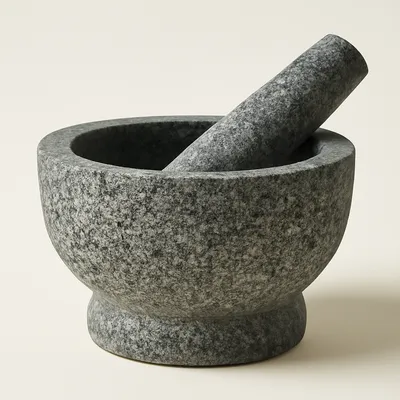
The dish's exact origin is unrecorded; it grew out of the everyday Hunan farmhouse practice of pounding ingredients in a stone mortar (擂钵). Pounding charred chilies into a coarse paste — 擂辣椒 — is a classic Hunanese cold dish dressed with garlic, salt, soy sauce, and sometimes fermented black beans; the mortar is a near-universal fixture in rural Hunan kitchens, and the dish is often pounded and eaten straight from it at the table. Pairing the pounded chili with alkaline-cured century egg (皮蛋/松花蛋) is the best-known version, alongside cousins such as pounded chili with eggplant (擂辣椒茄子).
Served cold or at room temperature, looking deliberately rough — a coarse jade-green paste flecked with dark amber century egg. The chili carries a charred, smoky edge and a soft, almost melting texture; the century-egg white is springy and the yolk creamy, smoothing out the chili's heat. First comes salty-savory, then a slow build of green-chili pungency, rounded by garlic and a thread of vinegar and sesame oil.
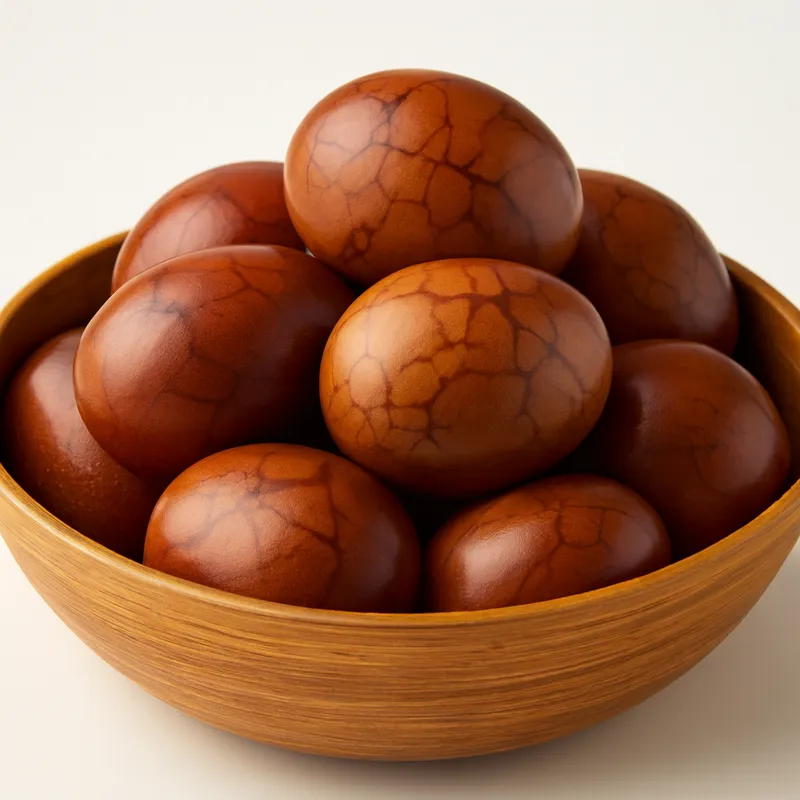
Roasting the chilies over flame or in a dry wok blisters the skin to a tiger-stripe char: above roughly 140–170℃ the Maillard reaction builds the smoky, toasted aroma, while the heat softens the flesh and drives off raw-green harshness. Pounding rather than slicing tears the cell walls so the chilies' juices and the dressing soak deep into the ragged flesh, and it lets the porous yolk of the century egg melt into the paste — a sauce a knife could never make. The century egg itself is a duck egg cured in an alkaline clay of soda ash and slaked lime: strong alkali (sodium and potassium hydroxide) denatures the egg-white proteins and re-cross-links them by hydrogen bonding into a firm amber gel, the surface 松花 "pine-flower" pattern being fibrous magnesium-hydroxide crystals, while sulfur amino acids break down to hydrogen sulfide and ammonia — the source of the egg's pungent savor — and iron sulfide tints the yolk dark green. The sesame oil and a little soy emulsify lightly into the moisture released by pounding, carrying flavor across every shred.
Variations
The closest cousin is pounded chili with eggplant (擂辣椒茄子), using steamed eggplant in place of (or alongside) the egg; plain 擂辣椒 omits the egg entirely. Cooks split over fermented black beans (豆豉) — some pound a spoonful in for extra savor, others keep it clean. The chilies may be charred over open flame, dry-roasted in a wok, or blistered in a little oil; a related Hunan method, 烧椒, roasts then tears the chilies by hand rather than pounding. The dish is widespread across Hunan farmhouse cooking and now standard on 湘菜 restaurant menus.
On the Palate
Where Pounded Chili with Century Egg sits in the Chinese flavor cloud
Ingredients
Serves 3
How it's made
7 steps · 10 min
- 18 min
Wipe 4 green chilies dry and remove the stems. Roast them over an open flame, in a dry wok, or in an air fryer, turning, until the skins blister into a charred tiger-stripe pattern and the flesh goes soft.
Watch outRoast the chilies until the skins blister into charred tiger-stripes and the flesh goes soft — that char is the smoky flavour, so don't stop at merely wilted.
- 22 min
Let the chilies cool slightly, then peel off the loose charred skin if you like a milder result; tear out the seed cores for less heat, or leave them in.
- 32 min
Peel 2 century eggs and cut each into quarters or rough chunks. Peel and mince 3 cloves of garlic.
- 41 min
Put the charred chilies and garlic into a stone mortar and pound to a coarse, ragged paste.
- 51 min
Add the century egg and pound a few more times, just enough to break the yolk into the chili without turning it to mush.
Watch outPound the century egg just a few times into the chili — enough to break the yolk in, not so much you turn it to mush.
- 61 min
Dress with 1 tablespoon light soy sauce, 1 teaspoon rice vinegar, 1 teaspoon sesame oil, and salt to taste; pound or stir briefly to combine.
- 70 min
Serve cold or at room temperature, ideally straight from the mortar.
Archive tool suggestions — not reviewed
These legacy suggestions have not been evidence-reviewed and are not presented as required tools.