
Wuhan's open-topped steamed dumpling and a staple of the city's 过早 (breakfast-out) culture, written 烧梅 rather than 烧卖. A thin wrapper with a frilled, ruffled rim is pleated around a savory glutinous-rice filling that is deliberately heavy on oil and black pepper, often with diced pork, shiitake and bamboo shoot, then steamed. Wuhan 烧梅 are larger and softer than the shaomai of other regions, and the open top with its crimped petal-edge is said to look like a blossoming plum flower, which is taken as the source of the 梅 ('plum') in the name. They are eaten hot from the steamer at breakfast, the peppery, oily rice filling spilling from the ruffled mouth.




Heavy-oil shaomai is a signature of Wuhan's breakfast-out (过早) tradition, the morning street-food culture for which the city is known. The 烧梅 spelling is the local form: as reference works note, the same open-topped dumpling is written 梢梅 in Shanxi, 烧卖 in Jiangnan and 烧梅 in Hubei. The name 烧梅/烧卖 has several competing folk explanations and no settled etymology; the locally favored one holds that the wrapper's rim is rolled out with a ridged pin into a frilled 'plum-blossom' edge, so the steamed dumpling opens like a plum flower (梅). What distinguishes the Wuhan version is documented plainly: it is built on a glutinous-rice filling made deliberately rich with oil and heavy on black pepper — 重油 ('heavy oil') is in the name — and it is made larger and softer than shaomai elsewhere, using little fatty pork in the filling, a habit local sources tie to the regional climate. The exact origin and date of the Wuhan style are not documented.
You pick one up by the ruffled top and the wrapper is thin and a little chewy at the pleats, soft and almost translucent where it has steamed against the filling. Inside is glutinous rice, sticky and glistening with oil, studded with bits of pork, shiitake and bamboo shoot, and the first thing that hits is black pepper — a real, throat-warming pepperiness that is the whole character of the dish, not a background note. The rice is savory and a touch sweet, slick rather than dry, and the lard or oil keeps each grain separate and glossy. Eaten hot it is rich and comforting. Done well the wrapper is thin and the filling moist and aggressively peppery; done badly the rice is dry and clumped because it was understeamed or skimped on oil, the pepper is timid, or the thick wrapper turns gummy and doughy.
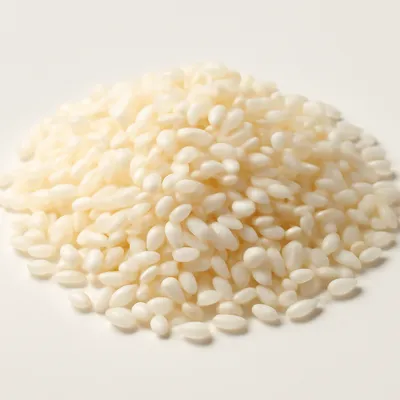
The filling is the engine, and it is built on cooked glutinous rice rather than raw meat. Glutinous rice is nearly all amylopectin, the branched starch that turns sticky and translucent when its granules gelatinize with moisture and heat, which is why the grains cling into a cohesive, glossy mass. The rice is steamed or half-cooked first, then dressed generously with oil or rendered lard: the fat coats each grain, keeps them from drying and clumping into a hard lump during the second steaming, and carries the fat-soluble aroma of the black pepper through the filling — which is exactly why the style insists on 'heavy oil.' Black pepper supplies both the warmth (piperine) and the fragrance, dosed high enough to define the dish. The wrapper is rolled thin with a ridged pin so its rim frills out, then steamed just until set and slightly translucent; over-steaming or too thick a wrapper turns it gummy, while too little oil leaves the rice dry.
Variations
Within Wuhan the filling varies — some stalls add diced pork, shiitake and bamboo shoot to the glutinous rice, others keep it simpler, but the heavy oil and black pepper are constant. The open-topped dumpling is a nationwide family under different names and fillings: the pork-and-aspic 烧卖 of Jiangnan, the glutinous-rice 烧卖 of the north and northeast, the 都督烧麦 of Yunnan and the translucent 翡翠烧卖 of Jiangsu are all cousins, distinguished by wrapper, filling and shape. The Wuhan version stands apart for its size, its softness, its rice-and-pepper filling and its 重油 character. Cooks differ on whether to bind the wrapper rim with a dusting of flour for a whiter, frillier edge, and on the exact pepper dose.
On the Palate
Where Heavy-Oil Shaomai sits in the Chinese flavor cloud
Ingredients
Serves 4


How it's made
7 steps · 50 min active + 40 min waiting
- 125 min
Rinse glutinous rice and steam or half-cook it until just done, then loosen the grains while warm.
- 28 min
Dice pork, soaked shiitake and bamboo shoot small; fry them with a little soy until fragrant.
- 36 min
Fold the cooked filling into the glutinous rice with a generous amount of oil or rendered lard and a heavy hand of ground black pepper, plus salt and a little sugar.
Watch outDress the cooked glutinous rice generously with oil or lard — the fat coats each grain so it won't dry into a hard lump during the second steam and it carries the black pepper through.
- 415 min
Make a hot-water dough, rest it, then divide and roll each piece thin with a ridged pin so the rim frills into a petal edge, dusting with flour.
- 512 min
Set a spoon of the rice filling in each wrapper and gather the sides up around it, leaving the top open and ruffled.
- 64 min
Arrange the shaomai in a lined steamer without crowding so they do not stick.
- 712 min
Steam over high heat until the wrappers are set and slightly translucent, then serve hot from the steamer.
Watch outSteam over high heat just until the wrappers set and turn slightly translucent — over-steam and the thin frilled edges go pasty and tear.
Archive tool suggestions — not reviewed
These legacy suggestions have not been evidence-reviewed and are not presented as required tools.


