




Ashkenazi Sabbath stew, with parallels in Sephardic hamin — the same problem solved twice by separated Jewish communities. Jewish law forbids lighting fire on Shabbat (Friday sunset to Saturday sunset), so the pot was set going on Friday afternoon and held in a low oven or buried in coals overnight. It probably descends from Sephardic hamin/adafina, which reached French Jewry via Provence after the First Crusade. The word 'cholent' is first attested in the 13th century — in the Or Zarua of Isaac ben Moses of Vienna (c.1180–1250) and in writings of his teacher, the Paris Tosafist Judah ben Isaac (Messer Leon), both describing a dish held in an oven for Shabbat. The popular gloss of the name as Old French chault-lent ('hot-slow') is a later folk etymology; the linguist Max Weinreich showed it actually derives from Old French chalant (from chaloir, 'to keep warm'), with the 'chaud + lent' reading an anachronistic back-formation from modern French.
Ashkenazi Sabbath stew documented in 13th-century rabbinic writings from northern France; the name probably from Old French chault-lent (hot-slow). At 90°C lectins denature without bursting bean coats, so beans hold shape but turn creamy; Maillard runs slow, which is why the whole pot ends up one warm beige.
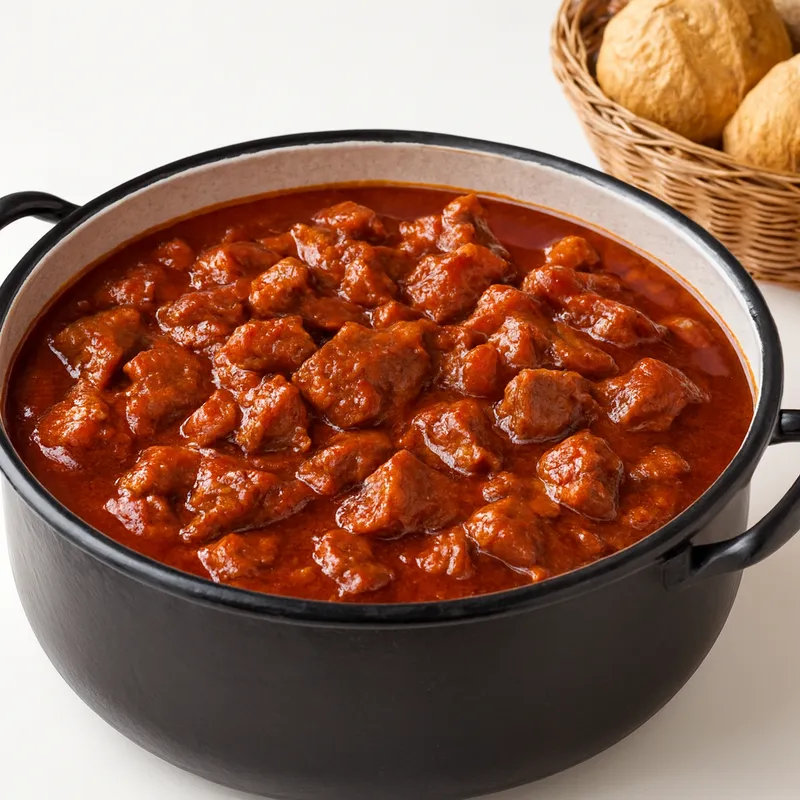
A heavy brown stew of beef shin, marrow bones, white beans, barley, potato and onion, sometimes a stuffed kishke (sausage skin filled with flour and schmaltz) buried in the middle. Cooked at 90–100 °C for 12–18 hours so everything turns the same warm beige. Served with the broth almost gone, the beans collapsed, the meat shreddable; eaten straight from the pot for Shabbat lunch.
The 18-hour low cook breaks beans down completely — at 90 °C the lectins denature without bursting the bean coats, so they hold shape but turn creamy inside. Maillard browning runs slowly at this temperature, which is why the whole pot turns one color. Marrow bones release fat and gelatin that body the sauce as the liquid reduces; the kishke is a starch sink that absorbs the surplus.
Variations
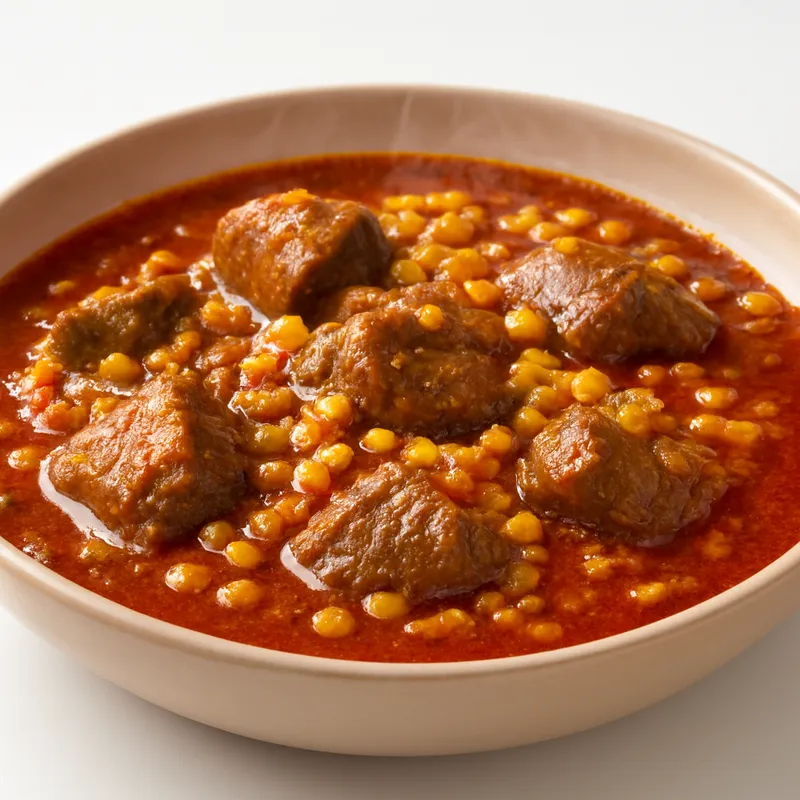
Hungarian sólet (paprika-heavy, smoked goose); Galician cholent (more potato, kishke central); Sephardic hamin (chickpea instead of white bean, hard-boiled brown eggs buried in the pot); Moroccan dafina (with dates and saffron, lamb instead of beef); Crock-Pot suburban-American version is the modern norm.
On the Palate
Where Cholent sits in the Israeli flavor cloud
Ingredients



How it's made
5 steps · 38 min active + 3 hours waiting
- 110 min
Begin by browning the beef in a large pot over medium-high heat, allowing it to develop a rich, caramelized crust. Listen for the sizzle and watch for a deep brown color before moving to the next step.
Watch outEnsure the beef is not overcrowded in the pot to avoid steaming instead of browning.
- 28 min
Add chopped onions to the pot, stirring occasionally until they soften and turn a golden hue, releasing their sweetness into the mix.
- 35 min
Introduce the beans, barley, and cubed potatoes to the pot, stirring to combine with the beef and onions. The ingredients should be well-mixed and evenly distributed.
- 410 min
Pour in enough water to cover the ingredients by about an inch. Add your chosen spices, bringing the mixture to a gentle simmer. The aroma should be savory and inviting.
Watch outEnsure the water level remains consistent; add more if it dips below the ingredients during cooking.
- 55 min
Reduce the heat to low, cover the pot, and allow the stew to simmer slowly. The flavors will meld over several hours, creating a hearty and rich dish.
Archive tool suggestions — not reviewed
These legacy suggestions have not been evidence-reviewed and are not presented as required tools.